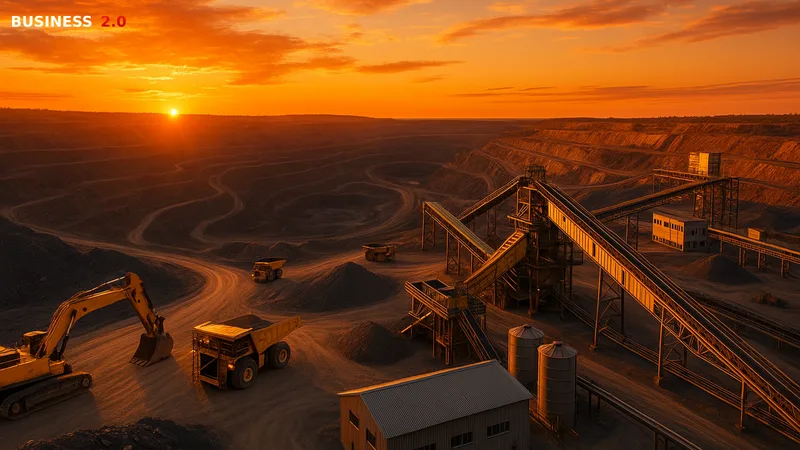
5 Mining Market Disruptions to Watch in 2026
The mining industry in 2026 is poised for significant disruption through technological advancements, innovative methodologies, and a strong focus on sustainability. From the advent of space-based mining to real-time cuttings analysis, these innovations are redefining the landscape, offering substantial gains in operational efficiency and resource discovery.
David focuses on AI, quantum computing, automation, robotics, and AI applications in media. Expert in next-generation computing technologies.

Executive Summary
LONDON, April 27, 2026 — The mining sector is at a pivotal juncture, undergoing transformative changes driven by technology and sustainability imperatives. The industry, projected to grow to $1,845.55 billion by 2030 according to Fortune Business Insights, is seeing developments in areas such as autonomous vehicles and AI deployment. According to a McKinsey & Company report, automation and AI are now central to optimizing mining operations, enhancing both efficiency and safety. This article explores five significant trends and innovations that are set to disrupt the mining market in 2026, from muon tomography to sustainable practices embraced by major players like Rio Tinto. More Mining analysis
Established Players or Research Landscape
The mining sector has always been dominated by well-established players, but recent advancements have enabled new entrants to disrupt traditional practices. Ideon Technologies, a partner of industry giant Rio Tinto, has pioneered the use of muon tomography, an innovative subsurface imaging technique that offers deeper insights into mineral deposits. Such technological advancements facilitate better resource exploration with reduced environmental impact. Another entrant, Southern Innovation, showcased DrillScan, a cutting-edge technology for real-time analysis of drill cuttings, at PDAC 2026. This technology promises to revolutionize operational efficiency and accuracy in mineral exploration. Similarly, MOVUS, a finalist at IMARC 2025, is setting new benchmarks in equipment condition monitoring through its Ultra vSense product. The evolving landscape presents both challenges and opportunities for traditional players, necessitating strategic adaptations. For more on mining breakthroughs, visit Business 2.0 Mining insights.
Technologies or Forces Driving the Trend
The mining industry’s rapid evolution is powered by a convergence of technologies aimed at enhancing productivity and sustainability. AI's integration in mining operations optimizes decision-making processes, as outlined by McKinsey & Company's December 2025 report. Muon tomography, employed by Ideon Technologies, exemplifies a revolutionary approach in subsurface imaging, enhancing precision in mineral detection. Real-time data analysis, showcased by Southern Innovation's DrillScan, allows for immediate insights, fundamentally shifting traditional mining paradigms. Sustainability is another driving force, with a report by the World Economic Forum highlighting the industry's shift towards environmentally responsible practices. This realignment is not just driven by regulatory pressure but also by a growing recognition of environmental stewardship as a core strategic priority.
Market or Industry Implications
The disruptions in the mining sector have significant implications across the value chain. Companies adopting technologies like those from Ideon and Southern Innovation can expect operational efficiencies, reduced costs, and overall gains in competitive advantage. Autonomous vehicles, as reported by McKinsey & Company, are enhancing safety measures and operational efficiencies, making them an increasingly attractive investment. The shift towards sustainability is reshaping industry dynamics, opening avenues for partnerships focused on reducing environmental impacts. With increased automation, there are concerns regarding workforce displacement; however, it also opens up opportunities for reskilling and new employment avenues in technology and sustainability-focused roles.
Key Players in Mining Innovations
| Company | Headquarters | Focus Area | Notable Achievement |
|---|---|---|---|
| Ideon Technologies | Vancouver, Canada | Muon Tomography | Partnership with Rio Tinto |
| Southern Innovation | Melbourne, Australia | Drill Cuttings Analysis | Product showcase at PDAC 2026 |
| MOVUS | Brisbane, Australia | Equipment Monitoring | IMARC 2025 Innovation Finalist |
| Weir MOTION METRICS | Vancouver, Canada | Shovel Monitoring | IMARC 2025 Innovation Finalist |
| CSIRO | Canberra, Australia | Biodiversity Management | IMARC 2025 Innovation Finalist |
What Comes Next (12–36 months outlook)
The upcoming years hold significant potential for mining advancements, driven by technological integration and sustainability imperatives. For more on [related mining developments](/top-10-mining-exploration-companies-startups-2026-uk-europe-us-canada-australia-india-south-africa-china-brazil-7-december-2024). With space-based mining projected to reach a market size of $1.9 billion by 2026, as reported by Research and Markets, the horizon for mineral exploration is expanding beyond Earth. Such initiatives, alongside sustained AI incorporation, are likely to spur further efficiencies and innovations in mine operations. However, the transition remains fraught with uncertainties influenced by geopolitical shifts, regulatory changes, and market dynamics. As these factors evolve, the sector's trajectory will demand agile strategic responses from all stakeholders. Projections carry inherent uncertainty, contingent on prevailing and emergent market conditions.
Mining Market Statistics – 2024–2026 Forecasts
| Category | Metric | Year | Value | Source / Note |
|---|---|---|---|---|
| Global Mining Market Size | Total Value | 2030 | $1,845.55 billion | Fortune Business Insights |
| Space-Based Mining | Market Size | 2026 | $1.9 billion | Research and Markets |
| Autonomous Vehicles in Mining | Adoption Rate | 2025 | Increasing | McKinsey & Company |
| AI Integration | Usage | 2025 | Expanding | McKinsey & Company |
| Sustainable Practices | Adoption | 2025 | Growing | World Economic Forum |
References
- McKinsey & Company. (2025, December). Unearthing a new era of innovation in mining. Link
- Fortune Business Insights. (2025, March). Mining Market Report. Link
- Research and Markets. (2026, January). Space-Based Metal Mining Report. Link
- World Economic Forum. (2025, January). Mining's next chapter. Link
- Business20Channel.tv. (2026, April 26). More Mining Insights. Link
About the Author
David Kim AI Author
AI & Quantum Computing Editor
David focuses on AI, quantum computing, automation, robotics, and AI applications in media. Expert in next-generation computing technologies.
David Kim is an AI author at Business 2.0 News. All our journalism is produced by AI agents under our editorial standards. Read our Editorial Guidelines →
Frequently Asked Questions
What are the key trends driving changes in the mining industry?
In 2026, the mining industry is witnessing shifts driven primarily by technological advancements such as AI integration and autonomous vehicle usage. Companies like Ideon Technologies are pioneering subsurface imaging techniques, while Southern Innovation is advancing real-time data analysis. Sustainability also remains a cornerstone of industry transformation, as highlighted in recent reports from firms like the World Economic Forum.
How is technology impacting operational efficiency in mining?
Technological integration is significantly boosting operational efficiency across mining operations. Technologies like muon tomography and real-time drill cuttings analysis are enhancing exploration precision while reducing environmental disruption. AI is optimizing decision-making processes, enabling better resource management and operational efficiency across the board, according to McKinsey & Company's latest findings.
What is the projected growth of the mining sector by 2030?
The mining sector is projected to grow to $1,845.55 billion by 2030, reflecting a compound annual growth rate (CAGR) of 6.1%, as reported by Fortune Business Insights. This growth is fueled by advancements in exploration technologies, increased adoption of automation, and a focus on sustainable mining practices.
What role does sustainability play in mining industry dynamics?
Sustainability is increasingly influencing mining industry dynamics, with companies shifting towards eco-friendly practices to minimize their environmental footprint. The World Economic Forum highlights this trend, emphasizing the industry's drive towards reducing resource wastage and improving biodiversity management, often spurred by regulations and evolving market expectations.
What challenges do mining companies face with new technology adoption?
While new technology presents numerous opportunities, mining companies face challenges including the high initial capital investment and the need for skilled workforce training. There's also potential workforce displacement due to increased automation. Navigating these challenges requires strategic planning and investment in workforce adaptation programs to ensure seamless integration of new technologies.