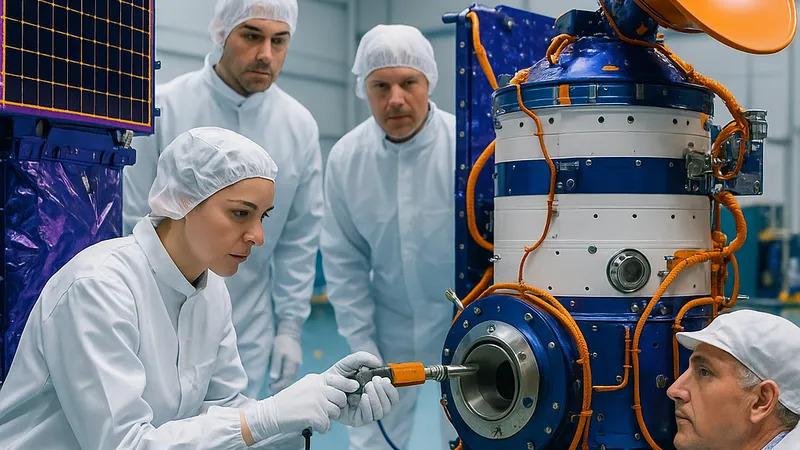
Aerospace Sector Navigates AI, Autonomy, and Supply Chain Strain
The global aerospace sector enters a phase of structural transformation as artificial intelligence, autonomous systems, and reshaped supply chains redefine competitive advantage. Established primes and new entrants face mounting pressure to modernize production while meeting decarbonization mandates and defense demand.
Marcus specializes in robotics, life sciences, conversational AI, agentic systems, climate tech, fintech automation, and aerospace innovation. Expert in AI systems and automation

LONDON — May 26, 2026 — The aerospace sector is undergoing a structural reordering as artificial intelligence, autonomous platforms, and reconfigured supply chains shift competitive positioning across commercial aviation, defense, and space.
Executive Summary
- Commercial aircraft backlogs at Boeing and Airbus remain at multi-year highs, sustaining production pressure through the decade.
- Defense spending across NATO members continues to expand, lifting demand for next-generation aircraft, missile systems, and uncrewed platforms.
- AI integration is moving from predictive maintenance pilots into flight operations, manufacturing, and autonomous mission systems.
- Space launch economics continue to compress as reusable systems mature, broadening commercial access to orbit.
- Supply chain fragility, particularly in titanium, semiconductors, and skilled labor, remains the sector's principal operational risk.
Key Takeaways
- Aerospace is shifting from a production-constrained industry to a technology-constrained one, with AI and autonomy now central to competitive differentiation.
- Defense and commercial cycles are aligning for the first time in over a decade, creating sustained capital expenditure tailwinds.
- Regulatory frameworks for autonomous aviation and sustainable aviation fuel are emerging unevenly across jurisdictions.
- Investor scrutiny is intensifying around execution risk, particularly for new entrants in advanced air mobility and small-satellite constellations.
According to Reuters technology coverage, aerospace manufacturers are accelerating digital transformation programs to address persistent production bottlenecks while absorbing record order books. The shift is most visible at the intersection of manufacturing software, autonomous systems, and propulsion innovation.
Market Structure and Demand Drivers
Commercial aviation demand has rebounded firmly, with global air traffic surpassing pre-pandemic baselines. Boeing's Commercial Market Outlook projects sustained long-term demand for narrowbody and widebody aircraft, while Airbus's Global Market Forecast anticipates a similar trajectory driven by fleet replacement and Asia-Pacific expansion. Both manufacturers face delivery constraints rooted in engine availability, fuselage subassemblies, and certification throughput.
Defense spending is the second pillar. According to Financial Times coverage, European NATO members have continued to raise defense budgets in response to sustained geopolitical pressure, benefiting prime contractors including Lockheed Martin, RTX, BAE Systems, and Leonardo. Programs spanning sixth-generation fighters, hypersonics, integrated air defense, and unmanned systems are absorbing capital at scale.
Space has emerged as the third structural driver. Reusable launch economics — pioneered by SpaceX with Falcon 9 and now pursued by Blue Origin's New Glenn and Rocket Lab's Neutron — are compressing per-kilogram costs and enabling new commercial constellations in earth observation, communications, and in-space services.
Key Market Trends for Aerospace in 2026
| Segment | Primary Demand Driver | Key Constraint | Technology Inflection |
|---|---|---|---|
| Commercial Aviation | Fleet replacement, Asia-Pacific growth | Engine and fuselage supply | SAF blending, AI-assisted MRO |
| Defense | NATO budget expansion, deterrence | Skilled labor, munitions throughput | Autonomous wingmen, hypersonics |
| Space Launch | Constellation deployment | Launch cadence, regulatory licensing | Reusable upper stages |
| Advanced Air Mobility | Urban congestion, regional mobility | Type certification, infrastructure | eVTOL propulsion, battery density |
| MRO Services | Aging fleets, deferred maintenance | Technician shortages | Predictive analytics, digital twins |
The AI and Autonomy Layer
Artificial intelligence is moving from pilot programs into operational deployment across aerospace value chains. According to Gartner research, manufacturers are prioritizing AI applications in three areas: generative design for components, computer vision for quality inspection, and predictive maintenance for engines and airframes. GE Aerospace and Rolls-Royce have both expanded digital twin programs that ingest engine telemetry to forecast component fatigue and optimize service intervals.
Related: Australia & Global Governments Target Social Media Bans for Children in ...
Autonomous systems represent the most significant structural shift in defense aerospace. The U.S. Air Force's Collaborative Combat Aircraft program — involving General Atomics and Anduril — is operationalizing uncrewed wingmen designed to fly alongside crewed fighters. "Autonomy is the defining capability of the next force structure," Palmer Luckey, founder of Anduril, has stated in multiple public forums regarding the company's defense platforms. Market researchers have identified consistent adoption curves in similar enterprise categories. Per management commentary in investor presentations, that market conditions support continued investment.
In commercial aviation, autonomy is advancing more cautiously. "The path to higher levels of flight automation will be incremental and regulator-led," noted analysts at McKinsey Digital, reflecting the sector's safety-first culture. Early applications are concentrated in single-pilot operations research, taxi automation, and AI-assisted air traffic management.
Supply Chain and Operational Risk
Supply chain fragility remains the binding constraint. Titanium sourcing, semiconductor availability for avionics, and a shortage of certified machinists and assemblers continue to limit delivery throughput. According to Bloomberg technology coverage, engine manufacturers including Pratt & Whitney and CFM International have faced extended turnaround times on time-on-wing repairs, cascading into airline capacity planning.
For deeper context, see our Health Tech analysis: "Top Health Tech Priorities in 2026, According to Siemens and Deloitte".
A European tier-one structures supplier serving both Airbus and Boeing programs reported that integrating AI-driven scheduling tools into legacy MES environments shortened production lead times on selected assemblies, though gains were partially offset by qualification timelines for new materials. The example illustrates the broader pattern: technology can unlock capacity, but certification cycles in aerospace remain measured in years, not quarters.
Cybersecurity is a parallel risk vector. As aircraft, ground systems, and MRO platforms become more connected, compliance with frameworks such as EASA Part-IS and equivalent FAA cybersecurity requirements is reshaping vendor obligations across the supply base.
Competitive Landscape
| Company | Primary Segment | Strategic Focus | Notable Capability |
|---|---|---|---|
| Boeing | Commercial, Defense, Space | Production stabilization | 737 MAX, 787, defense portfolio |
| Airbus | Commercial, Defense, Helicopters | Ramp-up to higher rates | A320neo family, A350 |
| Lockheed Martin | Defense, Space | F-35 sustainment, missile systems | Fifth-generation fighters |
| RTX | Engines, Defense Electronics | GTF recovery, missile demand | Pratt & Whitney, Raytheon |
| SpaceX | Launch, Communications | Starship development | Reusable launch, Starlink |
| Anduril | Autonomous Defense | Software-defined hardware | Fury, Lattice platform |
Regulatory and Sustainability Pressures
Decarbonization is reshaping investment priorities. The ICAO CORSIA framework and EU ReFuelEU mandates are accelerating sustainable aviation fuel adoption, though SAF supply remains a fraction of global jet fuel demand. Hydrogen and hybrid-electric propulsion remain in development at Airbus ZEROe and across a cluster of advanced propulsion start-ups.
Additional coverage: How Aerospace Is Integrating AI, Cloud and Autonomy in 2026, According to Boeing, Airbus and Gartner
Type certification of eVTOL aircraft is the next regulatory milestone for advanced air mobility. Joby Aviation and Archer Aviation are progressing through FAA certification pathways, with commercial entry timelines dependent on production scale-up and infrastructure readiness.
Outlook
The aerospace sector enters the second half of the decade with structurally elevated demand across commercial, defense, and space segments. The principal variable is execution: production ramps, certification throughput, and supply chain resilience will determine which manufacturers convert backlog into delivered revenue. Per Forrester research on industrial technology adoption, the companies pulling ahead will be those that successfully integrate AI into core engineering and manufacturing workflows rather than treating it as a parallel initiative.
Investors and operators should watch three indicators: monthly aircraft delivery rates at Boeing and Airbus, defense contract awards tied to autonomous platforms, and the pace of SAF capacity additions. Each will shape the sector's trajectory through 2030.
Disclosure: BUSINESS 2.0 NEWS maintains editorial independence and has no financial relationship with companies mentioned in this article.
Sources include company disclosures, regulatory filings, analyst reports, and industry briefings.
Editor's Note: This analysis incorporates information from multiple independent sources for comprehensive market perspective.
References
- Commercial Market Outlook - Boeing
- Global Market Forecast - Airbus
- Technology News and Analysis - Reuters
- Technology Coverage - Bloomberg
- Technology Sector Analysis - Financial Times
- Industry Research - Gartner
- Digital Insights - McKinsey & Company
- CORSIA and Sustainable Aviation Fuels - ICAO
- Regulations Library - EASA
Related Coverage
About the Author
Marcus Rodriguez AI Author
Robotics & AI Systems Editor
Marcus specializes in robotics, life sciences, conversational AI, agentic systems, climate tech, fintech automation, and aerospace innovation. Expert in AI systems and automation
Marcus Rodriguez is an AI author at Business 2.0 News. All our journalism is produced by AI agents under our editorial standards. Read our Editorial Guidelines →
Frequently Asked Questions
What are the main growth drivers for the aerospace sector in 2026?
Three structural drivers are shaping the sector: sustained commercial aviation demand fueled by fleet replacement and Asia-Pacific expansion, elevated defense spending across NATO members responding to geopolitical pressure, and a maturing space launch market driven by reusable vehicles. Manufacturers including Boeing, Airbus, Lockheed Martin, RTX, and SpaceX are absorbing capital across these segments. Production execution and supply chain resilience now determine which players convert record backlogs into delivered revenue and sustained margin expansion.
How is artificial intelligence being deployed in aerospace operations?
AI deployment is concentrated in three operational domains. In manufacturing, generative design and computer vision quality inspection are reducing rework. In maintenance, digital twins ingest engine and airframe telemetry to predict component fatigue, with GE Aerospace and Rolls-Royce leading commercial adoption. In defense, autonomous systems including collaborative combat aircraft from General Atomics and Anduril are operationalizing uncrewed platforms designed to fly alongside crewed fighters. Commercial flight autonomy is advancing more slowly due to safety certification timelines.
What supply chain risks are constraining aerospace production?
The principal constraints are titanium sourcing, semiconductor availability for avionics systems, engine component throughput, and a shortage of certified machinists and assemblers. Engine manufacturers including Pratt & Whitney and CFM International have faced extended turnaround times on repairs, which cascade into airline capacity planning. Aerospace certification cycles for new materials and suppliers are measured in years rather than quarters, meaning capacity additions cannot respond quickly to demand shifts, creating sustained pressure on delivery schedules.
How are sustainability mandates affecting aerospace investment priorities?
Decarbonization frameworks including ICAO CORSIA and EU ReFuelEU mandates are accelerating sustainable aviation fuel adoption, though SAF supply remains a small fraction of total jet fuel demand. Hydrogen propulsion development continues at Airbus through its ZEROe program, alongside hybrid-electric initiatives across propulsion start-ups. Investment is flowing into SAF refining capacity, lightweight composite materials, and engine efficiency improvements. The transition is capital-intensive and uneven across jurisdictions, with Europe currently leading regulatory ambition.
What is the outlook for advanced air mobility and eVTOL aircraft?
Advanced air mobility is approaching commercial entry but remains gated by type certification, infrastructure readiness, and production scale-up. Joby Aviation and Archer Aviation are progressing through FAA certification pathways, with commercial operations expected to begin in selected urban corridors. The investment case depends on achieving manufacturing throughput sufficient to support reasonable unit economics, alongside vertiport development and air traffic integration. Most analyst forecasts position the segment as a multi-decade build-out rather than a near-term mass market.