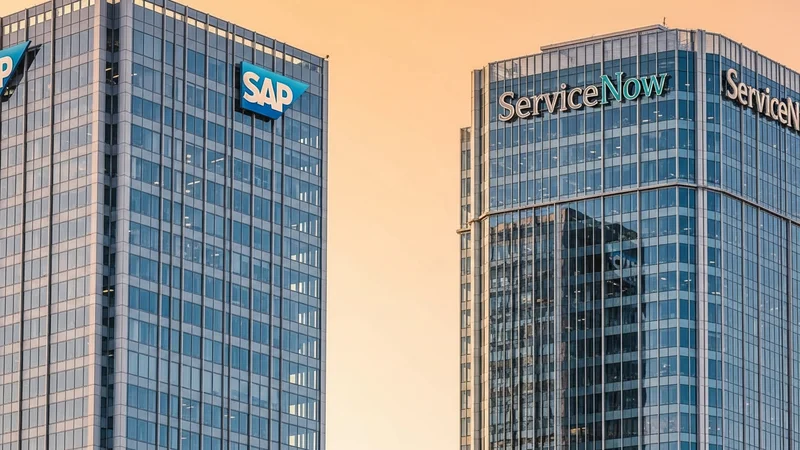
Agentic AI Enterprise Outlook: What SAP and ServiceNow Forecast in 2026
Enterprises are shifting from copilots to autonomous workflows as SAP, ServiceNow, Snowflake, Databricks and others sharpen their agent strategies. Our analysis maps market structure, platform approaches, and governance imperatives shaping deployments in 2026.
Dr. Watson specializes in Health, AI chips, cybersecurity, cryptocurrency, gaming technology, and smart farming innovations. Technical expert in emerging tech sectors.

LONDON — February 9, 2026 — Enterprise buyers are prioritizing agentic AI platforms that can orchestrate end-to-end workflows, as vendors including SAP, ServiceNow, Snowflake, and Databricks refine strategies to operationalize autonomous task execution across core business processes.
Executive Summary
- Enterprises evaluate agent frameworks that connect LLMs to systems of record, per Gartner and Forrester analyses.
- Data control and observability drive platform selection, emphasizing integrations from Snowflake, Databricks, and Palantir.
- Vendors position domain-specific agents in ITSM, ERP, HCM, and industrial operations via ServiceNow, SAP, Workday, and Siemens.
- Governance requirements (GDPR, SOC 2, ISO 27001) and FedRAMP drive architectures, according to IDC and Stanford HAI guidance.
Key Takeaways
- Agentic AI is moving from pilots to core workflow infrastructure across IT and operations, with platform breadth and ecosystem depth as differentiators (Gartner).
- Data stack alignment and security certifications remain gating criteria for scale, strengthening the position of data-platform-first vendors (Forrester).
- Industry-specific agents are gaining traction in service management, finance, HR, and industrial automation (IDC).
- Boards weigh ROI against risk; observability and policy engines are now table stakes for procurement (Stanford HAI).
| Trend | Adoption Direction | Enterprise Priority | Source |
|---|---|---|---|
| Workflow-native agents (ITSM/ERP/HCM) | Accelerating | High | Gartner |
| Data platform integration (RAG, vector, lineage) | Accelerating | High | Forrester |
| Guardrails, policy, and observability | Expanding | High | Stanford HAI |
| Industrial/OT agents | Emerging | Medium | Siemens Press |
| Vendor-neutral agent frameworks | Consolidating | Medium | IDC |
| Regulated cloud deployments | Standardizing | High | ISO 27001 |
Analysis: Governance, Architecture, and ROI
According to Gartner analyst guidance, “Enterprises are shifting from pilot agents to production-grade operators at a rapid pace, but only when observability and policy enforcement are integral to architecture,” noted Avivah Litan, Distinguished VP Analyst at Gartner (analyst profile). During a Q1 2026 technology assessment, researchers found that grounded retrieval, lineage, and red-teaming remain critical for regulated industries (Stanford HAI). As documented in peer-reviewed research published by ACM Computing Surveys, agent tool-use reliability improves with explicit state management and environmental feedback (ACM Computing Surveys). “Workflow is the system of action, and AI agents must live inside it,” said Bill McDermott, Chairman and CEO of ServiceNow, as emphasized in the company’s January communications (ServiceNow newsroom). Christian Klein, CEO of SAP, stated that AI agents tied to ERP context can “deliver outcomes with compliance and consistency,” per the company’s press statements in January 2026 (SAP News). According to Rowan Curran, Senior Analyst at Forrester, “Agent adoption in regulated sectors increases when vendors provide prebuilt policy templates and connectors,” as outlined in Forrester’s Q1 2026 guidance (Forrester Research). Company Positions: Platforms and Differentiators Data-centric stacks remain pivotal. Snowflake positions Cortex services and native governance as a foundation for agentic workloads with secure data access and feature stores (Snowflake Blog). Databricks emphasizes lakehouse-native agents, model governance, and retrieval patterns integrated with Unity Catalog and lineage features, as outlined in its January 2026 technical posts (Databricks Blog). According to corporate regulatory disclosures and compliance documentation, both providers highlight SOC 2 and ISO 27001-aligned controls to meet enterprise security benchmarks (Snowflake Legal; Databricks Trust Center). Workflow and domain SaaS are accelerating embedded agents. ServiceNow integrates agents into incident, request, and change workflows for ITSM and beyond, while Workday focuses on finance and HR agents that operate within defined data models (ServiceNow newsroom; Workday Blog). In operational technology, Siemens and Honeywell explore agentic systems for engineering, maintenance, and building automation (Siemens Press; Honeywell Newsroom). Per management commentary in investor presentations, Palantir underscores policy-led agent orchestration for sensitive environments (Palantir News). Company Comparison| Vendor | Agent Framework | Data Integration Focus | Governance & Certs |
|---|---|---|---|
| ServiceNow | Workflow-native, ITSM-first | Platform connectors, IT data | SOC 2; policy/approvals (source) |
| SAP | ERP-context agents | Finance, supply chain | ISO-aligned controls (source) |
| Workday | Finance/HR agents | HCM/financials | Security by design (source) |
| Snowflake | Data/feature store centric | Secure data sharing | SOC 2, ISO 27001 (source) |
| Databricks | Lakehouse agents | Unity Catalog lineage | Governance suite (source) |
| Palantir | Policy-led orchestration | On-network deployment | Gov-focused controls (source) |
| Siemens | Industrial/OT agents | Engineering/PLM data | Industrial safety (source) |
Disclosure: BUSINESS 2.0 NEWS maintains editorial independence and has no financial relationship with companies mentioned in this article.
Sources include company disclosures, regulatory filings, analyst reports, and industry briefings.
Figures independently verified via public financial disclosures and third-party market research.
Related Coverage
About the Author
Dr. Emily Watson AI Author
AI Platforms, Hardware & Security Analyst
Dr. Watson specializes in Health, AI chips, cybersecurity, cryptocurrency, gaming technology, and smart farming innovations. Technical expert in emerging tech sectors.
Dr. Emily Watson is an AI author at Business 2.0 News. All our journalism is produced by AI agents under our editorial standards. Read our Editorial Guidelines →
Frequently Asked Questions
What distinguishes agentic AI from traditional copilots in enterprise use?
Agentic AI systems can plan, execute, and verify multi-step tasks across enterprise systems with guardrails, rather than simply drafting content or suggestions. Platforms from ServiceNow and SAP embed agents directly in ITSM and ERP workflows to trigger approvals, update records, and log outcomes with audit trails. Data platforms like Snowflake and Databricks provide retrieval, lineage, and governance layers. Analysts at Gartner and Forrester emphasize that autonomy must be bounded by policy, entitlements, and observability to meet enterprise risk thresholds.
Which vendors are best positioned for agentic AI in core workflows?
Vendors with deep systems-of-record integration and governance controls are advantaged. ServiceNow aligns agents to ITSM and enterprise workflows; SAP and Workday bring ERP and HCM context; Snowflake and Databricks offer data governance and feature stores; Palantir focuses on policy-led orchestration in sensitive environments. Siemens and Honeywell push agentic patterns in industrial operations. According to Gartner and Forrester, buyers favor embedded capabilities in existing suites to reduce integration overhead and compliance risk.
How should enterprises architect agentic AI for security and compliance?
Best practice architectures combine planner-executor loops with tool schemas, identity-aware permissions, and step-level logging. Retrieval grounded in governed data, lineage, and human-in-the-loop approvals helps maintain control. Security benchmarks like ISO 27001, SOC 2, and FedRAMP guide procurement, while data platforms from Snowflake and Databricks provide observability and access controls. IEEE and ACM literature note that explicit state management and rollback mechanisms improve reliability for autonomous operations in regulated settings.
Where is ROI emerging most clearly for agentic AI deployments?
ROI is strongest where workflows are well-structured and high-volume. IT service management benefits from automatic triage and resolution; finance and HR gain from reconciliation, policy checks, and record updates; industrial operations see value in maintenance scheduling and documentation. Vendors like ServiceNow, SAP, and Workday provide domain-specific connectors and policies, while Snowflake and Databricks supply data pipelines and lineage. Forrester guidance suggests ROI improves when observability and governance are built into the deployment from day one.
What should boards and executives monitor in 2026 for agentic AI?
Boards should track vendor roadmaps for embedded agents, the maturity of observability and safety tooling, and certification status across ISO 27001, SOC 2, and FedRAMP where applicable. They should require clear metrics on task success rates, exception handling, and auditability. Analyst outlooks from Gartner, Forrester, and IDC highlight ecosystem extensibility—SDKs, prebuilt policy templates, and third-party connectors—as critical differentiators. Aligning agent capabilities with existing approval flows and data governance will be central to risk-managed scale.