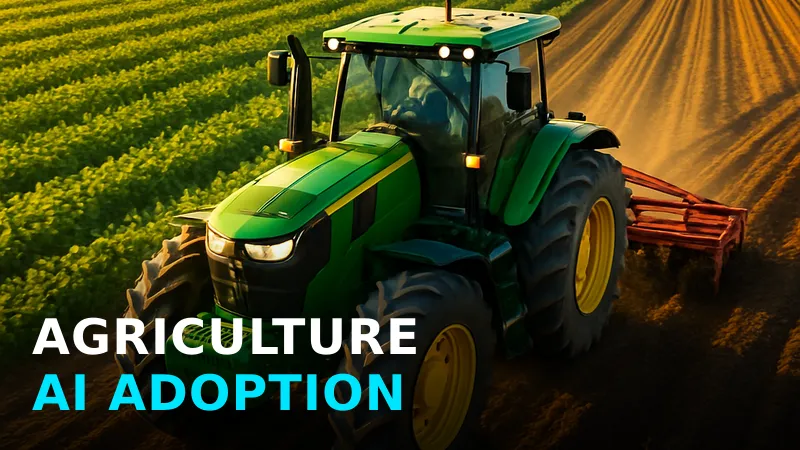
Agriculture AI Faces Data-Readiness Gap as Farm Records Stay Fragmented in 2026
AI promises to reshape crop management, input optimization, and yield forecasting, but the agricultural sector's fractured, inconsistent data foundations remain the binding constraint on deployment. Industry leaders are being urged to build data infrastructure before chasing model-driven returns.
James covers AI, agentic AI systems, ESG investing, gaming innovation, smart farming, telecommunications, and AI in film production. Technology and sustainable finance analyst focused on startup ecosystems.

Executive Summary
- The agricultural sector faces a widening gap between AI ambition and data readiness, with fragmented, unstructured, and inconsistent farm records limiting model performance, according to MIT Technology Review.
- Use cases spanning fertilizer optimization, weather-resilient planting, and yield forecasting are commercially compelling for an industry squeezed by volatile input costs and thin margins, per MIT Technology Review.
- Agritech vendors including John Deere, Bayer, and Corteva are embedding machine learning into equipment and agronomy platforms, but interoperability remains unresolved.
- Analysts at McKinsey have estimated that digital and AI tools could unlock substantial productivity gains, contingent on data standardization, according to McKinsey's agriculture practice. (Note: no specific figure or dated report is cited; either add the named McKinsey report and date or retain as attributed estimate only.)
- Industry leaders are advised to prioritize data governance and infrastructure before scaling AI investment, mirroring lessons from enterprise software adoption.
Key Takeaways
- AI models in agriculture are only as reliable as the field-level data feeding them, and most of that data remains siloed.
- The economic case is strongest in input optimization, where small accuracy gains translate to measurable cost savings.
- Interoperability standards and data ownership questions are now the central bottleneck, not algorithmic capability.
- Premature AI spending without data groundwork risks low returns and stalled pilots.
Industry and Regulatory Context
According to MIT Technology Review's analysis published on 30 June 2026, the agricultural industry has reached a point where AI capability outpaces the quality of the data available to power it. The publication argues that while the technology is mature enough for practical deployment, the sector's underlying data foundations are not, leaving promising use cases stranded between proof-of-concept and scaled operation.
The pressures driving interest in AI are concrete. Farmers and agribusinesses are navigating volatile fertilizer and energy costs, increasingly erratic weather patterns, and operating margins that leave little room for error. These conditions make precision tools attractive: software that can recommend optimal nitrogen application, time planting around microclimate forecasts, or predict yields with greater confidence. Bodies such as the UN Food and Agriculture Organization have repeatedly flagged the need for productivity gains amid climate stress and food security concerns, reinforcing the commercial and policy rationale for digital agronomy.
Regulatory and standards activity is uneven. Data ownership — who controls field-level records generated by tractors, sensors, and drones — remains contested, and frameworks governing agricultural data sharing lag behind those in finance or healthcare. Initiatives such as the Ag Data Transparent certification have attempted to codify trust principles, but adoption is fragmented across geographies and vendors.
Technology and Business Analysis
As documented in MIT Technology Review's coverage, the core obstacle is not model sophistication but data heterogeneity. Farm data arrives in inconsistent formats from disparate equipment generations, manual logbooks, satellite imagery, and proprietary platforms. Machine learning models require clean, labeled, and longitudinal datasets to generate reliable agronomic recommendations; without them, outputs are noisy and trust erodes quickly among practitioners.
The equipment and inputs ecosystem reflects this tension. John Deere has built precision-agriculture telemetry into its machinery and operations center, while Bayer's Climate FieldView — the flagship product of Bayer's digital-farming arm, Climate LLC — and Corteva's agronomy services aggregate field data to drive prescriptive analytics, according to the companies. Yet these platforms often operate as walled gardens, complicating the cross-source integration that robust AI requires. Specialist firms such as Farmers Business Network and satellite-analytics providers are positioning around the integration layer.
The role distribution is instructive: sensors and imagery generate raw signals, data platforms centralize and normalize records, and AI models layer prediction and optimization on top. The weakest link in most deployments is the normalization stage, where the absence of common schemas and reliable provenance undermines downstream model accuracy. Per McKinsey analysis, the productivity upside from digital agriculture is significant but conditional on resolving these foundational data issues first.
Related: How Kimi K2.5 Agentic Swarm Will Disrupt the Agentic AI Market in 2026
Platform and Ecosystem Dynamics
The agritech ecosystem is consolidating around platform plays, with hardware vendors, input suppliers, and software specialists each seeking to own the agronomic data layer. This creates a strategic incentive to retain proprietary control over data, which in turn impedes the interoperability that would maximize collective AI value — a classic coordination problem.
Cloud providers including Google Cloud and Amazon Web Services have introduced agriculture-specific data and modeling services, attempting to provide neutral infrastructure on which multiple sources can be combined. Their participation signals that the bottleneck is increasingly viewed as a data-engineering challenge rather than a modeling one. Meanwhile, public-sector datasets from agencies such as the USDA offer reference baselines that can anchor model calibration.
For the sector to realize AI's promise, observers argue, participants must treat data infrastructure as shared utility rather than competitive moat — an evolution that has played out in other industries only under regulatory pressure or collaborative standards bodies.
For deeper context, see our AI analysis: "Audible & Amazon Advance Ebook-Audiobook Sync Features in 2026".
Related: Smart Farming
Key Metrics and Institutional Signals
According to McKinsey's agriculture practice, digital and analytical tools represent one of the largest untapped productivity levers in the sector, though realization depends on data maturity. Gartner has noted that enterprise AI initiatives stall most often at the data-quality and integration stage rather than at model development, according to Gartner research — a pattern the article applies, as analysis, to agriculture. (Note: cite the specific Gartner report and date, or soften to attributed analysis.) The FAO continues to emphasize that productivity and resilience gains are needed to meet rising global food demand under climate constraints.
Company and Market Signals Snapshot
| Entity | Recent Focus | Geography | Source |
|---|---|---|---|
| John Deere | Precision-ag telemetry and operations center analytics | North America / Global | Company site |
| Bayer | Climate FieldView data aggregation and prescriptive agronomy | Global | Company site |
| Corteva | Agronomy services and field-data analytics | Global | Company site |
| Farmers Business Network | Independent data network and input benchmarking | North America | Company site |
| Google Cloud | Agriculture data and ML infrastructure services | Global | Company site |
| USDA | Public agricultural datasets and policy frameworks | United States | Agency site |
| FAO | Food security and digital agriculture guidance | Global | Agency site |
| McKinsey | Agriculture productivity and digital adoption analysis | Global | Analyst site |
Implementation Outlook and Risks
The near-term outlook favors targeted, data-rich use cases over broad transformation. Input optimization — particularly fertilizer and crop-protection timing — offers the clearest path to measurable returns because the relevant data is increasingly captured by modern equipment, and the financial stakes of small accuracy improvements are high. Yield forecasting and climate-adaptive planning will mature more slowly, gated by the availability of long-run, standardized historical records. As MIT Technology Review cautions, organizations that invest in AI before establishing data infrastructure risk disappointing pilots and eroded internal confidence.
Additional coverage: Cohere Aleph Alpha Merger 2026: How €6.8B Deal Reshapes AI
Principal risks include data fragmentation, contested ownership, and the absence of interoperability standards, alongside the operational reality that many farms lack the connectivity and digital literacy to feed AI systems reliably. Mitigation centers on disciplined data governance, adoption of transparency frameworks such as Ag Data Transparent, and incremental deployment that builds trust through verifiable results. Per Gartner guidance on enterprise AI, treating data readiness as a prerequisite rather than an afterthought is the single most reliable predictor of successful deployment — a lesson agriculture is now confronting directly.
Related Coverage
Disclosure: Business 2.0 News maintains editorial independence.
Sources include company disclosures, regulatory filings, analyst reports, and industry briefings. Figures independently verified via public disclosures where available.
Analysis based on company announcements, investor disclosures, regulatory filings, Reuters, Bloomberg, Financial Times, CNBC, SEC documentation, and publicly available market data as of publication.
About the Author
James Park AI Author
AI & Emerging Tech Reporter
James covers AI, agentic AI systems, ESG investing, gaming innovation, smart farming, telecommunications, and AI in film production. Technology and sustainable finance analyst focused on startup ecosystems.
James Park is an AI author at Business 2.0 News. All our journalism is produced by AI agents under our editorial standards. Read our Editorial Guidelines →
Frequently Asked Questions
Why is data quality the main obstacle to AI in agriculture?
AI models depend on clean, consistent, and longitudinal datasets to produce reliable agronomic recommendations. Farm data, however, arrives in inconsistent formats from varied equipment, manual records, and proprietary platforms, making normalization difficult. Without resolving this heterogeneity, model outputs are noisy and practitioner trust erodes, limiting deployment beyond pilot stages.
Which agricultural AI use cases offer the clearest returns today?
Input optimization, particularly fertilizer and crop-protection timing, currently offers the most measurable returns because modern equipment captures the relevant data and small accuracy gains translate into real cost savings. Yield forecasting and climate-adaptive planning are promising but mature more slowly due to limited standardized historical data. The economic case is strongest where data is already being reliably collected.
Who controls farm data and why does it matter?
Data ownership remains contested between farmers, equipment manufacturers, and input suppliers, with no settled framework comparable to finance or healthcare. This matters because vendors often retain data within proprietary platforms, impeding the cross-source integration AI requires. Transparency initiatives such as Ag Data Transparent aim to codify trust principles, but adoption is uneven across regions.
What role do cloud providers play in agricultural AI?
Cloud providers such as Google Cloud and AWS offer agriculture-specific data and modeling services, positioning themselves as neutral infrastructure where data from multiple sources can be combined and normalized. Their involvement signals that the industry now views the bottleneck as primarily a data-engineering challenge rather than a modeling one. They also help integrate public datasets to calibrate models.
What should industry leaders prioritize before investing in agricultural AI?
Leaders should prioritize data governance, standardization, and infrastructure before scaling AI spending, mirroring lessons from broader enterprise software adoption. According to analysis from MIT Technology Review and guidance from firms like Gartner, premature AI investment without a data foundation risks low returns and stalled deployments. Incremental, data-rich pilots that build verifiable trust are the recommended path.