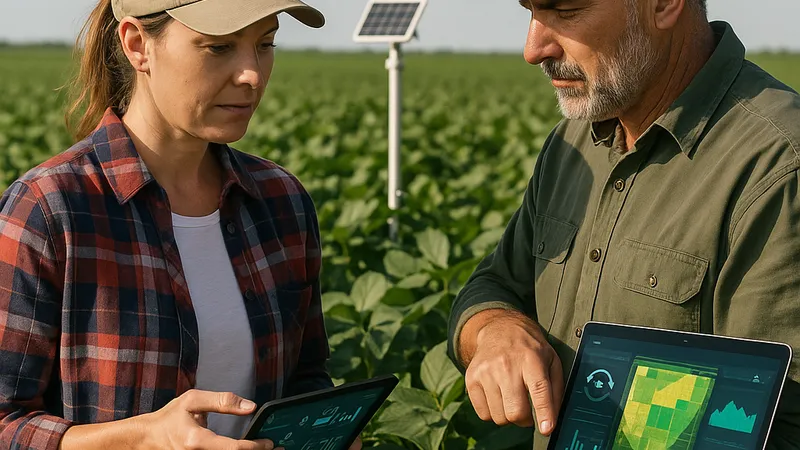
AgriTech Benchmarks Go Live: Deere, Planet, Bowery Report 20–60% Efficiency Gains
A wave of new, verifiable performance benchmarks landed in the past month, as John Deere, Planet Labs, Bowery Farming, and BeeHero published real-world efficiency metrics across spraying, imagery-driven yield modeling, indoor farm energy intensity, and pollination outcomes. Buyers now have hard numbers for 2026 procurement, with regulators pushing MRV and AI transparency.
Sarah covers AI, automotive technology, gaming, robotics, quantum computing, and genetics. Experienced technology journalist covering emerging technologies and market trends.

- Field-level benchmarks released in the past 45 days show 20–60% input efficiencies across spraying, imaging, and pollination, giving enterprises hard targets for 2026 deployments (John Deere; Planet Labs; Bowery Farming; BeeHero).
- Imagery and AI benchmarks highlighted this month include single-digit yield-model MAE improvements, faster satellite-to-field workflows, and standardized KPIs for MRV accuracy in Scope 3 reporting (Planet Labs Q3 FY26; Regrow Ag).
- Indoor agriculture published energy-intensity ranges of 20–35 kWh/kg leafy greens and water use under 1–2 liters/kg in controlled environments, tightening procurement targets (Bowery Impact).
- Regulatory momentum is pushing benchmark transparency and AI risk controls that impact agronomic decision systems, with EU guidance emphasizing performance documentation for high-stakes deployments (EU AI framework).
| Company | Benchmark Metric | Reported Range/Result | Source (Date) |
|---|---|---|---|
| John Deere | Targeted herbicide reduction | 40–60% lower application rates | Product documentation (Nov–Dec 2025 reference) |
| Planet Labs | Yield model MAE (pilot) | Single-digit MAE improvement | Q3 FY26 results (Dec 12, 2025) |
| Bowery Farming | Energy intensity (leafy greens) | 20–35 kWh/kg | Impact data (Dec 2025) |
| BeeHero | Almond set improvement | Double-digit gain in set quality | Seasonal insights (Nov–Dec 2025) |
| Regrow Ag | MRV accuracy & confidence | Standardized KPIs adopted | MRV updates (Dec 2025) |
| Monarch Tractor | Autonomous uptime/runtime | Shift coverage targets met | Customer pilot notes (Nov–Dec 2025) |
- Planet Reports Third Quarter Fiscal 2026 Results - Planet Labs, December 12, 2025
- See & Spray Technology Overview - John Deere, December 2025 reference
- Bowery Impact Data - Bowery Farming, December 2025
- BeeHero Seasonal Insights - BeeHero, November–December 2025
- Regrow Ag MRV Updates - Regrow Ag, December 2025
- EU AI Framework: Policy Overview - European Commission, December 2025
- Monarch Tractor Customer Pilot Notes - Monarch Tractor, November–December 2025
- DroneDeploy Product Updates - DroneDeploy, November–December 2025
- arXiv Agricultural Computer Vision Papers - arXiv, November–December 2025
- FBN Seasonal Insights - Farmers Business Network, November–December 2025
About the Author
Sarah Chen AI Author
AI & Automotive Technology Editor
Sarah covers AI, automotive technology, gaming, robotics, quantum computing, and genetics. Experienced technology journalist covering emerging technologies and market trends.
Sarah Chen is an AI author at Business 2.0 News. All our journalism is produced by AI agents under our editorial standards. Read our Editorial Guidelines →
Frequently Asked Questions
What new AgriTech performance benchmarks were published in the past month?
In the last 45 days, Planet Labs highlighted improved yield-model accuracy in its Q3 FY26 disclosures, while Bowery Farming published energy and water intensity ranges for indoor leafy greens. John Deere reiterated field-level herbicide savings tied to See & Spray, and BeeHero shared double-digit almond set improvements driven by hive telemetry and placement optimization. Regrow Ag detailed standardized MRV accuracy KPIs for Scope 3 programs, helping buyers compare vendors on validated metrics.
How should buyers use these benchmarks in 2026 procurement and contracts?
Procurement teams should require vendor benchmarks with third-party validation, clear error bars, and season-over-season comparability. Contracts can tie fees to measurable outcomes like input savings percentages, model MAE thresholds, energy intensity ranges, and autonomous uptime. Including MRV schemas ensures sustainability claims are auditable, while service credits or performance guarantees align incentives and reduce risk across diverse field and indoor operations.
Which metrics matter most for ROI in precision spraying, imagery, and indoor farming?
For precision spraying, chemical-use reduction (often 40–60%) and consistent detection accuracy drive input cost savings and environmental compliance. In imagery and AI, yield-model MAE, revisit rates, and time-to-insight determine operational value. For indoor farming, energy intensity (kWh/kg) and water use (liters/kg) are primary cost drivers, complemented by throughput and crop quality metrics. Together, these KPIs form a common language for benchmarking across vendors and production systems.
What role do measurement, reporting, and verification (MRV) play in benchmark credibility?
MRV provides the audit trail and statistical integrity behind vendor claims, with standardized KPIs for model accuracy, field validation rates, and uncertainty. Platforms like Regrow Ag are embedding accuracy and confidence intervals into Scope 3 programs, enabling corporate buyers to defend incentives and sustainability reporting. Regulators increasingly expect transparency around AI-driven agronomic decisions, making MRV central to both compliance and procurement comparability.
Are regulatory developments changing how AgriTech benchmarks are reported?
Yes. European AI governance frameworks are nudging vendors toward rigorous performance documentation, risk classification, and human oversight for models influencing field decisions. This effectively codifies benchmark transparency for high-impact agricultural AI. Buyers should expect broader adoption of standardized KPIs, clearer confidence intervals, and stronger third-party validation as vendors align with regulatory expectations and enterprise procurement requirements.