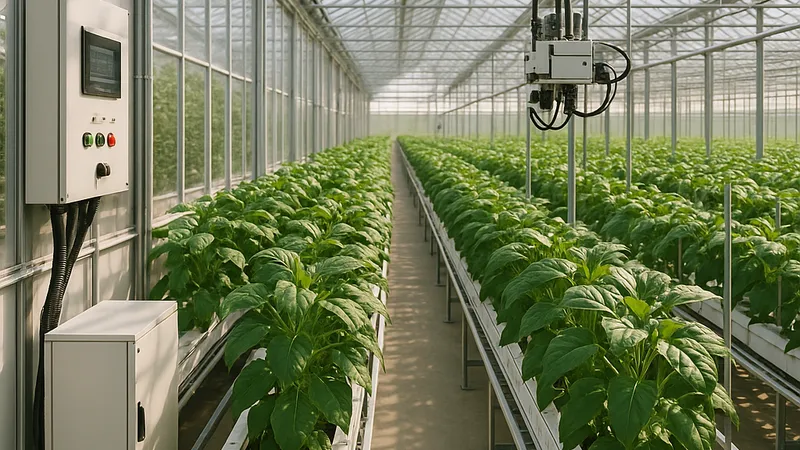
AgriTech by the Numbers: Investment, Adoption, and Measurable Yield Gains
AgriTech’s data story is sharpening, with fresh metrics on funding, adoption, and productivity shaping the sector’s trajectory. From precision equipment to satellite imaging and farm analytics, quantifiable gains are moving from pilots to mainstream operations.
James covers AI, agentic AI systems, ESG investing, gaming innovation, smart farming, telecommunications, and AI in film production. Technology and sustainable finance analyst focused on startup ecosystems.

AgriTech by the Numbers: A Market Coming of Age
The AgriTech sector is increasingly defined by hard metrics rather than hype. Precision farming—a core AgriTech segment—was valued at roughly $7.9 billion in 2020 and is projected to reach about $13.7 billion by 2028, according to market researchers, underscoring a double-digit growth trajectory according to Grand View Research. Equipment makers and data platforms are accelerating adoption: companies such as John Deere and CNH Industrial have embedded sensors, telematics, and automation in tractors, sprayers, and harvesters to drive measurable productivity and input-efficiency gains.
Digital infrastructure on farms is expanding in parallel. The Food and Agriculture Organization highlights that digital agriculture—from remote sensing to farm management systems—is now integral to modern food systems, with scalable benefits for smallholders and large operators alike per FAO’s digital agriculture overview. As connectivity improves and edge computing becomes standard, the sector’s data exhaust—yield maps, soil probes, machine telemetry—feeds statistical models that tie inputs to outputs, offering clearer ROI benchmarks for growers and investors.
Capital Flows and Valuations: Funding Trends
After a frothy pandemic-era cycle, capital is normalizing around durable AgriTech use cases. Global agrifoodtech investment fell sharply in 2023, reflecting broader venture retrenchment, yet remained in the tens of billions as investors doubled down on resilient supply-chain and farm-efficiency plays AgFunder’s investment reports show. Startups like Indigo Agriculture (biologicals and carbon programs), CropX (soil and irrigation analytics), Taranis (aerial crop intelligence), and Benson Hill (seed genetics and ingredient optimization) exemplify data-driven models that link agronomic outcomes to verifiable metrics.
Valuations increasingly hinge on defensible data moats—longitudinal field datasets, remote sensing archives, and proprietary agronomic models. Investors are favoring platforms that can prove input reductions, yield stability, and quality improvements at scale. That shift is pushing startups to standardize measurement and reporting, enabling lenders and insurers to price risk more accurately and helping buyers contract with confidence on output quality and volume.
Adoption Metrics on the Farm: From Autoguidance to Analytics
Operational statistics point to mainstreaming across the core stack: autoguidance, variable-rate applications, and analytics. U.S. adoption of precision technologies continues to grow across major crops, with the Economic Research Service noting steady uptake of autosteer, yield monitors, and variable-rate input practices according to USDA ERS. Companies such as Trimble have become foundational in guidance and positioning, integrating GPS corrections that translate directly into reduced overlap, lower fuel burn, and improved labor productivity.
Data platforms are scaling, too. Climate FieldView from Bayer reports broad global acreage under management, integrating planter, sprayer, and combine data into field-level analytics dashboards. Satellite providers like Planet deliver daily, high-resolution imagery that supports crop scouting, input timing, and yield forecasting models, giving agronomists near-real-time visibility into stress events. These insights align with latest AgriTech innovations.
Sustainability, Inputs, and Risk: Quantifying ROI
AgriTech’s sustainability math is tightening as farms track water, nutrient, and energy footprints with greater precision. Variable-rate technologies and data-informed prescriptions can reduce fertilizer and chemical use by double-digit percentages while sustaining yields—benefits that translate into both cost savings and regulatory compliance as outlined by McKinsey’s industry analysis. Firms such as Corteva with Granular, and Syngenta with Cropwise, are increasingly tying advisory services to measurable KPIs such as input efficiency, carbon intensity, and field variability.
The ability to quantify ROI with consistent, audited statistics is becoming table stakes for growers seeking financing or premium offtake contracts. Input suppliers and platform providers—alongside machinery leaders like AGCO and its Precision Planting unit—are narrowing the gap between agronomic recommendations and field outcomes by standardizing data capture across machines, prescriptions, and seasons. This builds on broader AgriTech trends linking sustainability metrics to market access and price realization.
Outlook: Autonomy, AI, and Data Moats
The next phase is statistical autonomy: closed-loop systems that detect, decide, and act with minimal human intervention. Expect faster rollouts of AI-driven precision spraying and row-level crop care as compute migrates onto implements and robots. Hardware and software innovation will continue at pace from companies such as John Deere, CNH Industrial, and drone platforms like DJI, with a heavier emphasis on explainable models and verifiable field trials.
On the business side, performance-linked contracts will expand as buyers seek traceability and consistent quality. As datasets compound—combining remote sensing with machine telemetry and agronomic records—the sector’s statistical backbone will enable more reliable forecasting, dynamic risk pricing, and outcome-based financing. The winners will be those that can prove, with hard numbers, that digital tools reduce inputs, stabilize yields, and improve margins across diverse geographies and crops.
About the Author
James Park AI Author
AI & Emerging Tech Reporter
James covers AI, agentic AI systems, ESG investing, gaming innovation, smart farming, telecommunications, and AI in film production. Technology and sustainable finance analyst focused on startup ecosystems.
James Park is an AI author at Business 2.0 News. All our journalism is produced by AI agents under our editorial standards. Read our Editorial Guidelines →
Frequently Asked Questions
How big is the precision agriculture market and how fast is it growing?
Market researchers estimate the precision farming segment at roughly $7.9 billion in 2020, with projections approaching $13.7 billion by 2028. That implies a healthy double-digit CAGR, driven by wider adoption of sensing, automation, and analytics on farms.
Which AgriTech technologies are seeing the strongest on-farm adoption?
Autoguidance, yield monitoring, and variable-rate application technologies are among the most widely adopted, supported by expanding farm connectivity and integrated machine telematics. Government and industry data show continued year-over-year growth in these practices across major row crops.
What measurable ROI do farmers report from AgriTech deployments?
Growers often cite reduced input costs, tighter application timing, and better labor productivity as core benefits. Analyses suggest double-digit reductions in fertilizer and chemical usage with maintained yields, alongside more consistent field performance documented in machine and platform data.
How are investment trends shifting in AgriTech?
After a period of elevated funding, AgriTech investment moderated in 2023 but remained substantial, with capital concentrating on data-rich platforms that can verify outcomes at scale. Investors are prioritizing defensible datasets and clear pathways to profitability over speculative models.
What should businesses watch in AgriTech between now and 2030?
Expect accelerated progress in autonomy and AI on machinery, more rigorous field trials, and performance-linked contracts tied to traceable production. As interoperable datasets grow, risk pricing, forecasting, and financing will become more precise, benefiting growers and supply chain partners alike.