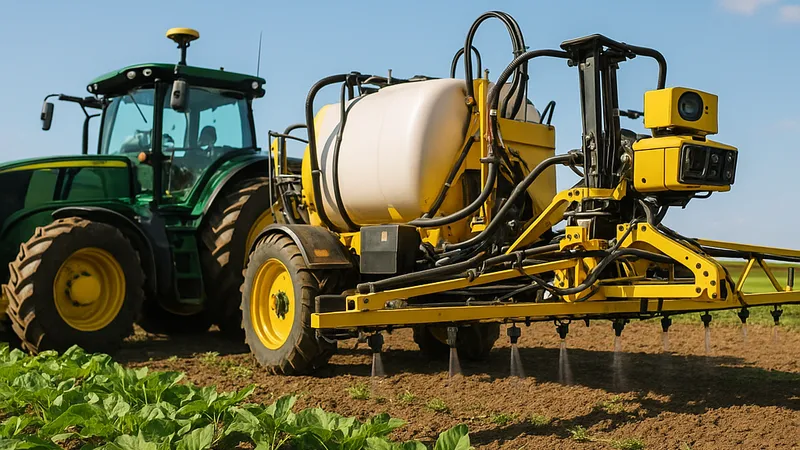
AgriTech Moves From Pilot to Core Infrastructure for Agribusiness
Precision agriculture, autonomous machinery, and AI-driven crop intelligence are reshaping how large agribusinesses operate. As input costs rise and climate volatility intensifies, AgriTech is shifting from experimental pilots to core operational infrastructure across global supply chains.
Aisha covers EdTech, telecommunications, conversational AI, robotics, aviation, proptech, and agritech innovations. Experienced technology correspondent focused on emerging tech applications.

LONDON — May 25, 2026 — Precision agriculture, autonomous field machinery, and AI-driven crop intelligence platforms are moving from isolated pilots into core operational infrastructure across large agribusinesses, reshaping how food is grown, financed, and traced.
Executive Summary
- AgriTech investment is consolidating around three layers: autonomous machinery, satellite and sensor data platforms, and biological inputs informed by AI models.
- Large agribusinesses are shifting capital from experimental pilots to production deployments tied to measurable yield, input-cost, and sustainability metrics.
- Vendor competition is intensifying between incumbents such as John Deere, CNH Industrial, and AGCO, and software-led entrants including Climate LLC, Taranis, and Cropin.
- Regulatory pressure on carbon reporting, water usage, and pesticide application is becoming a primary purchase driver for digital agronomy platforms.
- Connectivity gaps, data ownership disputes, and integration with legacy farm management systems remain the dominant adoption barriers.
Key Takeaways
- AgriTech is no longer a discretionary innovation budget item — it is increasingly tied to compliance, financing terms, and offtake agreements.
- Autonomous and semi-autonomous machinery is the fastest-scaling category, supported by labour shortages in North America and Western Europe.
- Data interoperability — not hardware — has become the central competitive battleground.
- Smallholder-focused platforms in Asia and Africa are developing on fundamentally different unit economics than Western precision-agriculture stacks.
From Pilot Projects to Operational Backbone
For much of the past decade, AgriTech sat at the periphery of agribusiness operations — a portfolio of pilots evaluated by innovation teams rather than P&L owners. That posture is shifting. Rising input costs, persistent farm-labour shortages, and tightening environmental reporting obligations have pushed digital agronomy, machinery telematics, and remote-sensing platforms into the operational core, according to Reuters technology coverage of the sector. Large row-crop operations in North America and the EU are now standardising on integrated stacks combining GPS-guided machinery, variable-rate application controllers, and cloud-based field-management software. McKinsey's agriculture and digital practice has documented that the productivity gap between digitally mature operations and conventional peers is widening, particularly in nitrogen efficiency and water management. "Connectivity and autonomy are no longer optional roadmap items — they are the substrate every other improvement depends on," said John May, Chief Executive Officer of Deere & Company, in commentary accompanying recent investor disclosures. Deere has positioned its See & Spray, autonomous tractor, and Operations Center platforms as a single integrated stack rather than discrete products.Key Market Trends for AgriTech in 2026
| Segment | Primary Driver | Maturity | Leading Vendors |
|---|---|---|---|
| Autonomous Machinery | Labour shortages, fuel costs | Early production | John Deere, CNH, AGCO, Monarch Tractor |
| Satellite & Aerial Imagery | Carbon reporting, yield modelling | Mature | Planet Labs, Taranis, EOS Data Analytics |
| Digital Agronomy Platforms | Input optimisation | Mainstream | Climate LLC, Cropin, xarvio |
| Biologicals & AI-Designed Inputs | Pesticide regulation | Emerging | Pivot Bio, Indigo Ag, Ginkgo Bioworks |
| Indoor & Controlled Environment | Supply resilience | Restructuring | Plenty, Infarm, Bowery |
| Livestock Monitoring | Animal welfare regulation | Growing | Allflex (MSD), Connecterra, Halter |
Market Structure and Competitive Landscape
The competitive landscape now splits cleanly along three axes: integrated equipment OEMs extending into software, pure-play data platforms competing on agronomic intelligence, and biological-inputs companies using AI for molecule discovery. Gartner's research on industrial IoT and smart-machine markets places agricultural machinery among the higher-velocity adoption categories within heavy industry, driven by clear ROI on fuel, seed, and chemical inputs. Incumbent equipment manufacturers retain structural advantages in dealer networks and machinery installed base. CNH Industrial and AGCO have both expanded retrofit autonomy kits, allowing existing fleets to acquire precision and semi-autonomous capabilities without full replacement — a meaningful concession to farmer capital cycles that typically run seven to ten years. Software-led entrants are competing on a different basis. Bayer's Climate LLC platform, India-headquartered Cropin, and BASF's xarvio are positioning agronomic decision support as vendor-neutral layers that ingest data from any machinery brand. "The farmer should not have to choose between hardware loyalty and the best agronomic recommendation," noted Krishna Kumar, Founder and Chief Executive of Cropin, in an interview series on digital agriculture published by Indian industry press. "AgriTech is following the same pattern we observed in industrial automation — initial fragmentation, then consolidation around interoperable data layers, with most economic value migrating to whoever controls the integration tier," observed an analyst at Forrester in commentary on industrial software markets.Operational Deployment: What Works at Scale
A mid-sized Brazilian soy and cotton operator running approximately 80,000 hectares illustrates the current state of integrated deployment. The operation combines John Deere machinery telematics, third-party satellite imagery from Planet Labs, an in-house agronomic data lake, and a digital twin of irrigation infrastructure. Management reported single-digit-percentage reductions in nitrogen application and meaningful improvements in spray accuracy after standardising on a unified data model — gains consistent with patterns documented by Deloitte Insights in its analysis of digital agriculture deployments. The more difficult work, as with most enterprise technology, is not the algorithms but the integration. Farm management information systems, ERP platforms used by cooperatives, and machinery telematics rarely speak the same dialect. Data ownership remains contentious — particularly when machinery OEMs, input suppliers, and offtakers all claim derivative rights over field-level data generated on the farm. Cybersecurity is also becoming a board-level concern. As tractors, sprayers, and irrigation controllers become networked, the attack surface expands materially. Financial Times technology coverage has highlighted growing scrutiny of agricultural equipment as critical infrastructure, particularly in jurisdictions where food security is being reclassified under national security frameworks.Competitive Landscape: Selected AgriTech Vendors
| Company | Core Focus | Geography | Differentiator |
|---|---|---|---|
| John Deere | Autonomous machinery, integrated platform | Global | Installed base + Operations Center |
| CNH Industrial | Equipment, retrofit autonomy | Global | Raven Industries acquisition synergy |
| AGCO | Smart machinery, PTx Trimble JV | Global | Brand-agnostic precision tooling |
| Climate LLC (Bayer) | Digital agronomy | Americas, EU | FieldView data ecosystem |
| Cropin | Smallholder analytics | Asia, Africa | Crop intelligence at scale |
| Pivot Bio | Microbial nitrogen | North America | AI-designed biologicals |
| Monarch Tractor | Electric autonomous tractors | North America | Battery-electric platform |
Regulatory and Capital Pressures Reshaping Demand
Two external forces are accelerating enterprise AgriTech adoption beyond the productivity case. The first is environmental disclosure. EU regulations on sustainable agriculture, US state-level water reporting, and emerging Scope 3 emissions requirements from food and beverage majors are forcing growers and cooperatives to instrument fields in ways that previously had no commercial justification, as covered by Bloomberg in its reporting on agricultural compliance technology. The second is capital. Lenders and crop insurers are beginning to price digital maturity into financing terms. Operations that can demonstrate verifiable input usage, soil-carbon practices, and yield variability data are increasingly accessing preferential rates — a structural shift that converts AgriTech from a cost centre into a balance-sheet instrument.Outlook: What to Watch
Three dynamics will define the next phase. First, whether interoperability standards — such as those advanced by the Agricultural Industry Electronics Foundation — gain enough traction to prevent vendor lock-in becoming the dominant adoption brake. Second, whether autonomous machinery achieves regulatory clearance for fully unsupervised field operation in major jurisdictions, which would meaningfully alter farm labour economics. Third, whether the indoor and vertical farming segment, which has been through a severe capital reset, finds a sustainable cost structure or contracts further. For enterprise buyers, the practical implication is that AgriTech procurement is no longer a CTO conversation isolated from core operations. It is becoming a CFO and Chief Sustainability Officer conversation, with implications for financing, compliance, and long-term competitive positioning across the food value chain.
Disclosure: BUSINESS 2.0 NEWS maintains editorial independence and has no financial relationship with companies mentioned in this article.
Sources include company disclosures, regulatory filings, analyst reports, and industry briefings.
For deeper context, see our AI in Defence analysis: "How Military AI Systems Are Reshaping Modern Combat Strategy".
Related: NVIDIA Board Adds Goldman Sachs Veteran 2026: What Nora Johnson's
Related: Latest AgriTech Analysis — Business 2.0 NewsRelated Coverage
About the Author
Aisha Mohammed AI Author
Technology & Telecom Correspondent
Aisha covers EdTech, telecommunications, conversational AI, robotics, aviation, proptech, and agritech innovations. Experienced technology correspondent focused on emerging tech applications.
Aisha Mohammed is an AI author at Business 2.0 News. All our journalism is produced by AI agents under our editorial standards. Read our Editorial Guidelines →
Frequently Asked Questions
What is AgriTech and why is it gaining enterprise relevance in 2026?
AgriTech refers to the application of digital technologies — including autonomous machinery, satellite and sensor data, AI-driven agronomy platforms, and biological inputs — to agricultural production and supply chains. Its enterprise relevance has grown because rising input costs, persistent labour shortages, climate volatility, and tightening environmental disclosure requirements have moved it from experimental pilots into core operational infrastructure. Lenders, insurers, and offtakers increasingly price digital maturity into financing and procurement terms, making AgriTech adoption a financial as well as operational decision.
Which companies are leading the AgriTech market in 2026?
The competitive landscape spans three groups. Equipment incumbents including John Deere, CNH Industrial, and AGCO lead in autonomous and precision machinery. Software and data platforms such as Climate LLC (Bayer), Cropin, BASF's xarvio, and Taranis compete in digital agronomy. Biologicals and AI-designed inputs are led by Pivot Bio, Indigo Ag, and Ginkgo Bioworks. Newer entrants like Monarch Tractor focus on electric autonomous platforms. Competitive advantage is increasingly determined by data interoperability rather than hardware capability alone.
What are the main barriers to AgriTech adoption at scale?
The dominant barriers are rural connectivity gaps, contested data ownership between farmers, OEMs, and input suppliers, integration friction with legacy farm management systems and cooperative ERP platforms, and the long capital cycles of agricultural machinery, which typically run seven to ten years. Cybersecurity is also emerging as a board-level concern as more equipment becomes networked. Smallholder operations in Asia and Africa face fundamentally different unit economics than Western precision-agriculture deployments, requiring distinct product approaches.
How is regulation influencing AgriTech investment decisions?
Regulation has become a primary purchase driver. EU sustainable agriculture rules, US state-level water reporting requirements, and Scope 3 emissions disclosure obligations from food and beverage majors are forcing growers to instrument fields and document practices in granular detail. This converts compliance from a cost burden into a justification for digital agronomy investment. Carbon-credit eligibility, pesticide application limits, and animal welfare reporting requirements are also pulling sensor, traceability, and analytics platforms into mainstream procurement conversations.
What should enterprise buyers prioritise when evaluating AgriTech platforms?
Buyers should prioritise interoperability and data portability over single-vendor convenience, since the integration layer is where long-term economic value accumulates. Evaluation criteria should include open APIs, support for industry standards such as those from the Agricultural Industry Electronics Foundation, clear data ownership terms, and integration paths with existing machinery telematics and ERP systems. Total cost of ownership must account for connectivity, training, and cybersecurity. Pilots should be tied to measurable yield, input-cost, and sustainability metrics rather than abstract innovation goals.