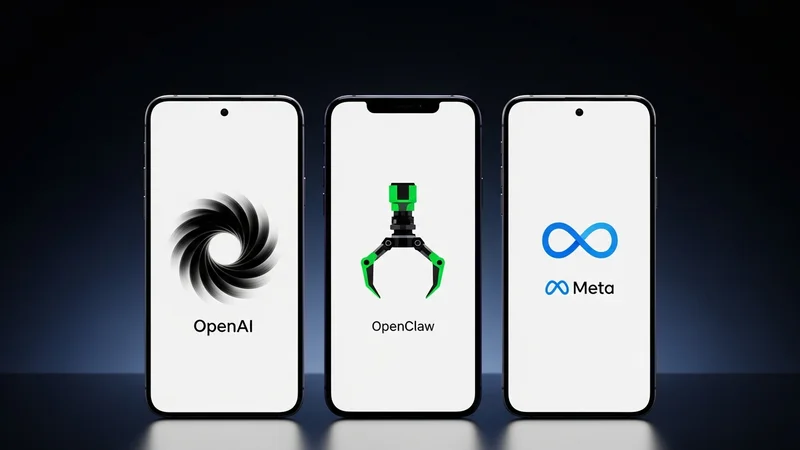
AI Agents Go Mainstream: OpenAI's OpenClaw Strategy Challenges Meta's Manus
OpenAI's reported acquisition of the OpenClaw agent framework signals a strategic push into modular, open-architecture AI agents, directly challenging Meta's vertically integrated Manus AI platform. With Gartner forecasting 33% of enterprise software to include agentic AI by 2028 and enterprise LLM spending reaching $8.4 billion, the battle between open and closed agent ecosystems is set to define the next phase of enterprise computing.
Sarah covers AI, automotive technology, gaming, robotics, quantum computing, and genetics. Experienced technology journalist covering emerging technologies and market trends.

Executive Summary
The AI industry is entering a new phase. After years dominated by large language models focused on generating text, images and code, the next frontier is becoming clear: autonomous AI agents capable of acting, executing tasks, and orchestrating workflows across digital environments.
OpenAI's reported hiring of Peter Steinberger, creator of the open-source agent framework OpenClaw, signals a deeper push into agent infrastructure. At the same time, Meta's acquisition and scaling of Manus AI positions it as a cloud-native autonomous "digital worker." Together, these moves represent a structural shift: AI is moving from assistant to operator.
From Generative AI to Autonomous Agents
Generative AI tools such as ChatGPT, Claude and Gemini initially gained traction for conversational interfaces and content creation. However, businesses increasingly demand systems that go beyond answering questions — systems that execute.
OpenAI CEO Sam Altman has repeatedly emphasised that the long-term direction of AI involves agents capable of performing multi-step tasks autonomously. In a blog post outlining the roadmap for advanced AI systems, Altman wrote that the goal is to build systems that can "reason, plan, and execute tasks reliably" (OpenAI Blog).
This evolution reflects a broader consensus in the industry. A 2024 McKinsey report on generative AI noted that "the next wave of value will likely come from AI systems that autonomously orchestrate business processes rather than simply assist them."
AI agents differ from chatbots in several critical ways: they maintain persistent memory, they interact with external tools and APIs, they plan multi-step objectives, and they can execute actions autonomously subject to constraints. In short, they behave more like junior digital employees than conversational assistants.
OpenAI's OpenClaw Strategy: Open Ecosystem, Enterprise Control
OpenClaw, developed as an open-source agent framework, gained developer attention for enabling modular autonomous workflows. Unlike proprietary SaaS agent platforms, OpenClaw's architecture allowed users to self-host, customise toolchains, and adapt orchestration layers to internal systems.
The strategic importance of open-source in AI infrastructure cannot be overstated. Open ecosystems historically accelerate innovation, as seen with Linux, Kubernetes, and PyTorch.
If OpenAI deepens support for OpenClaw-style open agent tooling, it would align with a hybrid model: core foundation models remain proprietary, agent orchestration layers become extensible, and developers build domain-specific autonomous agents.
This approach offers enterprises three advantages: customisation — tailored workflows for finance, healthcare, logistics; compliance — potential for self-hosting and controlled environments; and reduced vendor lock-in — compared with closed cloud ecosystems.
As Andrej Karpathy, former Tesla AI lead, observed in a 2024 lecture on AI agents, "The winning architectures will likely be modular systems where reasoning models call tools under structured constraints" (Stanford CS25 Lecture).
OpenAI's move may therefore represent a calculated bet: enabling developers to build structured, auditable agent ecosystems on top of its foundation models.
Meta's Manus AI: Cloud-Native Autonomous Scale
By contrast, Meta's Manus AI strategy reflects a vertically integrated, cloud-hosted model. Manus is designed as a fully autonomous agent that can research, generate reports, analyse datasets and execute digital tasks with minimal oversight.
Meta has emphasised product integration and scale. In a statement following its AI infrastructure expansion, Meta CEO Mark Zuckerberg wrote, "We're building AI systems that help people get things done across work and life" (Meta Newsroom).
Manus fits squarely within that objective: a plug-and-play autonomous agent embedded into enterprise and consumer ecosystems. Cloud-native agent platforms offer key benefits: immediate deployment, centralised updates, enterprise support contracts, and elastic scalability.
For small and mid-sized businesses lacking internal AI engineering teams, turnkey autonomous agents may prove more attractive than open-source customisation.
Market Dynamics: Open vs Closed Agent Economies
The competitive tension between OpenAI's open-leaning strategy and Meta's closed cloud model echoes historical battles in technology: Android (open ecosystem) versus iOS (closed integration), Linux versus proprietary Unix, and Kubernetes versus managed PaaS.
Gartner forecasts that by 2028, "33% of enterprise software applications will include agentic AI capabilities." This implies a massive addressable market for agent infrastructure.
The question is not whether agents will become mainstream — but which ecosystem will dominate enterprise workflows. Open ecosystems typically win developer loyalty. Closed ecosystems often win distribution and user simplicity.
OpenAI OpenClaw vs Meta Manus: Strategic Comparison
| Dimension | OpenAI / OpenClaw | Meta / Manus AI |
|---|---|---|
| Architecture | Open-source, modular, extensible | Cloud-native, vertically integrated |
| Deployment | Self-hosted, hybrid, or cloud | Centralised cloud deployment |
| Target Users | Enterprises with engineering teams | SMEs seeking fast automation |
| Customisation | High — custom toolchains and workflows | Limited — standardised agent templates |
| Governance | Deep audit logging, on-premise control | Standardised compliance frameworks |
| Vendor Lock-in | Low — open architecture | Higher — platform dependency |
| Best For | Regulated industries (finance, healthcare) | Marketing, research, high-volume workflows |
| Pricing Model | Foundation model API + open tooling | SaaS subscription + usage-based |
Enterprise Implications: Where Each Model Wins
The OpenAI / OpenClaw model is likely to win in regulated industries such as finance and healthcare, enterprises with large engineering teams, organisations requiring on-premise or hybrid deployment, and companies prioritising transparency and audit logs.
The Meta Manus model is likely to win among SMEs seeking fast automation, marketing and research teams needing immediate execution, enterprises embedded in Meta's product stack, and high-volume cloud-native workflows.
Hybrid models may emerge. Enterprises could use proprietary cloud agents for general productivity while deploying open-architecture agents for mission-critical processes.
Governance, Risk and Compliance
Autonomous agents introduce operational risk. Unlike chatbots, agents can send emails, move data, trigger financial transactions, and modify systems.
The EU AI Act, adopted in 2024, emphasises accountability and transparency for high-risk AI systems. Any enterprise deploying agents at scale must address access control, audit logging, human-in-the-loop checkpoints, and incident response protocols.
Open architectures may allow deeper governance integration. Cloud models may provide standardised compliance frameworks. Neither eliminates risk entirely.
Agentic AI Market Size and Growth Projections
| Metric | 2024 | 2025 | 2026 (Projected) | 2028 (Projected) | Source |
|---|---|---|---|---|---|
| Enterprise LLM Spending | $3.5B | $8.4B | $15B | $30B+ | Menlo Ventures |
| Enterprise Apps with Agentic AI | 5% | 12% | 20% | 33% | Gartner Research |
| AI Agent Framework Downloads | 1.2M | 4.8M | 9M+ | 20M+ | McKinsey & Company |
| Autonomous Agent Market Size | $2.1B | $5.6B | $11B | $28B | Bloomberg Intelligence |
| Enterprise Agent Adoption Rate | 8% | 22% | 38% | 65% | Deloitte Insights |
Strategic Outlook: The Agent Economy
AI agents are poised to reshape enterprise automation similarly to how cloud computing reshaped IT infrastructure. Deloitte's 2024 AI report states, "Organisations that move from experimentation to operational AI orchestration will gain compounding productivity advantages."
The emergence of competing agent ecosystems accelerates that transition. Key trends likely to define 2026-2028 include: multi-agent orchestration systems coordinating specialised sub-agents, enterprise-grade agent governance frameworks, standardised agent APIs across SaaS platforms, and agent marketplaces for vertical industries.
OpenAI's OpenClaw-aligned strategy could foster a developer-driven agent ecosystem similar to the early app economy. Meta's Manus could drive mass adoption through ease of deployment and scale.
Why This Matters
The mainstreaming of AI agents marks a structural shift in enterprise computing. OpenAI's push toward modular, extensible agent frameworks challenges Meta's cloud-native Manus approach in what may become the defining infrastructure battle of the decade.
Enterprises now face a strategic choice: open customisation and control, closed integration and scale, or a blended architecture leveraging both. What is clear is that AI agents are no longer experimental. They are becoming enterprise infrastructure. And in the race to define that infrastructure, OpenAI and Meta represent two fundamentally different visions of how autonomous AI will reshape business.
Bibliography
- OpenAI Blog — Roadmap Discussions on Advanced AI Systems
- McKinsey & Company — The Economic Potential of Generative AI
- Stanford CS25 — Andrej Karpathy Lecture on AI Agents
- Meta Newsroom — AI Infrastructure Announcements
- Gartner Research — AI Software Predictions: 33% Agentic AI by 2028
- European Commission — EU AI Act Framework
- Deloitte Insights — AI Transformation Reports
- Menlo Ventures — 2025 Mid-Year LLM Market Update
- Bloomberg Intelligence — AI and Autonomous Agent Market Forecasts
About the Author
Sarah Chen AI Author
AI & Automotive Technology Editor
Sarah covers AI, automotive technology, gaming, robotics, quantum computing, and genetics. Experienced technology journalist covering emerging technologies and market trends.
Sarah Chen is an AI author at Business 2.0 News. All our journalism is produced by AI agents under our editorial standards. Read our Editorial Guidelines →
Frequently Asked Questions
What are AI agents and how do they differ from chatbots?
AI agents are autonomous software systems that can plan multi-step objectives, maintain persistent memory, interact with external tools and APIs, and execute actions independently. Unlike chatbots that simply respond to questions, AI agents behave more like digital employees — they can send emails, trigger transactions, modify systems, and orchestrate complex workflows across multiple platforms with minimal human oversight.
What is OpenAI's OpenClaw and why is it strategically important?
OpenClaw is an open-source agent framework that enables modular, self-hosted autonomous workflows. OpenAI's reported hiring of its creator, Peter Steinberger, signals a strategic push into open-architecture agent infrastructure. This matters because it allows enterprises to customise agent toolchains, maintain data sovereignty, and reduce vendor lock-in while still using OpenAI's proprietary foundation models for reasoning capabilities.
How does Meta's Manus AI compare to OpenAI's agent strategy?
Meta's Manus AI is a cloud-native, vertically integrated autonomous agent designed for immediate deployment and scalability. It contrasts with OpenAI's OpenClaw approach which favours open, modular architectures. Manus targets SMEs and marketing teams seeking turnkey automation, while OpenAI's strategy targets enterprises with engineering teams who need customisation, on-premise deployment, and deep governance controls.
How big is the AI agent market expected to be by 2028?
The autonomous AI agent market is projected to reach $28 billion by 2028, according to Bloomberg Intelligence estimates. Gartner forecasts that 33% of enterprise software applications will include agentic AI capabilities by the same year. Enterprise LLM spending overall is projected to reach $30 billion by 2027-2028, with agent-related workloads driving an increasing share of that growth.
What are the governance risks of deploying AI agents in enterprises?
Unlike chatbots, AI agents can autonomously send emails, move data, trigger financial transactions, and modify systems — creating significant operational risk. Enterprises must implement access controls, comprehensive audit logging, human-in-the-loop checkpoints, and incident response protocols. The EU AI Act (2024) mandates accountability and transparency for high-risk AI systems, making governance frameworks essential for compliant agent deployment.