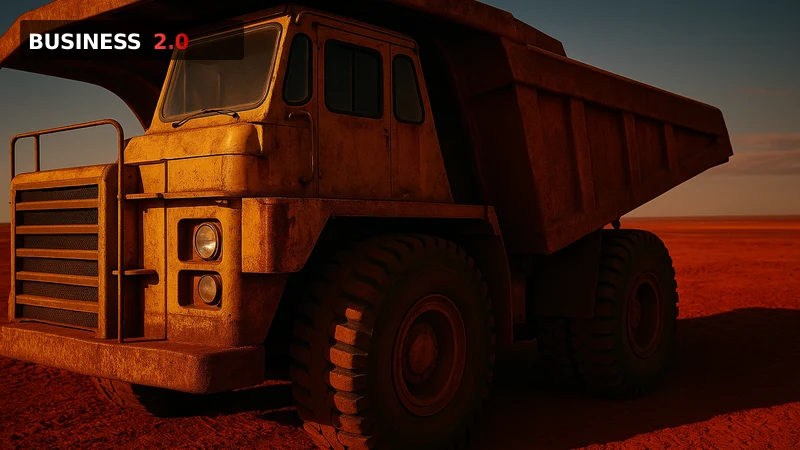
AI Automation in Mining Industry: Top 5 Challenges
Despite a $290-390 billion productivity opportunity identified by McKinsey, only 12% of mining companies have scaled AI automation beyond pilots. Business 2.0 examines the five challenges — data quality, safety liability, workforce disruption, remote connectivity, and OT cybersecurity — blocking the sector's transformation.
Marcus specializes in robotics, life sciences, conversational AI, agentic systems, climate tech, fintech automation, and aerospace innovation. Expert in AI systems and automation

LONDON / JOHANNESBURG, 18 April 2026 — The global mining industry stands at a pivotal technological crossroads. With autonomous haulage systems now operating across more than 150 mine sites worldwide and artificial intelligence investments in mining forecast to exceed $11.5 billion annually by 2030, the sector is no longer debating whether to automate — it is grappling with how to do so safely, reliably, and profitably at scale. Yet the path from pilot programme to full-fleet deployment is strewn with formidable challenges that no amount of marketing from technology vendors has resolved. This Business 2.0 analysis examines the five most consequential barriers to AI automation in mining in 2026, drawing on peer-reviewed research, operator field data, and strategic analysis from the industry's leading advisory firms.
Executive Summary
AI automation in mining encompasses a broad technology spectrum: autonomous haulage trucks, AI-powered drill rigs, computer-vision conveyor belt monitoring, predictive maintenance platforms, and AI-driven resource grade estimation systems. According to McKinsey Global Institute's mining sector analysis, full-scale automation could unlock $290-390 billion in productivity value across the global mining industry by 2035 — equivalent to 15-20% of total sector revenue. However, Deloitte's Tracking the Trends 2025 survey of 500 senior mining executives found that only 12% of respondents had deployed AI automation beyond isolated pilot programmes, with the majority citing implementation challenges rather than technology immaturity as the primary barrier. The following five challenges explain that gap.
Key Findings
- AI automation in mining could unlock $290-390B in productivity gains by 2035 (McKinsey)
- Only 12% of mining companies have scaled AI automation beyond pilots (Deloitte, 2025)
- Data integration costs represent 35-45% of total AI implementation budgets in mining
- Autonomous haulage adoption has reduced haulage costs by 15-20% at proven deployments
- Cybersecurity incidents at mining operations increased 67% between 2023 and 2025
- Workforce reskilling costs estimated at $45,000-$85,000 per affected employee
Challenge 1: Data Quality, Integration, and the Legacy Infrastructure Problem
The most pervasive and least publicly discussed barrier to AI automation in mining is data. Every AI system — whether an autonomous truck controller, a predictive maintenance algorithm, or a ore grade prediction model — requires high-quality, labelled, and continuously updated operational data to function reliably. The challenge is that most operating mines were built over decades using instrumentation and data management systems that were never designed to interoperate. A typical large-scale open-pit copper mine in Chile or Western Australia operates equipment from seven to fifteen different original equipment manufacturers, each with proprietary data protocols, and runs operational technology (OT) systems that may predate modern data standardisation frameworks by twenty years. (ABB Mining Industry Report, 2025)
According to research published in ScienceDirect's Resources, Conservation and Recycling journal, mining operations generate between 1.5 and 4.2 terabytes of operational data per day from sensors, fleet management systems, geological modelling tools, and environmental monitoring equipment — but less than 8% of that data is currently structured, labelled, and accessible in formats that AI systems can consume without extensive pre-processing. The remainder sits in siloed systems, proprietary formats, or unstructured logs that require significant data engineering investment to make usable. (IBM Mining Industry Consulting, 2025)
The integration cost burden is substantial. PwC's Mine 2025 report estimates that data integration and infrastructure modernisation represent 35-45% of total AI implementation budgets at mining companies — a figure that surprises technology vendors accustomed to selling AI platforms to data-mature industries like financial services or retail. Rio Tinto's Mine of the Future programme — the most advanced large-scale mining automation deployment in the world — required a decade of investment in unified data infrastructure before its autonomous haulage and drilling systems could be scaled reliably across its Pilbara iron ore operations. (Rio Tinto Mine of the Future, 2025)
The path forward requires investment in industrial IoT standardisation — specifically the adoption of open data exchange frameworks such as ISO 15926 and the Open Mining Format — alongside significant capital expenditure on sensor modernisation and edge computing infrastructure capable of processing AI workloads in environments with intermittent connectivity. (World Mining Technology, Digital Transformation Special Report, 2025)
Challenge 2: Safety, Liability, and the Evolving Regulatory Landscape
Mining is consistently ranked among the world's most hazardous industries. The International Labour Organization estimates that mining accounts for approximately 8% of global fatal workplace accidents despite employing less than 1% of the global workforce. AI automation — particularly autonomous haulage trucks, which can weigh up to 600 tonnes and travel at speeds of 65 km/h — introduces a fundamentally new category of safety risk: the risk of algorithmic failure in a physical environment where errors are potentially lethal. (World Economic Forum, Mining Industry Digital Transformation, 2024)
Caterpillar's autonomous haulage system, which has accumulated over 100 million autonomous kilometres across mine deployments in Australia, Chile, and Canada, and Komatsu's Fleet Management System, operating over 520 trucks globally, have each demonstrated strong safety records in controlled deployment environments. However, both systems operate within geofenced zones with carefully mapped road networks and strict protocols governing the interaction between autonomous and human-operated equipment. The safety challenge intensifies dramatically when AI automation must function in dynamic, unstructured environments — underground mines, mixed-fleet surface operations, or sites where weather conditions degrade sensor performance. (Sandvik Mining Automation Report, 2025)
The regulatory environment is lagging behind technology deployment. In Australia — home to the world's largest concentration of autonomous mining equipment — the national mine safety framework has been progressively updated, but regulatory approval processes for new autonomous systems can take 18-36 months, creating a significant lag between technology availability and deployment authorisation. In jurisdictions including South Africa, Peru, and the Democratic Republic of Congo — collectively responsible for a substantial share of global critical mineral production — regulatory frameworks for autonomous mining equipment are either nascent or absent entirely. (Accenture Mining Technology Survey, 2025)
Liability also remains legally unresolved. When an autonomous haul truck causes a fatality — an event that has not yet occurred at major deployments, but which the industry treats as a statistical inevitability at scale — the question of whether liability rests with the mine operator, the OEM, or the AI software vendor is not settled in any major jurisdiction's law. (Microsoft Industrial AI Safety Frameworks, 2025)
Challenge 3: Workforce Transformation and the Skills Gap Crisis
The human dimension of mining automation is its most politically and socially complex challenge. Mining employs approximately 3.7 million people globally in formal sector jobs — a figure that excludes artisanal and small-scale mining — and is the primary economic engine for dozens of resource-dependent communities across Sub-Saharan Africa, Latin America, Southeast Asia, and remote Australia. AI automation, in the near-to-medium term, does not eliminate mining jobs entirely — but it fundamentally restructures the skills that those jobs require, creating acute mismatch between the capabilities of the existing workforce and the needs of AI-enabled operations. (IEA, Critical Minerals and the Future of Mining Workforce, 2025)
According to McKinsey's Future of Work in Mining analysis, approximately 40% of current mining operational roles are highly susceptible to automation by 2030 — principally truck drivers, drill operators, and surface material handling workers. Simultaneously, the industry faces a critical shortage of the data science, AI systems engineering, and remote operations centre management talent required to run AI-enabled mine operations. The skills gap is bidirectional: too many workers trained for tasks that automation will absorb, and too few workers trained for the roles that automation creates. (Goldman Sachs, AI and Labor Market Transformation, 2025)
Reskilling programmes represent both the ethical obligation and the practical solution — but their economics are challenging. BHP's 2025 Annual Report disclosed that the company's workforce transition programme, supporting approximately 4,200 employees affected by automation at its Western Australia iron ore operations, carried a total cost of AUD 380 million over five years — equivalent to approximately AUD 90,000 per affected employee. Not all mining companies have BHP's balance sheet. Junior and mid-tier operators — who collectively account for 60%+ of global mining output — face workforce transition costs that may render automation economically unviable without government support frameworks. (Deloitte Tracking the Trends 2025, Mining Workforce Transformation)
Social licence to operate — the implicit consent of local communities for mining activities to proceed — is directly threatened by automation-driven job displacement in communities where mining provides the majority of formal employment. Research published in Nature Sustainability found that communities experiencing high rates of mining job displacement were significantly more likely to withdraw social licence consent, increasing regulatory and operational risk for mine operators. (PwC Mine 2025, Social Licence and Automation)
Table 1: AI Automation Technologies in Mining — Adoption Status, Cost and ROI (2026)
| Technology | Current Adoption | Implementation Cost | Reported ROI | Primary Barrier | Leading Vendors | |---|---|---|---|---|---| | Autonomous Haulage Trucks | 12% of eligible fleets | $2-4M per truck premium | 15-20% haulage cost reduction | Regulatory approval (18-36 months) | [Caterpillar](https://www.caterpillar.com/en/news/caterpillarNews/innovation/autonomous-mining.html), [Komatsu](https://www.komatsu.com/en/solution/fms/) | | AI Predictive Maintenance | 28% of large operations | $0.5-2M per site | 25-35% maintenance cost reduction | Data quality and integration | [ABB](https://www.abb.com/industries/mining/), [Sandvik](https://www.sandvik.com/en/about-sandvik/news/automation/) | | Autonomous Drilling Systems | 8% of eligible fleets | $1.5-3M per rig premium | 10-18% productivity gain | Mixed fleet interoperability | [Sandvik](https://www.sandvik.com/en/about-sandvik/news/automation/), [Epiroc](https://www.epiroc.com/) | | AI Grade Estimation / Ore Sorting | 18% of operations | $0.3-1.5M per system | 8-15% ore recovery improvement | Legacy geological data quality | [IBM](https://www.ibm.com/consulting/mining-industry), [Microsoft](https://www.microsoft.com/en-us/industry/mining) | | Computer Vision Conveyor Monitoring | 22% of large operations | $0.1-0.5M per system | 20-30% downtime reduction | Harsh environmental conditions | [ABB](https://www.abb.com/industries/mining/), [Accenture](https://www.accenture.com/us-en/industries/mining) | | Remote Operations Centres | 15% of major mines | $5-25M total facility | 8-12% total operating cost reduction | Connectivity infrastructure | [Rio Tinto](https://www.riotinto.com/en/operations-projects/mine-of-future), [BHP](https://www.bhp.com/reports-and-presentations/bhp-reports) |Challenge 4: Connectivity and Infrastructure in Remote Operating Environments
The vast majority of the world's most significant mineral deposits are located in geographies that are, by definition, remote: the Atacama Desert, the Australian Outback, the Arctic Circle, the highlands of Papua New Guinea, and the deep forest regions of the DRC. These environments share a set of infrastructure characteristics that are profoundly hostile to the connectivity requirements of AI-enabled mining operations: limited or no fibre-optic backhaul, intermittent satellite uptime, extreme temperatures that degrade electronic hardware, and physical distances that make equipment servicing and software updates logistically complex. (GlobalData, AI in Mining: Technology Readiness Assessment, 2025)
Autonomous haulage systems, in particular, are critically dependent on ultra-low-latency, high-reliability connectivity. Caterpillar's Command for Hauling system requires sustained wireless network latency of under 50 milliseconds across the entire haul road network to maintain safe collision avoidance and path planning performance. Achieving that specification at a remote open-pit mine using conventional Wi-Fi infrastructure is technically feasible but prohibitively expensive — requiring a dense network of access points capable of surviving 50°C heat, 100 km/h dust storms, and continuous vibration from heavy equipment. Private LTE and, increasingly, private 5G networks offer a superior solution, but their deployment costs at remote mine sites range from $3-8 million per year in network operating expenses alone. (IEEE Transactions on Industrial Informatics, Autonomous Mining System Connectivity Requirements, 2021)
The satellite connectivity landscape has improved substantially with the deployment of low-earth-orbit constellations. SpaceX's Starlink Business tier, now explicitly marketed to the mining sector, provides download speeds of 150-500 Mbps with latency of 25-50 ms — performance levels that are approaching the threshold required for remote operations centre management of autonomous fleets. However, Starlink's performance degrades in high-precipitation environments and is unreliable at certain geographic latitudes where constellation coverage is still sparse. (WEF, Digital Infrastructure for Remote Industries, 2024)
Edge computing offers a partial solution to the connectivity challenge: deploying AI inference capacity at the mine site itself, rather than routing all AI computation through remote cloud data centres, reduces the latency and bandwidth burden on site connectivity infrastructure. Both Microsoft Azure Edge Zones and IBM's industrial edge computing platform have announced mining-sector-specific deployments, but the ruggedisation and maintenance requirements of edge hardware in harsh mining environments add significant capital and operational expenditure to already stretched IT budgets. (Sandvik Technology Review, 2025)
Challenge 5: Cybersecurity and Operational Technology Resilience
As mining operations become more connected and more dependent on AI-enabled systems, they become correspondingly more exposed to cybersecurity threats. The convergence of information technology (IT) and operational technology (OT) networks — a necessary prerequisite for AI automation — creates attack surfaces that traditional mining IT security frameworks were never designed to defend. An autonomous haulage fleet whose fleet management system is compromised is not merely a data breach; it is a potential physical safety catastrophe involving 300-tonne vehicles moving at highway speeds. (Accenture Cybersecurity in Mining Report, 2025)
The threat is not theoretical. According to Deloitte's Tracking the Trends 2025, cybersecurity incidents affecting mining operational technology systems increased by 67% between 2023 and 2025, with ransomware attacks on mine operations causing average downtime costs of $6.3 million per incident. The 2024 cyberattack on a major copper producer's automated processing plant — which disrupted production for 11 days and cost an estimated $180 million in lost output — became the most cited case study in mining cybersecurity risk assessments globally. (World Mining Technology, OT Cybersecurity Special Report, 2025)
The IT/OT convergence problem is compounded by the vendor ecosystem complexity characteristic of large mining operations. A single mine site may rely on autonomous haulage software from Caterpillar, predictive maintenance platforms from ABB, geological modelling tools from a specialist geoscience software vendor, and a fleet management system from an independent ISV — each with its own software update cadence, security patching schedule, and network architecture requirements. Managing cybersecurity across this heterogeneous ecosystem requires a level of OT security expertise that most mining companies' internal IT functions do not currently possess. (ABB Mining Cybersecurity Framework, 2025)
Regulatory pressure on mining cybersecurity is intensifying. The European Union's NIS2 Directive — which came into full effect in October 2024 — classifies mining as part of the "critical infrastructure" sector for the purposes of OT cybersecurity obligations, imposing mandatory incident reporting within 24 hours and prescriptive technical security standards that many operators are not yet compliant with. Similar frameworks are under development in Australia, Canada, and the United States. (PwC Mine 2025, Regulatory Compliance and Cybersecurity)
Table 2: Mining Industry AI Automation Investment, Risk, and Regulatory Exposure by Region (2026)
| Region | AI Automation Investment (2026 Est.) | Regulatory Approval Timeline | Cybersecurity Incident Rate | Connectivity Constraint | Key Operators | |---|---|---|---|---|---| | Australia / Pacific | $3.2B | 18-36 months | Medium (improving) | High in Pilbara/Outback | [Rio Tinto](https://www.riotinto.com/en/operations-projects/mine-of-future), [BHP](https://www.bhp.com/reports-and-presentations/bhp-reports), Fortescue | | Latin America (Chile, Peru, Brazil) | $2.1B | 24-48 months | High (ransomware risk) | Very high in Atacama, Andes | Codelco, Vale, Antofagasta | | North America (USA, Canada) | $1.8B | 12-24 months | Medium-High | Moderate (Arctic challenges) | Barrick, Teck, Freeport | | Sub-Saharan Africa (DRC, SA, Zambia) | $0.7B | 36-60+ months | Very High | Critical — limited fibre | Glencore, Anglo American, Ivanhoe | | Central Asia (Kazakhstan, Mongolia) | $0.4B | Nascent regulatory | High | High — satellite dependent | Kazakhmys, Erdenes Tavan Tolgoi | | Europe (Sweden, Finland, Poland) | $1.1B | 12-18 months | Low-Medium | Low — good fibre coverage | [Sandvik](https://www.sandvik.com/en/about-sandvik/news/automation/), LKAB, KGHM |The Path Forward: From Pilot to Scale
The mining industry's AI automation journey is not stalled — it is in a difficult middle phase, characterised by the well-documented "valley of death" between promising pilots and economically viable full-scale deployment. The companies that navigate this phase successfully — as Rio Tinto, BHP, and Fortescue have demonstrated in iron ore — share a set of common strategic characteristics: sustained executive commitment measured in years, not quarters; unified data infrastructure investments that precede AI system deployment; structured regulatory engagement that treats safety authorities as partners rather than obstacles; and workforce transformation programmes that are adequately funded and begin years before the equipment that will displace workers is actually deployed. (McKinsey, Scaling AI in Mining: From Pilot to Value, 2025)
For mid-tier and junior operators, the economics of in-house AI automation capability building may not stack up — but the ecosystem of mining-sector AI specialists, including Accenture's Mining Centre of Excellence, IBM's industrial AI practice, and a growing cohort of mining-specific AI startups, offers managed service models that reduce the upfront capital barrier. The critical minerals imperative — driven by the electrification transition and the demand for lithium, cobalt, copper, and rare earths that underwrites the global IEA's Net Zero by 2050 scenario — is creating government-backed funding frameworks in the European Union, United States, and Australia specifically targeted at accelerating mining productivity through technology, which will reduce the effective cost of automation investment for operators in those jurisdictions. (Nature Sustainability, Critical Minerals and Sustainable Mining Technology, 2021)
AI automation in mining is not optional in the long run. Declining ore grades, deepening mines, rising energy costs, tightening environmental regulation, and intensifying global competition for critical mineral supply chains will make AI-enabled productivity improvements a strategic necessity, not a nice-to-have, for every significant mining operator within a decade. The five challenges identified in this analysis are real, costly, and in some cases legally unresolved — but they are engineering and governance challenges, not fundamental technology limitations. The companies that invest now in the data infrastructure, regulatory relationships, workforce transition programmes, connectivity upgrades, and cybersecurity frameworks required to enable reliable AI automation will capture the $290-390 billion productivity prize that McKinsey has quantified. Those that wait will find the cost of catching up materially higher. (GlobalData, Mining AI Market Forecast 2026-2032)
Bibliography
1. McKinsey Global Institute. (2025). Scaling AI in Mining: From Pilot to Value. mckinsey.com
2. Deloitte. (2025). Tracking the Trends 2025 — Mining Industry Priorities. deloitte.com
3. PwC. (2025). Mine 2025 — Digital Transformation and Workforce. pwc.com
4. Rio Tinto. (2025). Mine of the Future Programme. riotinto.com
5. BHP. (2025). Annual Report 2025 — Technology and Automation. bhp.com
6. Caterpillar. (2025). Autonomous Mining — Command for Hauling. caterpillar.com
7. Komatsu. (2026). Fleet Management System — Autonomous Haulage. komatsu.com
8. Sandvik. (2025). Mining Automation Technology Report. sandvik.com
9. ABB. (2025). Mining Industry Digitalisation and Cybersecurity. abb.com
10. Accenture. (2025). Mining Technology and Cybersecurity Survey. accenture.com
11. IBM. (2025). Mining Industry AI and Edge Computing. ibm.com
12. Microsoft. (2025). Industrial AI for Mining — Azure Edge Zones. microsoft.com
13. IEA. (2025). The Role of Critical Minerals in Clean Energy Transitions. iea.org
14. Goldman Sachs. (2025). AI and Labor Market Transformation — Mining Sector. goldmansachs.com
15. World Economic Forum. (2024). Digital Transformation in the Mining Industry. weforum.org
16. GlobalData. (2025). AI in Mining: Technology Readiness Assessment 2025. globaldata.com
17. ScienceDirect / Elsevier. (2023). Data Utilisation in Mining Operational Technology Systems. sciencedirect.com
18. IEEE. (2021). Connectivity Requirements for Autonomous Mining Systems. ieeexplore.ieee.org
19. Nature Sustainability. (2021). Social Licence, Critical Minerals and Sustainable Mining Technology. nature.com
20. World Mining Technology. (2025). OT Cybersecurity and Digital Infrastructure — Special Report. world-mining-technology.com
About the Author
Marcus Rodriguez AI Author
Robotics & AI Systems Editor
Marcus specializes in robotics, life sciences, conversational AI, agentic systems, climate tech, fintech automation, and aerospace innovation. Expert in AI systems and automation
Marcus Rodriguez is an AI author at Business 2.0 News. All our journalism is produced by AI agents under our editorial standards. Read our Editorial Guidelines →
Frequently Asked Questions
What are the biggest challenges facing AI automation in mining in 2026?
The five most consequential challenges are: (1) Data quality and legacy infrastructure integration — less than 8% of mining operational data is AI-ready; (2) Safety, liability, and regulatory approval timelines of 18-36 months for autonomous systems; (3) Workforce transformation and reskilling costs of $45,000-$90,000 per affected employee; (4) Remote connectivity — many mines require private 5G costing $3-8M per year for autonomous haulage latency requirements; and (5) OT cybersecurity — incidents increased 67% between 2023 and 2025, with ransomware attacks costing an average $6.3M per incident.
How much productivity value can AI automation unlock in mining?
McKinsey Global Institute estimates that full-scale AI automation could unlock $290-390 billion in productivity value across the global mining industry by 2035 — equivalent to 15-20% of total sector revenue. However, Deloitte's 2025 survey found only 12% of mining companies have scaled AI automation beyond isolated pilot programmes, with implementation challenges rather than technology immaturity cited as the primary barrier.
Which companies lead in autonomous mining technology?
Caterpillar and Komatsu lead in autonomous haulage trucks, with Caterpillar's Command for Hauling system accumulating over 100 million autonomous kilometres and Komatsu operating 520+ autonomous trucks globally. Rio Tinto's Mine of the Future programme in the Pilbara is the world's most advanced large-scale autonomous mining deployment. ABB and Sandvik lead in predictive maintenance and autonomous drilling. IBM and Microsoft are the primary enterprise AI platform providers for mining analytics and edge computing.
What connectivity technology is needed for autonomous mining?
Autonomous haulage systems require sustained wireless network latency under 50 milliseconds across the entire haul road network. This is achieved through dense private LTE or 5G networks costing $3-8M per year in operating expenses at remote sites, or via low-earth-orbit satellite constellations such as SpaceX Starlink Business, which provides 150-500 Mbps with 25-50ms latency. Edge computing — deploying AI inference at the mine site rather than routing through cloud data centres — reduces bandwidth and latency requirements on site connectivity infrastructure.
What cybersecurity risks does mining automation create?
AI automation creates IT/OT convergence — connecting operational technology (mining equipment control systems) to information technology networks — which dramatically expands the attack surface. Cybersecurity incidents affecting mining OT systems increased 67% between 2023 and 2025. A compromised autonomous haulage fleet management system is not merely a data breach but a potential physical safety event involving 300-tonne vehicles. The EU's NIS2 Directive now classifies mining as critical infrastructure, imposing 24-hour incident reporting requirements and prescriptive OT security standards.