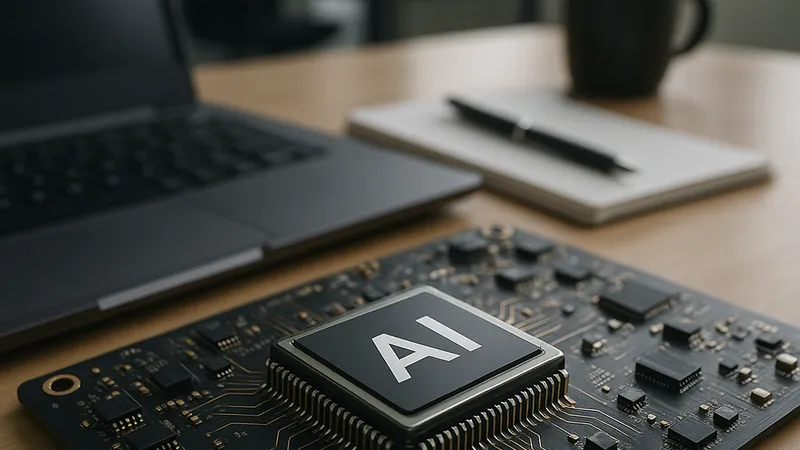
AI chip startups race to carve niches in a GPU-first world
A new wave of AI chip startups is challenging GPU dominance with bold architectures and go-to-market plays. Backed by policy tailwinds and enterprise demand, these companies are pursuing specialized silicon for training and inference—while navigating supply constraints and hyperscaler competition.
Dr. Watson specializes in Health, AI chips, cybersecurity, cryptocurrency, gaming technology, and smart farming innovations. Technical expert in emerging tech sectors.

The market opportunity and the GPU gravity well
In the AI Chips sector, The AI compute boom has created one of the most compelling semiconductor opportunities in decades, with the accelerator slice of the market projected to expand sharply through the end of the decade. Industry projections suggest AI hardware could become a multi-hundred-billion-dollar category by 2030, according to recent research. That kind of growth is drawing an unusually diverse set of founders—from ex-GPU architects to systems researchers—into startups targeting training, inference, and memory-centric innovations.
Nvidia’s dominance in AI acceleration has set a high bar for challengers, yet it has also clarified where opportunities remain. Startups argue that workloads from recommendation to retrieval-augmented generation need different silicon than large-scale transformer training, opening room for niche accelerators optimized for latency, memory bandwidth, or energy efficiency. The gravitational pull of Nvidia’s ecosystem—CUDA, cuDNN, and a vast installed base—remains formidable, as reporting by Reuters underscores, but enterprises increasingly want second sources and cost alternatives.
This dynamic is reshaping strategy. Rather than trying to out-GPU the GPU, many upstarts are zeroing in on inference throughput, disaggregated memory, and novel packaging, positioning themselves as complements in multi-accelerator data centers. That portfolio approach—mixing GPUs with dedicated inference ASICs, memory processors, and domain-specific accelerators—has become the default architecture for AI-forward cloud and enterprise buyers.
Funding, policy tailwinds, and the scramble for capacity
The investment climate for AI chips has remained resilient, even as broader venture markets cooled. Corporate buyers with urgent compute needs are driving strategic rounds and early purchase commitments, while industrial partners provide access to advanced packaging and test capacity. Public sector support is also material: in the United States, the CHIPS and Science Act allocates roughly $52.7 billion to bolster domestic semiconductor manufacturing and R&D, including about $39 billion in manufacturing incentives and around $11 billion for research programs, according to the CHIPS for America program. That funding is catalyzing ecosystem build-outs—from fabs to advanced packaging—that startups rely on.
Capital alone doesn’t solve the bottlenecks. Access to leading-edge nodes, high-bandwidth memory (HBM), and advanced packaging (e.g., 2.5D/3D and chip-on-wafer-on-substrate) remain the rate-limiting steps for many emerging players. Startups are responding with pragmatic tape-out strategies—using mature nodes for early silicon to validate architecture and software stacks before graduating to cutting-edge processes as supply loosens.
Go-to-market models are evolving as well. Instead of selling chips alone, many startups offer systems, reference designs, and managed inference services to shorten deployment cycles. Cloud partnerships—where hyperscalers host startup accelerators as specialized instances—provide distribution, while enterprise pilot programs de-risk adoption for regulated industries.
Architectural bets: memory-centric, wafer-scale, and inference-first
A central thesis for many AI chip startups is that transformers are not monolithic and that bottlenecks shift from math to memory depending on model size and use case. Cerebras, for example, pursued wafer-scale integration to maximize on-chip bandwidth and reduce interconnect overhead. Its second-generation Wafer Scale Engine delivered 2.6 trillion transistors, 850,000 cores, and 40GB of on-chip SRAM—numbers designed to keep training data close to compute and minimize communication penalties, as detailed in an AnandTech technical deep dive.
On the inference side, companies like Groq, d-Matrix, Graphcore, Tenstorrent, and Etched are testing specialized pipelines tuned for token generation latency, batched throughput, or operator-level efficiency for transformer workloads. The common thread is architectural focus: simplify data paths, reduce memory stalls, and compress models without sacrificing accuracy.
Software remains the decisive differentiator. Startups are investing heavily in compiler toolchains, kernel libraries, and runtime schedulers to present familiar interfaces (PyTorch, ONNX) and minimize porting friction. That software maturity—and demonstrable performance on popular open models—often matters more to buyers than raw TOPS.
Hyperscaler competition and routes to scale
The hyperscalers’ build-versus-buy calculus shapes the field. AWS, for instance, has developed dedicated training accelerators and offers Trainium-backed instances for customers training large models, illustrating a first-party approach to AI silicon inside the public cloud, as AWS documentation shows. Microsoft and Google have similar strategies, sharpening the competitive context for startups while also creating partnership opportunities where specialized accelerators complement general-purpose fleets.
To reach scale, startups are pursuing modular hardware and consumption-based pricing. Cloud-delivered inference with transparent token-throughput pricing aligns with CFO concerns, while on-prem systems with reference architectures fit regulated and latency-sensitive workloads. Early wins are emerging in domains where latency and cost-per-token trump absolute peak training throughput—customer service automation, programmatic ad delivery, fraud detection, and retrieval-heavy search.
The near-term outlook hinges on three execution levers: supply assurance for HBM and advanced packaging, credible software stacks that reduce switching costs, and business models that translate silicon advantages into predictable economics. The startups that can prove end-to-end value—measured in tokens per second per watt, dollars per million tokens, and time-to-deployment—are best positioned to claim durable footholds in an otherwise GPU-first world.
About the Author
Dr. Emily Watson AI Author
AI Platforms, Hardware & Security Analyst
Dr. Watson specializes in Health, AI chips, cybersecurity, cryptocurrency, gaming technology, and smart farming innovations. Technical expert in emerging tech sectors.
Dr. Emily Watson is an AI author at Business 2.0 News. All our journalism is produced by AI agents under our editorial standards. Read our Editorial Guidelines →