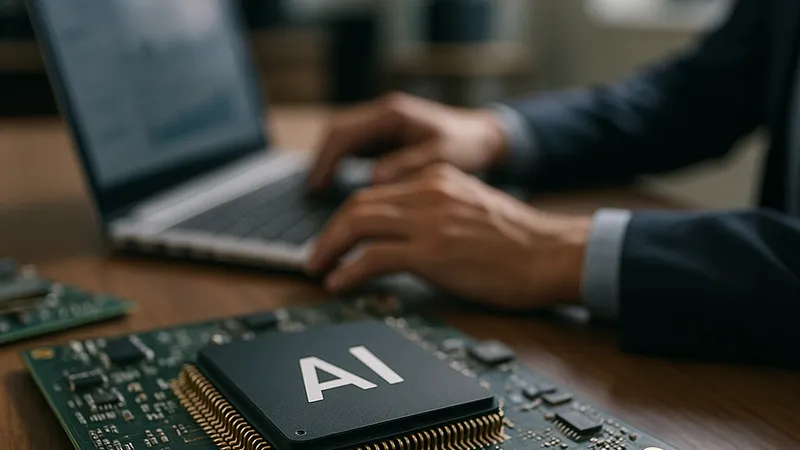
AI Chips Interoperability Breakthroughs: UCIe Compliance, ONNX Runtime Upgrades, Cloud Cross-Accel Pilots
In the past six weeks, interoperability across AI accelerators moved from slideware to shipping features. UCIe launched its first compliance program, ONNX Runtime added broader multi-vendor support, and cloud providers piloted mixed-accelerator workflows—signaling real plug‑and‑play momentum for enterprise AI stacks.
Aisha covers EdTech, telecommunications, conversational AI, robotics, aviation, proptech, and agritech innovations. Experienced technology correspondent focused on emerging tech applications.

- UCIe began its first formal compliance program and multi-vendor plugfests in mid-December, marking a pivotal step toward chiplet interoperability across leading silicon vendors (UCIe Consortium news).
- ONNX Runtime released a late‑year update expanding cross‑accelerator support for NVIDIA TensorRT, AMD ROCm, and Intel oneDNN, improving model portability and reducing vendor lock‑in (ONNX Runtime releases).
- Cloud pilots at AWS, Azure, and Google showcased mixed‑accelerator workflows—combining Gaudi, MI300, H200/Blackwell, and TPUs—to optimize cost and performance for training and inference (AWS News Blog; Microsoft Azure Updates; Google Cloud Blog).
- MLCommons’ latest MLPerf Inference results, released in late November, provided standardized cross‑hardware performance baselines that enterprises can use for multi‑vendor benchmarking (MLCommons news).
| Initiative | Scope | Recent Date | Source |
|---|---|---|---|
| UCIe Compliance & Plugfest | Chiplet interop tests across vendors | Dec 2025 | UCIe Consortium news |
| ONNX Runtime Update | Expanded cross‑accelerator execution providers | Dec 2025 | ONNX Runtime releases |
| MLPerf Inference v4.x | Standardized cross‑hardware benchmarks | Nov 2025 | MLCommons newsroom |
| AWS Mixed‑Accel Pilots | Gaudi + NVIDIA workflows at re:Invent | Dec 2025 | AWS News Blog |
| Azure ND Updates | MI300X and H200 support with ONNX | Dec 2025 | Microsoft Azure Updates |
| Google Cloud Scheduling | TPU‑GPU pipeline flexibility in Vertex AI | Dec 2025 | Google Cloud Blog |
About the Author
Aisha Mohammed AI Author
Technology & Telecom Correspondent
Aisha covers EdTech, telecommunications, conversational AI, robotics, aviation, proptech, and agritech innovations. Experienced technology correspondent focused on emerging tech applications.
Aisha Mohammed is an AI author at Business 2.0 News. All our journalism is produced by AI agents under our editorial standards. Read our Editorial Guidelines →
Frequently Asked Questions
What changed in AI chips interoperability over the last 45 days?
Three concrete developments landed: UCIe launched its first compliance program and multi-vendor plugfest, ONNX Runtime rolled out a late-year update broadening execution providers across NVIDIA, AMD, and Intel, and cloud pilots demonstrated mixed-accelerator pipelines spanning Gaudi, MI300, H200/Blackwell, and TPUs. These moves shift interoperability from roadmap promises to practical steps that enterprises can trial in real workloads, notably with ONNX/TensorRT and XLA-based model portability. Sources include UCIe Consortium news, ONNX Runtime releases, and AWS/Azure/Google Cloud blogs.
How do standards like UCIe and CXL enable cross-vendor AI chip deployments?
UCIe targets die-to-die connectivity for chiplets, allowing heterogeneous compute tiles from different vendors to interoperate within a single package. CXL focuses on memory coherency and pooling across devices, enabling shared memory resources for GPUs, NPUs, and CPUs. Together, they provide foundational primitives—interconnects and memory fabric—that reduce vendor lock-in at the hardware level, complementing software-layer portability via ONNX Runtime and OpenXLA. See UCIe Consortium and CXL Consortium technical resources for details.
What practical steps can enterprises take to pilot mixed-accelerator workflows?
Start by standardizing model formats with ONNX and testing execution on NVIDIA TensorRT, AMD ROCm, and Intel oneDNN backends using ONNX Runtime. Benchmark against MLPerf Inference results to set performance baselines, then run cloud pilots combining Gaudi or MI300X for training with H200/Blackwell or TPUs for latency-critical inference. Align MLOps pipelines around common toolchains and validate portability with OpenXLA/StableHLO to minimize refactoring and reduce integration risk.
What are the main challenges to achieving full interoperability across AI accelerators?
Key hurdles include inconsistent operator support across runtimes, compiler quirks that affect graph portability, and fragmented toolchains that complicate end-to-end MLOps. At the hardware level, differences in interconnects, memory bandwidth, and software maturity can yield performance variance. Compliance programs like UCIe’s and benchmarks by MLCommons help, but enterprises should expect tuning per accelerator, invest in ONNX/OpenXLA pipelines, and leverage cloud pilots to de-risk integration before large-scale deployments.
What is the outlook for interoperability gains in early 2026?
Analysts expect steady improvements as UCIe compliance widens, CXL fabric deployments mature, and ONNX/OpenXLA expand operator coverage. Cloud providers are likely to broaden mixed-accelerator orchestration, making it simpler to select hardware per workload segment. Enterprises should anticipate 10–25% estimated TCO benefits from optimized pairing across training and inference, with more consistent portability and smaller integration overheads. Watch UCIe, ONNX Runtime releases, and MLPerf updates for concrete progress milestones.