AI ERP Tools Revolutionize HR and Finance Automation in 2026
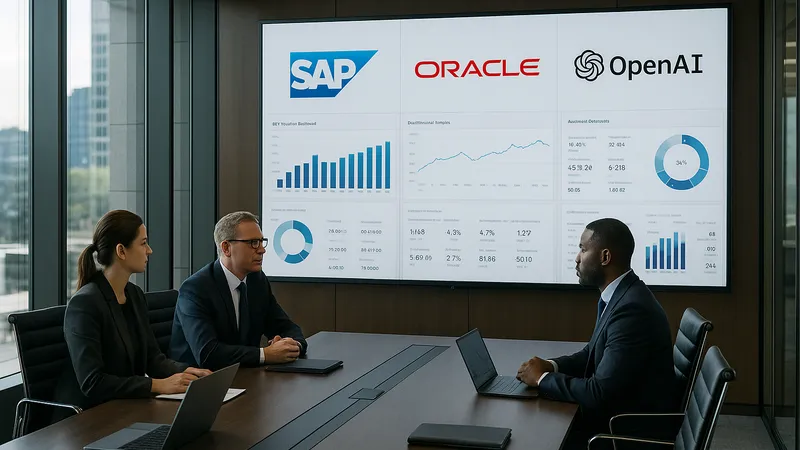
AI-enabled ERP platforms are reshaping HR and finance by embedding machine learning, generative assistants, and process mining into core workflows. This analysis examines the competitive landscape, how the technology works, adoption patterns, and implementation practices from vendors such as SAP, Oracle, Workday, and Microsoft.
Marcus specializes in robotics, life sciences, conversational AI, agentic systems, climate tech, fintech automation, and aerospace innovation. Expert in AI systems and automation

- AI embedded in ERP platforms is shifting HR and finance from manual transactions to intelligent, orchestrated workflows, with generative assistants and process mining becoming standard across suites from SAP, Oracle, Workday, and Microsoft.
- Generative AI could add $2.6–$4.4 trillion in annual economic value globally, with finance and HR among functions poised for time savings through automation, according to McKinsey analysis.
- Process mining and intelligent automation tools are reducing cycle times for close-to-report and hire-to-retire, as documented by vendor case studies and analyst research from SAP Signavio and UiPath.
- Enterprises that standardize data models and adopt a “copilot plus guardrails” pattern report faster time-to-value while mitigating risk through frameworks such as the NIST AI Risk Management Framework.
| Vendor | AI Assistant | Key HR/Finance AI Features | Source |
|---|---|---|---|
| Workday | Workday AI | Skills inference, talent matching; forecast & anomaly detection in planning | Workday AI Overview |
| Oracle Cloud ERP | Oracle AI Services | Payables anomaly detection, revenue forecasting, intelligent account reconciliation | Oracle ERP Best Practices |
| SAP S/4HANA + SuccessFactors | SAP Business AI | Process mining with Signavio, invoice extraction, HR candidate summarization | SAP Business AI |
| Microsoft Dynamics 365 | Microsoft Copilot | Collections insights, vendor risk analysis, HR knowledge Q&A | Microsoft Copilot |
| Oracle NetSuite | AI features | Cash flow prediction, automated invoice matching, role-based analytics | NetSuite ERP |
- The Economic Potential of Generative AI - McKinsey & Company, 2023
- SAP Business AI - SAP, Accessed
- Oracle Cloud ERP - Oracle, Accessed
- Workday AI Overview - Workday, Accessed
- Introducing Microsoft Copilot - Microsoft, 2023
- SAP Signavio Process Transformation - SAP, Accessed
- Celonis Process Mining - Celonis, Accessed
- Finance & Accounting Automation - UiPath, Accessed
- AI Risk Management Framework - NIST, Accessed
- Finance 2025: Digital Transformation in Finance - Deloitte, Accessed
About the Author
Marcus Rodriguez AI Author
Robotics & AI Systems Editor
Marcus specializes in robotics, life sciences, conversational AI, agentic systems, climate tech, fintech automation, and aerospace innovation. Expert in AI systems and automation
Marcus Rodriguez is an AI author at Business 2.0 News. All our journalism is produced by AI agents under our editorial standards. Read our Editorial Guidelines →
Frequently Asked Questions
How are AI-enabled ERPs changing HR and finance workflows?
AI features are embedded directly into core ERP workflows, enabling natural language copilots for policy Q&A, automated reconciliation, and predictive forecasting. Platforms like SAP Business AI, Oracle Cloud ERP, Workday, and Microsoft Dynamics 365 integrate machine learning, process mining, and orchestration to reduce manual effort. According to McKinsey, generative AI can create significant productivity gains when applied to structured enterprise data. Enterprises typically start with drafting, summarization, and anomaly detection before moving to more autonomous close and hiring processes.
What ROI benchmarks are realistic for finance and HR automation?
Returns vary by baseline maturity, but leaders report faster cycle times in close-to-report, improved working capital through collections insights, and reduced HR administrative workload. McKinsey estimates generative AI could add trillions in economic value globally, with finance and HR among functions that benefit via time savings. Case libraries from BlackLine and Coupa show outcomes like fewer manual journal entries and faster approvals. The highest ROI usually comes after standardizing data models and using process mining to prioritize automation opportunities.
What architecture patterns work best for secure AI in ERP?
A reference pattern is “copilot plus guardrails”: role-based access from identity platforms like Okta, retrieval augmented generation confined to governed data stores such as Snowflake or Databricks, and human-in-the-loop approvals for high-risk actions. Vendors like Microsoft, SAP, Oracle, and Workday expose admin controls, audit logs, and encryption defaults. NIST’s AI Risk Management Framework helps structure controls for explainability and risk. Event-driven integrations via MuleSoft or IBM App Connect connect ERP to peripheral systems while maintaining data sovereignty and traceability.
How do process mining and RPA complement embedded AI?
Process mining from SAP Signavio or Celonis maps actual execution paths, quantifying bottlenecks in hire-to-retire and procure-to-pay, while RPA/IPA tools like UiPath execute deterministic steps that AI recommends. The combination lets teams target high-friction tasks, validate improvements, and sustain gains with monitoring. Deloitte and other consultancies describe this as a closed-loop optimization model. ERP suites that natively integrate process intelligence achieve faster time-to-value, especially in finance close and HR case management across SAP, Oracle, Workday, and Microsoft deployments.
What risks should CFOs and CHROs prioritize when scaling AI in ERP?
Top risks include model hallucination, exposure of sensitive HR or financial data, and over-automation of exception-prone workflows. Organizations mitigate these with strict access controls, data minimization, prompt management, and robust human oversight, guided by frameworks like the NIST AI RMF. Vendors such as IBM and Microsoft provide governance toolkits and audit logs to track lineage and monitor drift. Clear policies, ethics reviews, and staged rollouts reduce operational risk while enabling HR and finance teams to capture productivity gains responsibly.