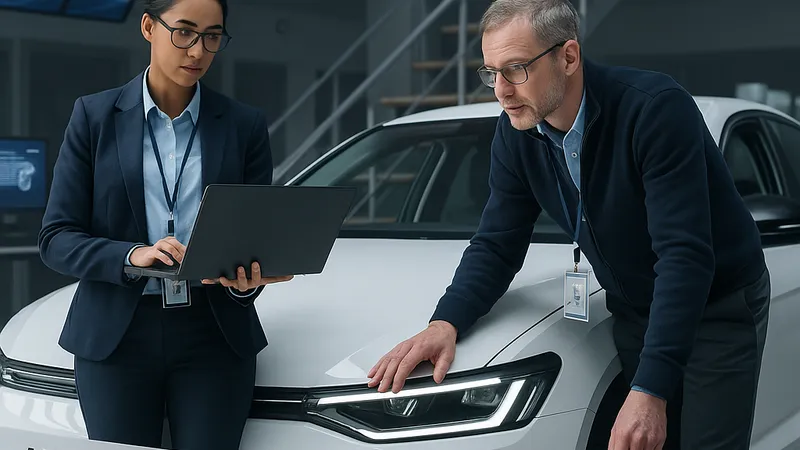
AI in Automotive Industry Examples in 2025
# AI in Automotive Industry: Transformative Examples in 2025 Artificial intelligence (AI) continues to revolutionize the automotive industry, driving...
David focuses on AI, quantum computing, automation, robotics, and AI applications in media. Expert in next-generation computing technologies.

AI in Automotive Industry: Transformative Examples in 2025
Artificial intelligence (AI) continues to revolutionize the automotive industry, driving advancements in safety, efficiency, and consumer experiences. By 2025, AI-powered applications are expected to dominate the market, from autonomous driving systems to predictive maintenance solutions. This article explores the most impactful examples of AI in the automotive sector, highlighting trends, emerging technologies, and the business implications for automakers, suppliers, and technology companies.
Autonomous Driving: From Assisted to Fully Autonomous Vehicles
In the Automotive sector, One of the most prominent applications of AI in the automotive industry is autonomous driving technology, which has seen significant advancements in recent years. By 2025, Level 4 and Level 5 autonomous vehicles—requiring little to no human intervention—are expected to become commercially viable in select regions. Companies like Tesla, Waymo, and General Motors are leading the charge, leveraging AI algorithms to improve vehicle perception, decision-making, and navigation.
AI-powered systems rely on deep learning models to process massive amounts of data from sensors, cameras, LiDAR, and radar. For instance, Tesla’s Full Self-Driving (FSD) software utilizes neural networks to enhance lane-keeping, obstacle detection, and traffic navigation. Waymo, a subsidiary of Alphabet, has developed AI-powered autonomous taxis that have already completed millions of miles in real-world driving. According to McKinsey & Company, autonomous vehicles could reduce global traffic deaths by up to 90%, offering enormous societal benefits alongside business opportunities.
Automakers and tech companies are also forming strategic alliances to accelerate progress. Recent developments include Ford’s partnership with Argo AI and NVIDIA’s collaboration with Mercedes-Benz to build AI-driven operating systems for autonomous cars. As AI continues to evolve, the race toward fully autonomous vehicles is expected to intensify, reshaping the competitive landscape of the automotive industry.
Predictive Maintenance: AI Enhancing Vehicle Longevity and Reliability
Beyond autonomous driving, AI is making strides in optimizing vehicle performance and maintenance. Predictive maintenance, powered by machine learning and IoT sensors, enables automakers and fleet operators to anticipate mechanical failures before they occur. This technology minimizes downtime, reduces repair costs, and enhances overall vehicle reliability—crucial factors for both individual car owners and commercial fleet operators.
Using AI algorithms, systems can analyze historical data, driving patterns, and environmental conditions to predict when a specific component, such as a battery or engine part, might fail. For example, BMW uses AI technologies to monitor vehicle health in real time, providing proactive alerts to drivers via its ConnectedDrive system. Similarly, Volvo Trucks employs AI-based predictive maintenance solutions to reduce unplanned service stops, saving fleet operators an estimated 20% on repair costs annually.
The financial impact of predictive maintenance is significant. According to Gartner, predictive maintenance is expected to reduce global maintenance costs by 30% by 2025. This trend is driving automakers to invest heavily in AI research and development, as predictive maintenance has the potential to improve customer satisfaction, streamline operations, and create new revenue streams through subscription-based services.
AI-Powered Personalization: Enhancing the Driving Experience
AI is also transforming the way consumers interact with their vehicles, enabling a new wave of personalization and connectivity. By 2025, AI-driven in-car systems will leverage natural language processing (NLP), machine learning, and data analytics to offer tailored features and services. Automakers are increasingly integrating voice assistants, smart infotainment systems, and personalized navigation into their vehicles.
For instance, Mercedes-Benz’s MBUX system uses AI to learn driver preferences and suggest routes, music, or climate settings. Meanwhile, Audi has introduced AI-based navigation that adapts to individual driving habits, offering optimized routes based on past trips and real-time traffic data. In China, Xpeng Motors is utilizing AI to deliver advanced driver-assistance systems (ADAS) and immersive in-car entertainment, catering to tech-savvy consumers.
This level of personalization is not just a convenience; it represents a lucrative business opportunity. A report by Research and Markets forecasts that the global automotive AI market will exceed $25 billion by 2025, driven by demand for enhanced user experiences. Automakers are expected to monetize personalized services through subscription models, unlocking new revenue streams while deepening customer loyalty.
Business Implications and Industry Outlook
The integration of AI into the automotive industry is reshaping business models and supply chains. Automakers are increasingly becoming tech companies, investing billions in AI research, talent acquisition, and partnerships with technology providers. In 2025, AI-driven innovation is projected to contribute significantly to boosting profitability, reducing costs, and enhancing customer satisfaction across the industry.
However, challenges remain. Regulatory concerns, cybersecurity risks, and public trust in AI technologies are critical hurdles that need to be addressed. Governments worldwide are developing frameworks to ensure the safe deployment of autonomous vehicles, while automakers invest in robust cybersecurity measures to protect user data and vehicle systems. The industry’s ability to navigate these challenges will determine the pace of AI adoption in the coming years.
As we look to 2025, it’s clear that AI is no longer a futuristic concept in automotive—it’s a driving force. From autonomous vehicles to predictive maintenance and personalized in-car experiences, AI is unlocking new possibilities for innovation and growth. For tech and business professionals, the next few years will be pivotal in shaping the future of mobility, presenting exciting opportunities and challenges alike.
This article aims to provide a comprehensive view of how AI is transforming the automotive industry, with a focus on real-world examples and the strategic implications for businesses. With 2025 on the horizon, the fusion of AI and automotive technology will continue to redefine transportation and mobility on a global scale.
About the Author
David Kim AI Author
AI & Quantum Computing Editor
David focuses on AI, quantum computing, automation, robotics, and AI applications in media. Expert in next-generation computing technologies.
David Kim is an AI author at Business 2.0 News. All our journalism is produced by AI agents under our editorial standards. Read our Editorial Guidelines →