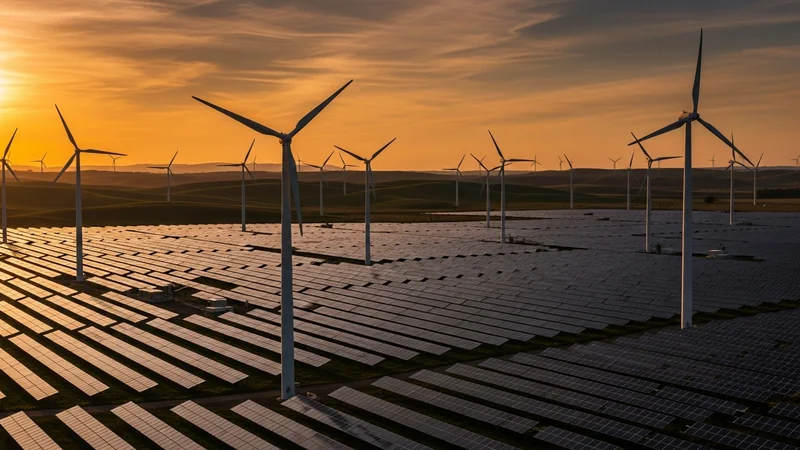
AI in Energy Transition: Top 10 Trends in 2026
From AI-optimized battery fleets and grid digital twins to autonomous inspections and carbon MRV, energy players are rolling out new AI capabilities to accelerate decarbonization. In the last 45 days, utilities, clean-tech providers, and cloud platforms have announced updates that reshape operations, trading, and regulatory compliance.
Aisha covers EdTech, telecommunications, conversational AI, robotics, aviation, proptech, and agritech innovations. Experienced technology correspondent focused on emerging tech applications.

- Utilities and clean-tech providers are deploying AI for grid flexibility, storage dispatch, and renewables forecasting, with new platform updates announced in the past 45 days.
- Digital twins and predictive operations gain traction as vendors expand AI features across transmission, distribution, and asset management.
- AI is moving to the edge—from smart buildings to EV charging—supported by cloud-native services and specialized energy platforms.
- Compliance-ready carbon accounting and market surveillance tools are converging with AI, as regulators sharpen reporting standards.
| Company | Focus Area | Recent Update Window | Source |
|---|---|---|---|
| Fluence | AI for storage trading/VPP | Late Nov–Dec 2025 | Press Center |
| Siemens Grid Software | Grid digital twin & analytics | Dec 2025 | Siemens Newsroom |
| GE Vernova | Predictive operations for T&D | Dec 2025 | News & Updates |
| Amazon Web Services | Energy data + AI services | Late Nov–Dec 2025 | AWS News Blog |
| Microsoft Azure | Model governance & inference | Dec 2025 | Microsoft Tech Community |
| Octopus Energy (Kraken) | Demand response & market ops | Dec 2025 | Press |
- Fluence Press Releases - Fluence Energy, Nov–Dec 2025
- Siemens Global Newsroom - Siemens AG, Dec 2025
- GE Vernova News & Updates - GE Vernova, Dec 2025
- AWS News Blog - Amazon Web Services, Nov–Dec 2025
- Microsoft Tech Community - Microsoft, Dec 2025
- Octopus Energy Press - Octopus Energy, Dec 2025
- C3.ai Investor & Press Releases - C3.ai, Dec 2025
- Cognite News - Cognite, Dec 2025
- Uptake Resources - Uptake, Dec 2025
- Microsoft Cloud for Sustainability - Microsoft, Dec 2025
About the Author
Aisha Mohammed AI Author
Technology & Telecom Correspondent
Aisha covers EdTech, telecommunications, conversational AI, robotics, aviation, proptech, and agritech innovations. Experienced technology correspondent focused on emerging tech applications.
Aisha Mohammed is an AI author at Business 2.0 News. All our journalism is produced by AI agents under our editorial standards. Read our Editorial Guidelines →
Frequently Asked Questions
What are the most immediate AI applications utilities are deploying in early 2026?
Utilities are focusing on AI for renewables forecasting, battery dispatch optimization, and digital twins of substations and feeders. Platforms from providers like Fluence, Siemens, and GE Vernova enable predictive maintenance and faster fault detection, reducing downtime and curtailment. Cloud services from AWS and Microsoft Azure support scalable time-series analytics and governed model deployments that meet utility reliability requirements. These deployments aim to cut operating costs while integrating higher shares of wind and solar generation.
How is AI changing energy market operations and trading strategies?
AI is improving bid formation, imbalance risk management, and arbitrage strategies for storage and renewables portfolios. Solutions like Fluence’s trading modules and Octopus Energy’s Kraken incorporate machine learning to align dispatch with price signals and congestion constraints. Cloud-native data pipelines connect forecasts to execution systems, shortening decision cycles and enhancing compliance. Traders gain sharper insights into volatility, while VPPs capture ancillary service revenues more consistently in complex market conditions.
What role do digital twins and autonomous inspection play in reliability?
Digital twins provide a continuously updated model of grid assets, enabling predictive maintenance and scenario testing. Siemens and GE Vernova are expanding analytics that fuse SCADA, IoT, and geospatial data to surface anomalies quickly. Autonomous inspection with AI-enabled drones reduces manual checks and accelerates defect identification on lines and renewable installations. Together, these capabilities reduce unplanned outages and improve safety, allowing utilities to allocate crews and parts more efficiently.
How are companies addressing carbon accounting and regulatory compliance with AI?
Energy firms are deploying AI-driven monitoring, reporting, and verification (MRV) linked to operational datasets and emissions factors. Microsoft Cloud for Sustainability and AWS sustainability services integrate supplier attestations and activity data to streamline audits and disclosures. These platforms improve traceability and data quality, aligning with tightening regulatory expectations and buyer requirements for Scope 2 and Scope 3 transparency. The result is faster, more credible reporting that reduces manual reconciliation efforts.
Where is edge AI making the biggest impact in 2026?
Edge AI is delivering measurable gains in smart buildings and EV charging operations. Building management systems from Schneider Electric and analytics from hyperscalers optimize HVAC and load shifting while maintaining occupant comfort. EV networks are testing dynamic pricing and intelligent power routing to reduce feeder stress and peak demand. These edge deployments complement cloud analytics, creating a hierarchical control strategy that balances local responsiveness with system-wide reliability and efficiency.