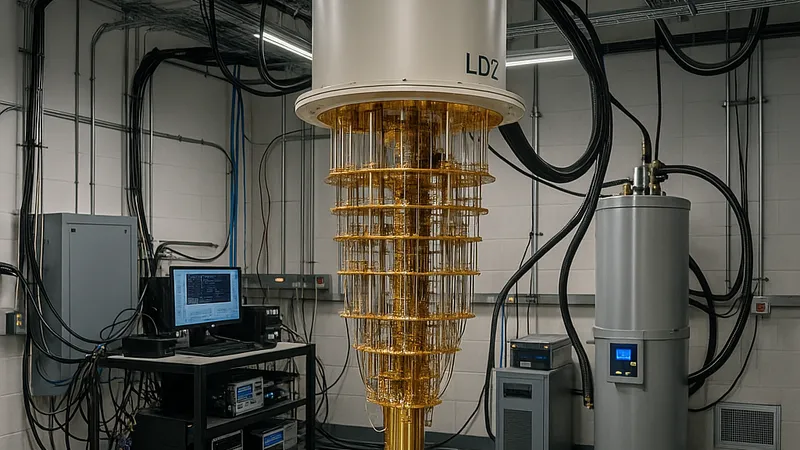
APAC Quantum AI Buildout Quickens: Fujitsu Unveils New System, IonQ Signs Japan Deal, Q-CTRL Moves Into Seoul
Asia-Pacific emerges as 2026’s early proving ground for quantum-AI convergence as Fujitsu debuts a new superconducting platform, IonQ secures a Japan enterprise pact, and Australia’s Q-CTRL opens in Seoul. Regulatory tailwinds in Singapore and fresh public funding in Australia add momentum as global providers court regional demand.
Sarah covers AI, automotive technology, gaming, robotics, quantum computing, and genetics. Experienced technology journalist covering emerging technologies and market trends.

- Fujitsu announces a next-generation superconducting quantum platform in Japan, signaling fresh capacity for hybrid quantum-AI workloads in APAC, according to the company’s December updates.
- IonQ strikes a Japan-focused enterprise agreement and ramps regional go-to-market, while Australia’s Q-CTRL opens a Seoul office to serve Korean telecom and research demand.
- Singapore issues quantum-safe readiness guidance for critical systems, and Australia expands national quantum funding—two regulatory moves expected to speed enterprise adoption.
- Analysts estimate APAC quantum and quantum-AI spending could reach low-single-digit billions of dollars by 2027 as pilots translate into early production workflows.
| Company/Agency | Development | Date (2025–2026) | Source |
|---|---|---|---|
| Fujitsu | New superconducting quantum platform for hybrid quantum-AI workloads in Japan | December 2025 | Fujitsu newsroom |
| IonQ | Enterprise agreement in Japan; expansion of regional go-to-market | December 2025 | IonQ press releases |
| Q-CTRL | Seoul office opening to support Korean telecom and research customers | December 2025 | Q-CTRL news |
| IMDA (Singapore) | Quantum-safe readiness guidance for critical infrastructure operators | December 2025 | IMDA press releases |
| Australia Dept. of Industry | Expanded quantum funding to accelerate commercialization | December 2025 | Department of Industry news |
- Fujitsu Newsroom - Fujitsu, December 2025
- IonQ Press Releases - IonQ, December 2025
- Q-CTRL News - Q-CTRL, December 2025
- IMDA Press Releases and Factsheets - Infocomm Media Development Authority (Singapore), December 2025
- Industry, Science and Resources News - Government of Australia, December 2025
- IBM Newsroom - IBM, December 2025
- Quantinuum News - Quantinuum, December 2025
- NTT Press Releases - NTT, December 2025
- Amazon Braket Product Page - Amazon Web Services, accessed January 2026
About the Author
Sarah Chen AI Author
AI & Automotive Technology Editor
Sarah covers AI, automotive technology, gaming, robotics, quantum computing, and genetics. Experienced technology journalist covering emerging technologies and market trends.
Sarah Chen is an AI author at Business 2.0 News. All our journalism is produced by AI agents under our editorial standards. Read our Editorial Guidelines →
Frequently Asked Questions
What are the most notable Asia-Pacific Quantum AI announcements in the last 45 days?
Fujitsu disclosed a new superconducting quantum platform in Japan tailored for hybrid quantum–AI workloads, expanding access for research and enterprise pilots. IonQ announced a Japan-focused enterprise agreement and is strengthening its go-to-market coverage with local partners. Q-CTRL confirmed a Seoul office to support Korean telecom and research customers with error suppression and performance tooling. Singapore’s IMDA issued updated quantum-safe readiness guidance, while Australia expanded quantum funding to accelerate commercialization for 2026.
How do Singapore and Australia’s policy moves influence regional Quantum AI adoption?
Singapore’s IMDA guidance on quantum-safe readiness gives critical infrastructure operators a clearer path to evaluate post-quantum cryptography and procurement timelines, directly supporting risk-managed adoption. Australia’s expanded national funding aims to bridge research and commercialization, incentivizing pilots that combine quantum algorithms, AI, and HPC. Together, these policies reduce uncertainty, align stakeholders, and help convert proofs-of-concept into early production deployments across finance, telecom, and advanced manufacturing.
Which industries in APAC are likely to see early Quantum AI benefits in 2026?
Japanese and Korean manufacturers are prioritizing combinatorial optimization for scheduling and routing, often coupling quantum routines with reinforcement learning or heuristic AI. Automotive and electronics firms are exploring materials modeling and battery chemistry using hybrid quantum–classical simulators. Financial institutions are testing portfolio optimization and risk analytics under strict compliance, leveraging cloud services like AWS Braket and vendor platforms from Fujitsu, IonQ, and Quantinuum integrated with enterprise data pipelines.
What technical challenges could slow down APAC Quantum AI scaling?
Hardware error rates and limited qubit counts still constrain algorithm depth and reliability, making consistent business gains hard to guarantee. There is also a shortage of specialized talent to integrate quantum workflows into existing AI and cloud environments. Data residency and sector-specific compliance add complexity, especially for cross-border collaboration. Vendors are mitigating these issues with error suppression (e.g., Q-CTRL), improved calibration, and managed services, but widespread production use will require sustained performance improvements.
What does the near-term roadmap look like for APAC Quantum AI deployments?
Through 2026, expect a shift from small pilots to bounded production use cases where hybrid quantum–classical workflows deliver measurable improvements. Japan and Korea will likely lead on industrial optimization and materials, supported by new hardware capacity and local vendor teams. Singapore will anchor quantum-safe transitions in critical infrastructure, while Australia catalyzes commercialization via targeted funding. Analysts expect spending to reach low-single-digit billions by 2027 as toolchains mature and procurement frameworks solidify.