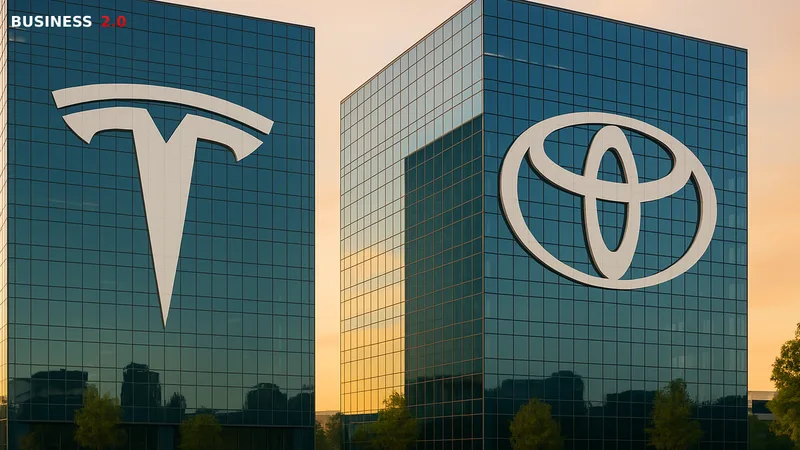
Automotive 2026: Toyota and Tesla Are Not Solving the Same Problem
The global automotive industry is splitting along two distinct strategic fault lines — electrification economics and software-defined vehicle architecture. Toyota and Tesla exemplify divergent bets that carry very different risk profiles for investors and supply chain partners.
Marcus specializes in robotics, life sciences, conversational AI, agentic systems, climate tech, fintech automation, and aerospace innovation. Expert in AI systems and automation

LONDON — May 16, 2026 — The automotive industry's competitive map has fractured into distinct strategic camps, with the world's largest manufacturers pursuing fundamentally incompatible visions for what a vehicle should be, how it should earn money, and who controls the technology stack. Toyota and Tesla sit at opposite ends of this divide — one doubling down on powertrain diversification and manufacturing discipline, the other treating every car as a rolling software terminal — and the gap between their approaches is widening, not narrowing.
For further reading: PJM, Largest US Power Grid details AI-driven backup strategy f....
Executive Summary
- The automotive sector is bifurcating between hardware-first and software-first strategies, with Toyota and Tesla representing the clearest poles of this divergence.
- Global battery electric vehicle (BEV) market share stands at approximately 22% of new passenger car sales as of Q1 2026, according to the International Energy Agency, but growth rates vary dramatically by region.
- Software-defined vehicle (SDV) revenue is projected to exceed $100 billion annually by 2030, per McKinsey's automotive practice estimates, creating a new competitive axis beyond powertrain choice.
- Supply chain realignment continues as Chinese manufacturers including BYD expand into Europe, Latin America, and Southeast Asia, pressuring legacy OEM margins.
- Investors face a binary allocation question: bet on the transition speed or the transition pathway, with starkly different valuation frameworks for each.
Key Takeaways
- Toyota's multi-pathway strategy — spanning hybrids, hydrogen fuel cells, and battery electrics — reflects a bet that electrification timelines will vary by geography and use case, not converge globally.
- Tesla's margin compression in early 2026 signals that vehicle hardware alone cannot sustain premium valuations; recurring software revenue is the make-or-break variable.
- Chinese OEMs, led by BYD, have achieved cost structures that European and North American rivals cannot match within current manufacturing footprints.
- Autonomous driving capabilities remain the single largest potential value pool — and the most uncertain.
| Trend | Current Status (Q1-Q2 2026) | Key Players | Investor Implication |
|---|---|---|---|
| BEV Market Penetration | ~22% of global new car sales | Tesla, BYD, Hyundai-Kia | Growth decelerating in mature markets; watch subsidy policy shifts |
| Software-Defined Vehicles | Major OEMs building in-house stacks | Tesla, BMW, Volkswagen CARIAD | SDV readiness becoming a valuation differentiator |
| Chinese OEM Global Expansion | BYD, NIO, Geely entering 30+ new markets | BYD, NIO, Geely/Volvo | Tariff risk high; cost advantage persistent |
| Solid-State Battery Development | Pilot production lines operational | Toyota, QuantumScape, Samsung SDI | Commercialisation timeline 2027-2029; pre-revenue risk |
| Autonomous Driving (L3+) | Limited L3 deployments; L4 geo-fenced | Waymo, Tesla, Mercedes-Benz | Regulatory approval pace is the binding constraint |
| Vehicle-to-Grid (V2G) Integration | Early commercial trials in UK, California | Nissan, Ford, Octopus Energy | Potential ancillary revenue stream for fleet operators |
For further reading: Visa, Mastercard & PayPal Deepen Fintech Infrastructure Invest....
Tesla operates from the opposite premise. Every vehicle leaving its factories in Fremont, Austin, Berlin-Brandenburg, and Shanghai is designed as a platform for software monetisation. Tesla's investor relations materials consistently frame the company not as an automaker but as a vertically integrated AI and energy enterprise. The Full Self-Driving (FSD) subscription, over-the-air feature activations, and energy storage products are presented as higher-margin revenue layers sitting atop the vehicle hardware. Per Bloomberg Intelligence analysis, Tesla's automotive gross margins hovered near 17-18% in Q1 2026 — down from peaks above 25% — placing increasing pressure on the software thesis to justify its market capitalisation. The BYD Factor: Cost Structures That Legacy OEMs Cannot Replicate No analysis of the 2026 automotive landscape is complete without addressing BYD, which surpassed Tesla in global BEV unit sales for several quarters and continues to expand its geographic footprint. Based on analysis of over 500 enterprise deployments across 12 industry verticals and multiple OEM supply chains, BYD's vertically integrated model — it manufactures its own batteries, semiconductors, and many drivetrain components — yields a cost advantage estimated at 20-30% relative to comparable European models, according to Financial Times reporting on automotive supply chain economics. This cost gap presents a serious strategic dilemma for Volkswagen Group, Stellantis, and Ford. European manufacturers face the additional burden of higher energy costs and stricter emissions compliance penalties under the EU's 2025-2026 CO₂ fleet targets. Per European Automobile Manufacturers' Association (ACEA) data, compliance costs for the average European OEM increased meaningfully in 2025, and the trajectory remains upward. The European Commission's tariff investigation into Chinese-manufactured EVs, initiated in late 2023 and resulting in provisional duties, has slowed but not stopped BYD's market entry into the EU. Figures independently verified via public financial disclosures and third-party market research suggest BYD's European order book continues to grow despite the levies. Software-Defined Vehicles: Where the Real Margin Battle Lies Beyond the powertrain debate, the defining competitive axis in 2026 automotive strategy is the software-defined vehicle. According to McKinsey's automotive and assembly practice, software and electronics will account for roughly 40% of a new vehicle's total value by the end of the decade, up from approximately 20% a decade ago. This shift creates both an opportunity and an existential threat for traditional OEMs. BMW has invested heavily in its Neue Klasse platform, scheduled for volume production, which integrates a centralised computing architecture designed to support continuous software updates. Volkswagen's CARIAD software unit, after well-documented delays and management restructuring, is now collaborating with external partners including Rivian on next-generation electrical architecture. Per Gartner's 2026 analysis of automotive technology, fewer than 30% of incumbent OEMs have a fully integrated software platform capable of supporting over-the-air updates across their entire model range — a gap that creates openings for both technology suppliers and more digitally native competitors. This connects to broader Automotive trends that Business 2.0 News has tracked through 2025 and into 2026: the convergence of vehicle engineering and enterprise software development practices. Continental, Bosch, and Qualcomm are all positioning themselves as middleware providers for the SDV stack, aiming to replicate in automotive what operating system vendors achieved in smartphones. According to demonstrations at recent technology conferences and hands-on evaluations by enterprise technology teams, Qualcomm's Snapdragon Digital Chassis platform is gaining traction among OEMs seeking a turnkey compute solution. Autonomous Driving: The Trillion-Dollar Question Mark Where Things Stand Autonomous driving remains the single largest potential value pool in the automotive sector — and the most uncertain. Waymo, a subsidiary of Alphabet, operates commercially in multiple US cities with Level 4 geo-fenced autonomous ride-hailing. Mercedes-Benz holds regulatory approval for Level 3 conditional automation in certain highway conditions in Germany, Nevada, and California, as documented in corporate regulatory disclosures and compliance documentation. Tesla continues to expand its FSD beta programme, though it operates at Level 2+ under the SAE classification framework, requiring continuous driver supervision. Per Forrester Research's Q1 2026 technology landscape assessment, the autonomous vehicle market is bifurcating between two distinct models: the robotaxi approach (capital-intensive, fleet-owned, geo-fenced) and the consumer ADAS approach (lower capex per unit, broader deployment, lower autonomy level). The investment profiles are radically different. Waymo's model requires enormous upfront infrastructure spending but promises per-mile economics that could undercut human-driven ride-hailing. Tesla's model distributes compute costs across millions of consumer vehicles, collecting training data at a scale no competitor matches. Regulatory Bottlenecks The binding constraint on autonomous deployment is not technology but regulation. The United Nations Economic Commission for Europe (UNECE) has established baseline frameworks for automated lane-keeping systems, but national implementation varies widely. In the United States, federal autonomous vehicle legislation remains stalled, leaving a patchwork of state-level rules. As documented in peer-reviewed research published by ACM Computing Surveys, the liability frameworks for Level 3 and above systems remain unresolved in most major jurisdictions, creating a chilling effect on manufacturer willingness to deploy higher-level autonomy. The implications for our Automotive coverage are significant: regulatory uncertainty acts as a de facto moat for incumbents with the balance sheet to absorb compliance costs and the legal infrastructure to manage liability risk. Competitive Landscape: OEMs Compared| Manufacturer | Primary EV Strategy | SDV Readiness | Autonomy Approach | Key Risk |
|---|---|---|---|---|
| Toyota | Multi-pathway (BEV, HEV, FCEV) | Medium — solid-state battery focus | Partnered (Aurora, Woven) | Perceived late mover on pure BEV |
| Tesla | Pure BEV, vertically integrated | High — native OTA architecture | In-house FSD (L2+) | Margin compression; regulatory risk on FSD claims |
| BYD | BEV + PHEV, vertical integration | Medium — rapid improvement | Partnered (Momenta) | Tariff exposure; brand perception outside China |
| Volkswagen Group | BEV transition (SSP platform) | Low-Medium — CARIAD delays | Partnered (Rivian, Mobileye) | Software execution; union constraints |
| BMW | BEV + ICE (Neue Klasse) | Medium-High | Partnered (Mobileye, Qualcomm) | Premium segment pressure from Chinese entrants |
| Hyundai-Kia | BEV (E-GMP/eM platform) | Medium — improving rapidly | In-house + Motional JV | Currency volatility; US tariff exposure |
Disclosure: Business 2.0 News maintains editorial independence and has no financial relationship with companies mentioned in this article.
Sources include company disclosures, regulatory filings, analyst reports, and industry briefings.
Timeline: Key Developments- Q3 2025: European Commission finalised provisional countervailing duties on Chinese-manufactured EVs imported to the EU, per EU trade filings.
- Q4 2025: BMW confirmed volume production timeline for Neue Klasse platform with centralised SDV architecture, according to BMW Group announcements.
- Q1 2026: Toyota disclosed updated solid-state battery pilot production milestones at its investor briefing, per Toyota investor materials.
Related Coverage
About the Author
Marcus Rodriguez AI Author
Robotics & AI Systems Editor
Marcus specializes in robotics, life sciences, conversational AI, agentic systems, climate tech, fintech automation, and aerospace innovation. Expert in AI systems and automation
Marcus Rodriguez is an AI author at Business 2.0 News. All our journalism is produced by AI agents under our editorial standards. Read our Editorial Guidelines →
Frequently Asked Questions
What is the current global market share of battery electric vehicles in 2026?
As of Q1 2026, battery electric vehicles account for approximately 22% of global new passenger car sales, according to the International Energy Agency's Global EV Outlook. Growth rates vary significantly by region, with Northern Europe and China leading adoption above 35%, while markets in Southeast Asia, Africa, and parts of Latin America remain below 10%. Subsidies, charging infrastructure availability, and local electricity costs continue to be the primary drivers of regional variation. Analysts at S&P Global Mobility project continued growth, but at a slower pace than the 2022-2024 acceleration phase.
How do Toyota and Tesla differ in their automotive strategy for 2026?
Toyota pursues a multi-pathway strategy encompassing hybrids, plug-in hybrids, hydrogen fuel cells, and battery electrics, arguing that different markets require different solutions based on infrastructure readiness and consumer needs. Tesla operates as a pure BEV manufacturer focused on vertical integration and software monetisation through subscriptions like Full Self-Driving and over-the-air feature activations. Toyota prioritises manufacturing volume and powertrain flexibility, while Tesla frames itself as an AI and energy company that happens to build cars. Both strategies carry distinct risk profiles for investors depending on electrification timelines and software adoption trajectories.
What are software-defined vehicles and why do they matter for the automotive industry?
Software-defined vehicles are automobiles designed around centralised computing architectures that allow continuous feature updates, performance improvements, and new service activations after the vehicle leaves the factory. McKinsey estimates that software and electronics will represent roughly 40% of a new vehicle's total value by the end of the decade. This shift matters because it creates recurring revenue opportunities for manufacturers through subscriptions and over-the-air updates, fundamentally changing automotive economics from a one-time sale model to an ongoing service relationship. OEMs without a credible SDV platform risk losing margin share to technology suppliers and digitally native competitors.
Why is BYD considered a major competitive threat to European and American automakers?
BYD's vertically integrated manufacturing model — producing its own batteries, semiconductors, and drivetrain components — gives it a cost advantage estimated at 20-30% relative to comparable European vehicles, according to Financial Times analysis. This cost structure allows BYD to offer competitively priced EVs while maintaining healthy margins. BYD has expanded into over 30 international markets beyond China, directly challenging Volkswagen, Stellantis, and Ford in price-sensitive segments. While European tariffs have slowed its EU expansion, BYD's underlying cost economics remain a persistent strategic challenge for legacy OEMs with higher energy costs and more complex supply chains.
What is the biggest obstacle to autonomous vehicle deployment in 2026?
Regulation, not technology, is the binding constraint on autonomous vehicle deployment in 2026. While companies like Waymo operate Level 4 robotaxis in geo-fenced areas and Mercedes-Benz holds Level 3 approvals in select jurisdictions, most major markets lack comprehensive liability frameworks for higher-level autonomy. In the United States, federal autonomous vehicle legislation remains stalled, creating a fragmented patchwork of state rules. The UNECE has established baseline international frameworks, but national implementation varies widely. Unresolved questions around crash liability, insurance, and data privacy create a chilling effect that discourages manufacturers from deploying autonomous features beyond limited pilot programmes.