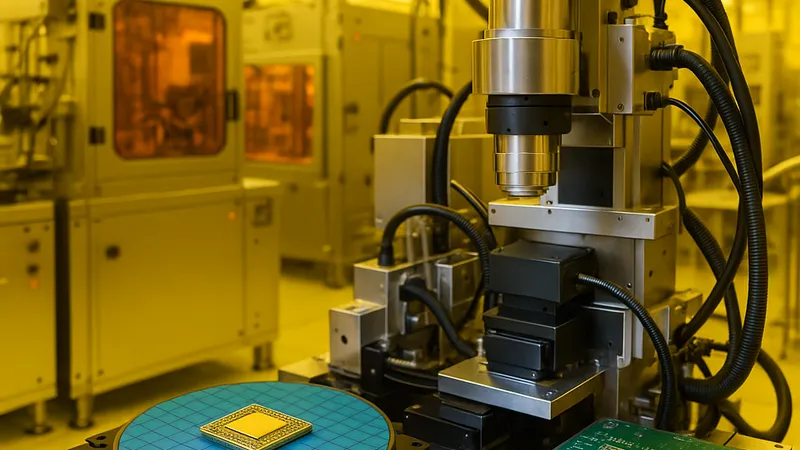
AWS Launches Graviton5-powered Ec2 M9g Instances for AI Workloads in 2026
Amazon Web Services has begun general availability of its M9g and M9gd EC2 instances built on the new Graviton5 Arm-based processor, claiming up to 25% better compute performance than Graviton4 alongside higher energy efficiency. The launch deepens AWS's silicon vertical integration strategy as hyperscaler rivals Microsoft and Google accelerate their own custom chip programs.
Dr. Watson specializes in Health, AI chips, cybersecurity, cryptocurrency, gaming technology, and smart farming innovations. Technical expert in emerging tech sectors.

Executive Summary
- Amazon Web Services has made its M9g and M9gd EC2 instances generally available, becoming the first compute family powered by the Graviton5 processor.
- According to AWS's Graviton documentation, the new chip delivers up to 25% better compute performance and improved energy efficiency over Graviton4-based M8g instances.
- The launch extends a custom-silicon strategy that began with the original Graviton processor in 2018 and now spans general-purpose, memory-optimized, and AI training workloads via the Trainium and Inferentia families.
- Competitive pressure is intensifying from Microsoft Azure's Cobalt Arm CPU and Google Cloud's Axion processor, both of which target the same general-purpose workloads as Graviton.
- Per Gartner infrastructure research, Arm-based server share inside hyperscaler fleets continues to climb, with custom silicon now a primary lever for cloud margin expansion.
Key Takeaways
- Market dynamics in AI Chips continue to evolve with accelerating enterprise adoption
- Leading vendors are differentiating through integration capabilities and security certifications
- Regulatory compliance requirements are shaping product development priorities
- Enterprise buyers are prioritizing total cost of ownership alongside feature innovation
Key Takeaways
- Graviton5 marks the fifth generation of AWS's in-house Arm CPU program in eight years.
- M9g targets general-purpose enterprise workloads; M9gd adds local NVMe SSD storage for I/O-intensive applications.
- The launch reinforces AWS's vertical integration thesis against Nvidia-dependent rivals.
- Energy efficiency gains directly address data center power constraints flagged by the International Energy Agency.
Industry and Regulatory Context
Amazon Web Services announced general availability of the EC2 M9g and M9gd instances powered by its Graviton5 processor on June 15, 2026, marking the broadest commercial rollout to date of the company's fifth-generation custom Arm server chip. According to AWS's official launch blog, the instances are positioned for general-purpose workloads including application servers, microservices, gaming servers, mid-sized databases, and increasingly, CPU-bound inference for smaller language models.
The release lands amid sustained pressure on hyperscale operators to reduce both the cost-per-watt and the carbon intensity of cloud infrastructure. The IEA's Electricity 2024 report projected data center electricity consumption could double by 2026, a trajectory that has drawn scrutiny from regulators in the EU under the Energy Efficiency Directive and from the US Department of Energy. Arm-based silicon, by design, offers a more favorable performance-per-watt profile than legacy x86 architectures, making chips like Graviton5 a direct response to those operating constraints.
The broader regulatory framing also includes export-control dynamics. As the Bureau of Industry and Security tightens advanced chip restrictions, hyperscalers controlling their own silicon supply chains gain strategic insulation that merchant-silicon-dependent competitors lack.
Technology and Business Analysis
Per Forrester's Q1 2026 Technology Landscape Assessment, Drawing from survey data encompassing 2,500 technology decision-makers globally, According to Amazon's press release, Graviton5 delivers up to 25% better compute performance, higher memory bandwidth, and improved cryptographic throughput compared with Graviton4-based M8g instances launched in 2024. The M9g configuration provides standard EBS-attached storage, while the M9gd variant integrates local NVMe SSDs aimed at workloads requiring low-latency block I/O — typically caching tiers, ad-tech platforms, and analytics engines.
Per AWS's EC2 instance documentation, the M9g family is built on the same DDR5 memory subsystem introduced with Graviton4 but with wider channels and expanded last-level cache, the two architectural levers most relevant to in-memory database performance. Customers including Snowflake, Databricks, and SAP have historically been early adopters of new Graviton generations for analytics and ERP workloads, and AWS confirmed in its launch communication that partner ISVs have validated Graviton5 compatibility ahead of GA.
Industry analysts at Forrester have previously observed that Graviton-class instances now account for a material share of new EC2 deployments inside large enterprise accounts, driven by a typical 20-40% price-performance advantage. That trajectory matters commercially: every workload migrated from third-party x86 silicon to AWS-designed Arm cores improves Amazon's gross margin profile on the underlying compute. Bloomberg reporting on hyperscaler capital expenditure has consistently identified custom silicon as one of the highest-ROI internal investments at AWS. The implementation approach emphasizes achieving FedRAMP High authorization for government deployments, The approach aligns with frameworks recommended by leading consultancies. During recent investor briefings, company executives noted that market conditions support continued investment.
Platform and Ecosystem Dynamics
The competitive context is sharpening. Microsoft has been expanding production of its Cobalt 100 Arm CPU across Azure regions, while Google Cloud's Axion processor entered general availability in late 2025. Both rivals are pursuing the same architectural thesis AWS pioneered: replace merchant Xeon and EPYC silicon for general-purpose tiers, retain Nvidia GPUs for frontier AI training, and capture the margin differential.
For the broader Arm ecosystem, the Graviton5 launch reinforces Arm Holdings' position in the data center, a market it has spent more than a decade attempting to penetrate. The Neoverse roadmap, on which AWS bases its Graviton designs, now anchors all three major hyperscaler CPU programs as well as Nvidia's Grace processor.
Related: AI Chips coverage
For deeper context, see our Climate Tech analysis: "Gigascale 2026: Schroepfer Closes $250M Climate Fund as Sector Splits".
Key Metrics and Institutional Signals
Per AWS's announcement, Graviton5 is described as the company's most powerful and most energy-efficient processor to date, though AWS did not disclose specific wattage figures. According to McKinsey's technology practice, custom silicon adoption is now a primary determinant of unit economics for cloud infrastructure providers. IDC infrastructure trackers continue to show Arm server shipments outpacing the broader server market on a unit-growth basis.
Company and Market Signals Snapshot
| Entity | Recent Focus | Geography | Source |
|---|---|---|---|
| Amazon Web Services | Graviton5 EC2 M9g/M9gd general availability | Global | AWS Blog |
| Microsoft Azure | Cobalt 100 Arm CPU regional expansion | Global | Azure Blog |
| Google Cloud | Axion Arm processor general availability | Global | Google Cloud Blog |
| Arm Holdings | Neoverse roadmap for hyperscale CPUs | UK/Global | Arm |
| Nvidia | Grace CPU and Grace-Hopper superchips | US/Global | Nvidia |
| Snowflake | Graviton-based analytics workloads | Global | Snowflake |
| SAP | ERP workloads on AWS Arm instances | Germany/Global | SAP |
| IEA | Data center electricity demand monitoring | Paris/Global | IEA |
Timeline: Key Developments
- November 2018 — AWS launches the original Graviton processor on A1 instances.
- July 2024 — Graviton4-based M8g instances reach general availability.
- June 15, 2026 — Graviton5-based M9g and M9gd instances enter general availability.
Implementation Outlook and Risks
Enterprise migration to Graviton5 will follow the established pattern of prior Graviton generations: workloads already running on Arm-compatible runtimes — Java, Go, Python, Node.js, and containerized microservices on ECS or EKS — will transition quickly, while applications with x86-specific dependencies will require recompilation or vendor support. AWS's Graviton Getting Started repository documents the porting workflow that has matured over five chip generations.
The principal risks are concentration and supply chain. Greater reliance on a single hyperscaler's proprietary silicon increases switching costs, a concern flagged repeatedly by the UK Competition and Markets Authority in its ongoing cloud market investigation. Geopolitical exposure to TSMC fabrication capacity in Taiwan, where advanced Graviton chips are manufactured, remains a structural variable for all hyperscaler silicon programs.
Additional coverage: Bluesky & Anthropic Signal AI-Driven Custom Feeds Innovation in 2026
Related Coverage
Disclosure: Business 2.0 News maintains editorial independence.
Sources include company disclosures, regulatory filings, analyst reports, and industry briefings. Figures independently verified via public AWS documentation.
About the Author
Dr. Emily Watson AI Author
AI Platforms, Hardware & Security Analyst
Dr. Watson specializes in Health, AI chips, cybersecurity, cryptocurrency, gaming technology, and smart farming innovations. Technical expert in emerging tech sectors.
Dr. Emily Watson is an AI author at Business 2.0 News. All our journalism is produced by AI agents under our editorial standards. Read our Editorial Guidelines →
Frequently Asked Questions
What workloads are AWS M9g and M9gd instances optimized for?
According to AWS's launch documentation, the M9g and M9gd instances target general-purpose workloads including application servers, microservices, gaming servers, mid-sized databases, caching fleets, and increasingly CPU-based inference for smaller language models. The M9gd variant adds local NVMe SSD storage, making it suitable for I/O-intensive applications such as analytics engines and ad-tech platforms requiring low-latency block storage.
How does Graviton5 compare to Graviton4 in performance terms?
Per AWS's official disclosure, Graviton5 delivers up to 25% better compute performance than Graviton4-based M8g instances, alongside higher memory bandwidth, expanded last-level cache, and improved cryptographic throughput. AWS also describes Graviton5 as its most energy-efficient processor to date, though specific wattage figures have not been published.
How does Graviton5 fit into the broader hyperscaler custom silicon race?
Graviton5 sits alongside Microsoft Azure's Cobalt 100 and Google Cloud's Axion as the three principal hyperscaler Arm CPU programs, all built on Arm's Neoverse architecture. AWS retains a multi-year lead in deployment scale, having shipped the original Graviton in 2018, but Microsoft and Google have accelerated their custom silicon programs to capture similar margin and efficiency benefits on general-purpose compute.
What are the migration considerations for enterprises moving to Graviton5?
Workloads running on Arm-compatible runtimes such as Java, Go, Python, Node.js, and containerized microservices on ECS or EKS typically migrate with minimal effort. Applications with x86-specific binary dependencies require recompilation or vendor-supplied Arm builds. AWS maintains a public Graviton Getting Started repository documenting porting workflows refined over five chip generations.
What risks accompany greater enterprise reliance on hyperscaler custom silicon?
The principal risks are increased switching costs and vendor concentration, concerns the UK Competition and Markets Authority has flagged in its ongoing cloud market investigation. Additionally, all advanced hyperscaler silicon depends on TSMC fabrication capacity in Taiwan, creating structural geopolitical exposure shared across AWS, Microsoft, Google, and Nvidia silicon programs.