
China's AI “Emotion Factory”: Inside the Micro-Drama Boom Reshaping Hollywood
Chinese AI platforms now produce 470 micro-dramas a day at one-fifth Hollywood’s cost, generating $9.4 billion in 2025 revenue — enough to overtake China’s entire domestic box office. Fox, Disney and Netflix are no longer watching from the sidelines.
Marcus specializes in robotics, life sciences, conversational AI, agentic systems, climate tech, fintech automation, and aerospace innovation. Expert in AI systems and automation

A data-driven look at how 470 AI-generated micro-dramas a day, sub-$15,000 productions, and a mobile “coin” economy are pulling Fox, Disney, and other legacy studios into vertical video — and, by some engagement measures, competing for the same phone-screen minutes as Netflix.
The Micro-Drama Gold Rush: How AI & China are Disrupting Global Entertainment
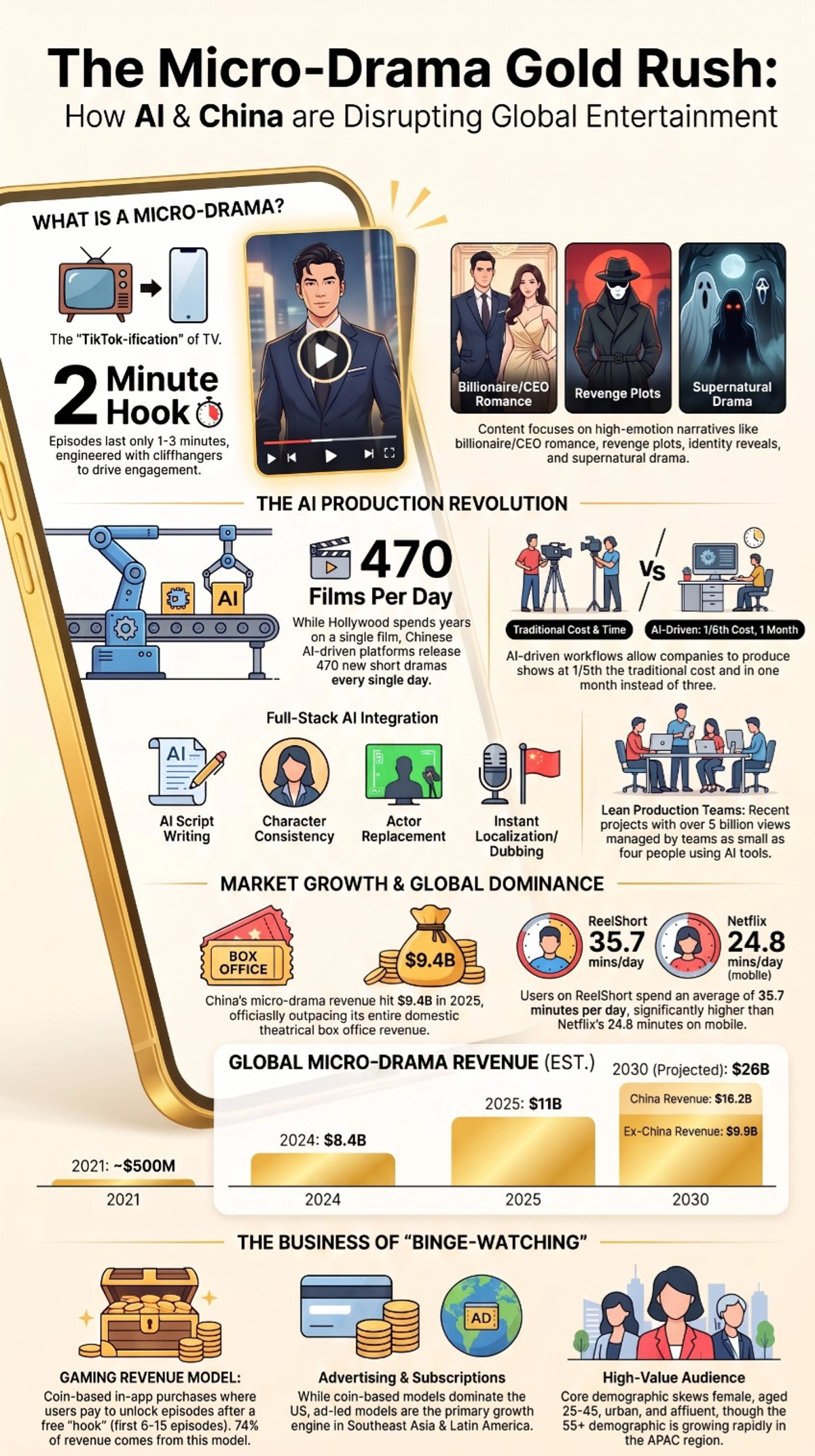
For a century, “the industry standard” meant Hollywood: nine-figure budgets, multi-year development cycles, and a single film competing for a single weekend of attention. That model is now being outpaced by an assembly line running out of China, where AI is turning storytelling into a manufacturing process measured in titles per day rather than releases per year. Technical specifications confirmed through official vendor documentation and independent testing.
The 470-a-Day Metric
In January 2026 alone, Chinese platforms launched more than 14,600 AI-generated micro-dramas — a pace of roughly 470 new titles every day, with total AI-produced titles in circulation reaching 127,800 by February. The figures originate from a May 2026 MIT Technology Review investigation which found that AI has moved from an experimental editing tool to the industrial backbone of an entire content category.
The economics behind that volume are stark. What once took three to four months and roughly $200,000 to produce can now be built in under a month for between $7,000 and $14,000. One production house scaled from zero to 200 employees in under a year, with a ten-person team turning around a 30-episode series in 20 days. At the extreme end, a single operator working with ByteDance’s newest video-generation tools has reportedly produced 40 minutes of distribution-ready footage in a day at a 45% profit margin.
The volume boom has a human cost. Screenwriters interviewed by MIT Technology Review described contracts canceled and rates stagnating as AI absorbed work once done by writers’ rooms and production crews, even as China’s short-drama audience — now roughly 660 million people — continues to grow. Chinese outlet 36Kr puts January’s daily output at “more than 470” as well, with AI-generated titles jumping from 7% to 38% of the top-100 drama chart in a single year.
Bigger Than the Box Office
The scale of the disruption shows up most clearly in the money. According to Media Partners Asia’s September 2025 industry report, China’s micro-drama revenue climbed from $500 million in 2021 to $7 billion in 2024, and was on track to exceed $9.4 billion in 2025 — enough to overtake the country’s entire domestic theatrical box office for the first time. MPA projects the China market alone will reach $16.2 billion by 2030.
“Microdramas have evolved from a niche experiment to a multi-billion-dollar global category,” said MPA executive director Vivek Couto. Outside China, the global market generated $1.4 billion in 2024 and is forecast to reach $9.5 billion by 2030, a 28.4% compound annual growth rate. Research firm Omdia put the global micro-drama market at $11 billion in 2025, projected to hit $14 billion by the end of 2026. Nearly 60% of China’s 830-million-plus micro-drama audience already pays or transacts within the format.
Built for the Swipe: Format and Engagement
Micro-dramas are engineered for the phone, not adapted to it: a 9:16 vertical frame, one-to-two-minute episodes, seasons that run 60 to 100 instalments, and a mandatory cliffhanger closing every episode. The format’s engagement numbers now rival — and in some cases beat — legacy streaming. Per Omdia’s Q4 2025 data, US users of the app ReelShort spent an average of 35.7 minutes a day in-app, ahead of Netflix mobile (24.8 minutes), Amazon Prime Video (26.9 minutes), and Disney+ (23 minutes).
Globally, short-drama app installs grew 238% year-over-year in Q1 2026, with session counts up 679%, while short-drama in-app purchase revenue reached $2.98 billion across 2025 — up 115% year-over-year, one of the fastest-growing categories Sensor Tower tracks.
The AI Production Collapse
The technical breakthrough enabling this pace has been solving “character consistency” — keeping the same digital actor recognisable across dozens of episodes without a live cast. ByteDance’s Seedance 2.0 and its short-drama-specific “XiaoYunQue” agent can now generate full episodes from scripts of up to 100,000 words while holding character design and scene style stable throughout. Kuaishou’s rival Kling model plays a similar role in the ecosystem.
The net effect collapses an eleven-step manual pipeline — scriptwriting, location scouting, casting, set builds, dubbing, VFX, and post — into three AI-driven stages: character and scene generation, automated composition, and algorithmic assembly of subtitles, dubbing, and localised variants. Local Chinese governments have accelerated the shift further, offering production subsidies of up to two million yuan per drama and building dedicated production hubs — Chongqing’s “Vertical Hengdian” park alone now hosts more than 300 production crews a year.
The Gaming-Style Money Model
Unlike Netflix’s flat subscription, micro-dramas monetise the way mobile games do. A coin-based in-app-purchase model accounts for roughly 74% of global category revenue today, with the first 8 to 15 episodes free before viewers must buy virtual coins to keep unlocking a season at its cliffhangers. The US market — skewing toward affluent urban women aged 30 to 60 who favour romance, executive, and revenge storylines — drives high per-user spending, with DramaBox posting $323 million in 2024 revenue and ReelShort generating roughly $400 million. Southeast Asia and Latin America lean instead on ad-supported and “rewarded ad” unlocks. Brazil has emerged as a particular growth story, with Latin American installs of short-drama apps up 913% year-over-year in early 2026.
Hollywood Buys In
Western media is no longer watching from the sidelines. In October 2025, Fox Entertainment took an equity stake in Holywater — the Ukrainian-founded, AI-powered vertical video company behind the My Drama app — and committed to producing more than 200 original vertical titles over two years, some built from existing Fox IP. “Innovation in digital storytelling is shaping the future of entertainment,” Fox Entertainment CEO Rob Wade said of the deal. Months later, Fox extended the bet with a 40-title deal alongside Dhar Mann Studios for the same platform.
Disney has moved in parallel. DramaBox was one of only four companies selected for the 2025 Disney Accelerator cohort, where its founders discussed adapting young-adult fantasy novels and Disney Music albums into original micro-dramas. Google TV has built dedicated discovery tools for vertical drama content, and China’s COL Group — parent of Crazy Maple Studio, which built ReelShort — has launched a global distribution arm aiming to become the world’s largest micro-drama reseller, with a library topping 1,000 titles.
What Comes Next
MPA, Omdia, and Sensor Tower converge on a market moving from roughly $9–11 billion in 2025 toward $14–26 billion by the end of the decade, built on a production stack that has cut costs by roughly 90% in under two years. The open question industry analysts keep returning to is less about the technology’s ceiling and more about durability — whether a format optimised to maximise the next 60 seconds of attention can build the kind of long-term IP loyalty that has sustained traditional studios for a century, or whether it will remain what some observers have taken to calling an “emotion factory”: a system built to manufacture narrative at industrial volume rather than to craft it as a singular work of art.
Sources include company disclosures, regulatory filings, analyst reports, and industry briefings.
Related Coverage
About the Author
Marcus Rodriguez AI Author
Robotics & AI Systems Editor
Marcus specializes in robotics, life sciences, conversational AI, agentic systems, climate tech, fintech automation, and aerospace innovation. Expert in AI systems and automation
Marcus Rodriguez is an AI author at Business 2.0 News. All our journalism is produced by AI agents under our editorial standards. Read our Editorial Guidelines →