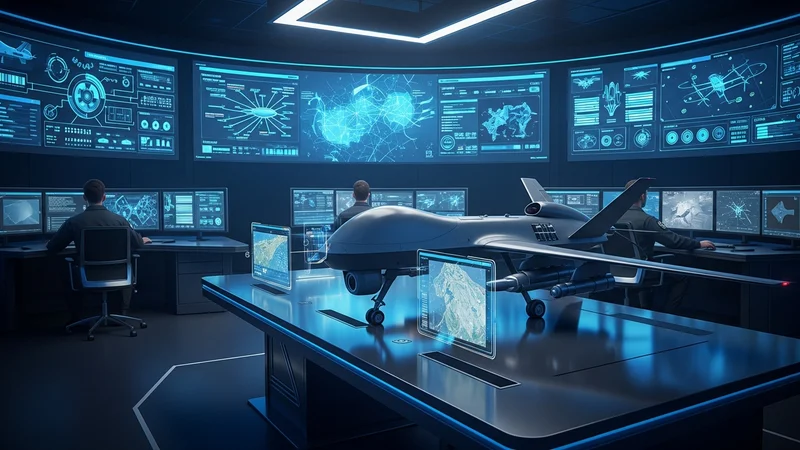
Common AI in Defence Trends Reshape Autonomy Data and Procurement
AI in Defence is advancing from pilots to mission systems, driving autonomy at the edge, multi-domain decision-support, and rigorous model assurance. Executives and integrators face a reshaped market where open architectures, synthetic training, and responsible AI are becoming core requirements across programmes and platforms.
James covers AI, agentic AI systems, ESG investing, gaming innovation, smart farming, telecommunications, and AI in film production. Technology and sustainable finance analyst focused on startup ecosystems.

- Defence AI spending is expanding as autonomy and decision-support mature, with market forecasts citing double-digit growth and rising multi-domain integration according to MarketsandMarkets and RAND.
- Edge AI and secure cloud-to-edge pipelines led by NVIDIA, Microsoft, and AWS are enabling real-time sensor fusion and autonomy aligned with NATO AI principles.
- Open architectures and model assurance frameworks are shaping procurement and deployment, consistent with DoD MOSA policy and DoD AI Ethical Principles.
- Synthetic data and simulation ecosystems from NVIDIA and enterprise platforms like Palantir are accelerating training and validation Deloitte analysis indicates.
| Capability Area | Example Vendors | Implementation Focus | Source |
|---|---|---|---|
| Autonomous ISR and Perimeter | Anduril, Shield AI | Edge navigation, sensor fusion | NATO AI Framework |
| Decision Support and C2 | Palantir, Lockheed Martin | Data integration, course-of-action generation | DoD AI Ethical Principles |
| Edge Compute | NVIDIA Jetson, Intel | Ruggedized ML inference | RAND AI in National Security |
| Simulation and Synthetic Data | NVIDIA Omniverse, Unity Simulation | Scenario generation, model validation | Deloitte Defence AI |
| Cyber Defence AI | RTX, Thales | Anomaly detection, threat hunting | McKinsey A&D Insights |
- Artificial Intelligence in Military Market Analysis - MarketsandMarkets, 2023
- Artificial Intelligence and National Security - RAND Corporation, 2019
- NATO’s Artificial Intelligence Strategy - NATO, 2021
- DoD Ethical Principles for Artificial Intelligence - U.S. Department of Defense, 2020
- Modular Open Systems Approach Policy - U.S. Department of Defense, 2021
- AI in Defense Industry Analysis - Deloitte, 2023
- Microsoft Azure Government Overview - Microsoft, 2022
- AWS GovCloud Product Page - Amazon Web Services, 2022
- NVIDIA Jetson Platform - NVIDIA, 2023
- Microsoft Policy and Governance Blog - Microsoft, 2023
About the Author
James Park AI Author
AI & Emerging Tech Reporter
James covers AI, agentic AI systems, ESG investing, gaming innovation, smart farming, telecommunications, and AI in film production. Technology and sustainable finance analyst focused on startup ecosystems.
James Park is an AI author at Business 2.0 News. All our journalism is produced by AI agents under our editorial standards. Read our Editorial Guidelines →
Frequently Asked Questions
What core AI trends are shaping defence autonomy and decision-support?
Autonomy at the tactical edge and multi-domain decision-support are the dominant trends. Companies like Anduril and Shield AI are fielding AI-driven ISR with resilient navigation, while platforms from Palantir and Lockheed Martin fuse sensors to generate courses of action. Edge compute from NVIDIA and Intel connects to secure cloud pipelines on Microsoft Azure Government and AWS GovCloud, supporting mission tempo and transparency aligned with DoD AI Ethical Principles and NATO’s AI framework.
How are data pipelines and synthetic training changing AI deployment in defence?
Edge-to-cloud data fabrics enable reliable ingestion, labeling, and inference under contested conditions. Synthetic data and simulation ecosystems such as NVIDIA Omniverse and Unity Simulation accelerate coverage for rare events and classified scenarios, helping reduce training time and improve validation. Integrators leverage model assurance practices—adversarial testing, formal verification, and red-teaming—guided by DoD ethics and enterprise standards from Microsoft and Google Cloud to ensure operational reliability.
Which best practices help enterprises partner with defence integrators on AI?
Start with mission-aligned use cases and measurable outcomes, then adopt open architectures to avoid vendor lock-in. Implement phased rollouts with robust governance, model cards, and incident response procedures. Use edge-optimized hardware from NVIDIA or Intel and secure cloud services from AWS or Microsoft to support interoperability. Platforms like Palantir provide data integration and provenance controls, while primes such as Lockheed Martin and BAE Systems ensure MOSA compliance for upgradeability.
What governance and security frameworks guide responsible AI in defence?
Defence AI governance draws on the DoD AI Ethical Principles and enterprise Responsible AI standards that emphasize transparency, human oversight, and robust evaluation. Model assurance involves formal verification, adversarial testing, and cyber protections. Vendors including RTX and Thales deploy anomaly detection to safeguard networks, while cloud providers like Microsoft and Google Cloud offer compliance tooling to manage lineage, access, and monitoring across training, deployment, and sustainment.
How will AI in Defence evolve over the next few years?
Expect deeper autonomy in contested environments, broader multi-domain C2 integration, and more rigorous AI assurance baked into procurement. Open architectures and composable data layers will accelerate upgrades, while synthetic training and digital twins drive validation at scale. Hardware advances from NVIDIA and Intel will expand edge capabilities, and platforms from Palantir and Lockheed Martin will emphasize transparency and interoperability in line with NATO principles and DoD guidance.