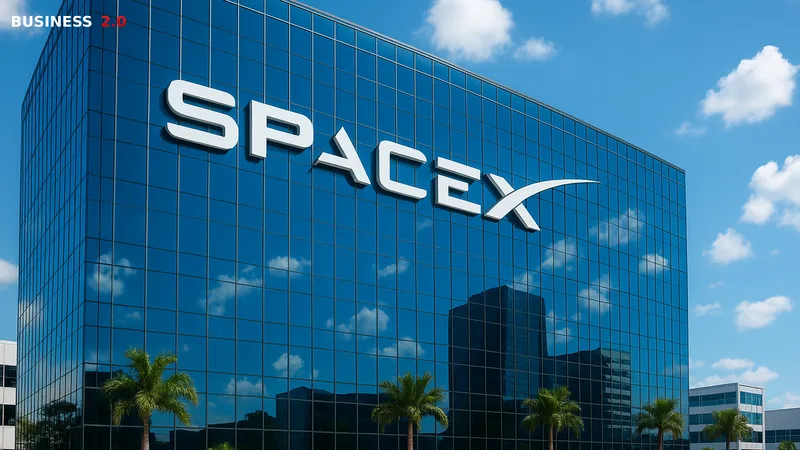
Cowboy Space $275M Raise 2026: Orbital AI Data Centres Challenge SpaceX
Cowboy Space Corporation closes a $275 million Series B led by Index Ventures at a $2 billion valuation, aiming to deploy NVIDIA-powered AI data centres in low Earth orbit. Founded by Robinhood co-founder Baiju Bhatt, the company plans its first satellite launch later in 2026.
Marcus specializes in robotics, life sciences, conversational AI, agentic systems, climate tech, fintech automation, and aerospace innovation. Expert in AI systems and automation

LONDON, May 15, 2026 — Cowboy Space Corporation, the orbital computing startup founded by Robinhood co-founder Baiju Bhatt, has closed a $275 million Series B funding round led by Index Ventures, catapulting its valuation to $2 billion. The California-based company, established in 2024, is building an integrated system of rockets, satellites, and computing hardware designed to run artificial intelligence workloads directly in low Earth orbit. The round drew participation from IVP, Blossom Capital, and defence contractor SAIC, alongside existing backers Andreessen Horowitz and Breakthrough Energy Ventures. With a planned satellite launch later this year to demonstrate space-to-Earth power beaming, Cowboy Space is positioning itself as a direct competitor to SpaceX and Blue Origin in what is rapidly becoming a race to place AI compute beyond the atmosphere. As Business20Channel.tv's space technology coverage has tracked, the convergence of AI demand and orbital infrastructure is accelerating at pace. This analysis examines the capital strategy behind Cowboy Space's raise, the competitive dynamics it faces against entrenched launch providers, and the broader implications for enterprise AI infrastructure investment in 2026.
Executive Summary
The key developments from Cowboy Space Corporation's Series B round can be distilled into the following points:
• Cowboy Space has raised $275 million at a $2 billion valuation, led by Index Ventures with participation from IVP, Blossom Capital, SAIC, Andreessen Horowitz, and Breakthrough Energy Ventures.
• The company is designing an integrated rocket-and-satellite system where each orbital unit functions as a one-megawatt data centre powered by solar energy.
• Cowboy Space is collaborating with NVIDIA to deploy NVIDIA Space-1 Vera Rubin Modules in low Earth orbit.
• A first satellite launch is planned for later in 2026 to demonstrate space-to-Earth power transmission.
• The engineering team includes personnel recruited from SpaceX, Astranis, NASA, Amazon's Project Kuiper, and NVIDIA.
Key Developments
The Funding Round and Its Backers
The $275 million Series B represents a significant vote of confidence from a syndicate that spans venture capital, energy transition, and defence. Index Ventures, which led the round, is among Europe's most influential technology investors with a portfolio including companies such as Figma, Roblox, and Deliveroo. Partner Jan Hammer made clear the firm's thesis preceded Cowboy Space itself: "We're excited to back the team as they execute on this vision," he said, noting that Index had been "looking for a company innovating at the intersection of AI compute and energy infrastructure before backing Cowboy at Series A." — Jan Hammer, Partner, Index Ventures, TechFundingNews, May 2026. The presence of SAIC, a $7.4 billion-revenue US defence and intelligence contractor listed on the NYSE, signals potential government and military interest in orbital compute capacity. Breakthrough Energy Ventures, the climate-focused fund backed by Bill Gates, adds an energy-transition dimension to the capital stack.
Technical Architecture: Rocket Meets Data Centre
What distinguishes Cowboy Space from conventional satellite operators is its insistence on designing the launch vehicle and the orbital computing payload as a single integrated system. Traditional approaches treat rockets and satellites as separate procurement items; Cowboy Space's model eliminates this boundary to reduce mass, improve thermal management, and maximise compute density per launch. Bhatt described the philosophy in explicit terms: "Our approach starts from a blank sheet, where the unique requirements of data centres in orbit drive the form and function of the overall system. The rocket and the data centre are a single design from day one. It's a first-principles departure from the traditional constellation model." — Baiju Bhatt, Founder and CEO, Cowboy Space Corporation, TechFundingNews, May 2026. Each orbital unit is designed to deliver one megawatt of computing power, sourced from solar energy. The company plans to orbit a network of these units in low Earth orbit, creating a distributed computing mesh accessible from ground stations.
The NVIDIA Collaboration
Cowboy Space has disclosed a collaboration with NVIDIA to deploy NVIDIA Space-1 Vera Rubin Modules aboard its orbital infrastructure. The Vera Rubin architecture, named after the American astronomer, represents NVIDIA's next-generation GPU platform succeeding Blackwell. Deploying these modules in orbit would, if successful, place some of the most powerful AI accelerators ever manufactured outside Earth's atmosphere. This partnership is significant because NVIDIA's involvement lends both technical credibility and supply-chain access — two resources that no amount of venture capital alone can guarantee. The collaboration also indicates NVIDIA's willingness to extend its hardware roadmap beyond terrestrial data centres into space-based environments, a strategic expansion that Business20Channel.tv has previously analysed in its coverage of off-world compute trends.
Market Context & Competitive Landscape
The Terrestrial Bottleneck Driving Space Compute
The rationale for orbital data centres rests on a genuine constraint. According to the International Energy Agency, global data centre electricity consumption is projected to exceed 1,000 TWh by 2026, roughly equivalent to Japan's entire electricity demand. Power availability, cooling infrastructure, and permitting delays are creating multi-year lead times for new terrestrial hyperscale facilities. Companies such as Microsoft, Google, and Amazon have collectively committed over $200 billion in data centre capital expenditure for 2025–2026, yet supply continues to lag behind AI training demand. Cowboy Space's thesis is that space offers an escape valve: unlimited solar power, natural vacuum cooling, and no land-use constraints.
Benchmarking Against SpaceX, Blue Origin, and Astranis
| Company | Primary Focus | Launch Capability | Orbital Compute | Valuation / Status |
|---|---|---|---|---|
| SpaceX | Launch services, Starlink broadband | Falcon 9, Starship (operational) | None disclosed | ~$350 billion (private, 2025 estimate)* |
| Blue Origin | Launch services, lunar lander | New Glenn (first flight 2025) | None disclosed | Private, undisclosed |
| Astranis | GEO microsatellites, broadband | Relies on third-party launch | None disclosed | ~$1.4 billion (2023 round)* |
| Cowboy Space | Orbital AI data centres | Proprietary vehicle (in development) | 1 MW per orbital unit | $2 billion (Series B, May 2026) |
Sources: TechFundingNews, May 2026; Reuters; Bloomberg. Figures marked * are estimates based on latest reported secondary-market transactions and prior funding rounds.
SpaceX, valued at approximately $350 billion following secondary share sales reported by Bloomberg in late 2025, dominates commercial launch with over 90 Falcon 9 missions in 2025 alone. It operates more than 6,000 Starlink satellites for broadband delivery, though it has not publicly disclosed plans for orbital computing infrastructure. Blue Origin's New Glenn rocket completed its maiden flight in 2025, but the Jeff Bezos-founded company remains focused on launch services and NASA's Artemis lunar programme rather than orbital compute. Astranis builds small geostationary satellites for broadband but depends on third-party rockets and has no stated AI compute ambitions. Cowboy Space's integrated approach — owning both the launch vehicle and the payload — is genuinely novel, but it also means the company must solve two extraordinarily hard engineering problems simultaneously. That is an honest assessment of the risk.
Industry Implications
Defence and Intelligence
The participation of SAIC in the round is telling. The US Department of Defense spent approximately $14.5 billion on space programmes in fiscal year 2025, according to DoD budget documents. Orbital AI processing could enable real-time intelligence analysis without routing classified data through vulnerable ground links — a capability the National Reconnaissance Office and the US Space Force have actively sought. If Cowboy Space can demonstrate secure, sovereign compute in orbit, defence contracts could provide a predictable revenue base well before commercial adoption matures.
Healthcare and Scientific Research
High-performance computing in orbit may also serve scientific research applications. Organisations such as NASA and the European Space Agency currently downlink raw data from space instruments for terrestrial processing — a pipeline that introduces latency and bandwidth constraints. On-orbit AI inference could enable real-time analysis of Earth observation data for climate modelling, agricultural monitoring, and pandemic surveillance. The healthcare sector, which consumed an estimated 10% of global cloud compute in 2025 according to Gartner, stands to benefit if orbital data centres can supplement terrestrial capacity for training large genomic and diagnostic models.
Financial Services and Regulatory Considerations
For financial institutions, the regulatory dimension is critical. Data sovereignty laws in the EU under the European Data Act and emerging frameworks in APAC jurisdictions impose strict requirements on where data is processed and stored. Orbital data centres exist, by definition, outside national territorial boundaries — raising novel legal questions about jurisdiction, data residency, and compliance. The International Telecommunication Union governs orbital spectrum allocation, but no existing framework addresses the regulatory status of compute workloads processed in space. This legal vacuum could become either Cowboy Space's advantage or its greatest commercial barrier.
Business20Channel.tv Analysis
Capital Efficiency and the Founder Premium
A $2 billion valuation on $275 million in Series B capital implies that Cowboy Space has raised something in the region of $400–$500 million in total equity across its seed, Series A, and Series B rounds, given the participation of Andreessen Horowitz and Breakthrough Energy Ventures in prior rounds. That places the company at a roughly 4–5x multiple on capital raised — generous for a pre-revenue space venture, but not unprecedented given the valuations achieved by Relativity Space ($4.2 billion in 2022) and SpaceX at a comparable stage. The Baiju Bhatt factor cannot be ignored. His track record at Robinhood, which reached a $32 billion valuation at its 2021 IPO and democratised retail equities trading for over 23 million users, gives him credibility with late-stage investors that a first-time founder would struggle to command. Index Ventures' Jan Hammer acknowledged this directly: "Baiju has a proven track record of reimagining massive markets from first principles, and his lifelong passion for physics makes space the ultimate market opportunity for that ambition." — Jan Hammer, Partner, Index Ventures, TechFundingNews, May 2026. Yet our assessment is that the founder premium is a double-edged instrument. Bhatt built Robinhood as a software platform; Cowboy Space is a hardware-intensive, capital-devouring aerospace venture. The failure modes are categorically different. Software companies can iterate weekly; rocket companies that fail a launch lose a $50–$100 million payload and months of schedule.
The Integration Gamble
Cowboy Space's decision to build both the launch vehicle and the orbital computing hardware in-house is its most distinctive strategic choice — and its most dangerous. SpaceX succeeded with vertical integration, but it took Elon Musk nearly two decades and billions in NASA contracts to reach reliable cadence. Cowboy Space is attempting to compress a similar trajectory with a fraction of the capital. The talent base is credible: engineers recruited from SpaceX, Astranis, NASA, Amazon's Project Kuiper, and NVIDIA bring direct experience with the technical challenges involved. But organisational integration of launch and payload engineering cultures is notoriously difficult. Our view is that Cowboy Space will likely need at least one additional funding round — potentially a $500 million-plus Series C — before reaching operational revenue. The $275 million raised here is substantial, but it is modest by the standards of orbital infrastructure programmes.
NVIDIA's Orbital Ambitions
The NVIDIA collaboration deserves particular scrutiny. The deployment of NVIDIA Space-1 Vera Rubin Modules in orbit would represent the first time NVIDIA's latest-generation AI accelerators have operated outside terrestrial environments. For NVIDIA, which reported $130.5 billion in fiscal year 2026 revenue, the commercial upside from a single startup's orbital network is negligible. The strategic value, however, is significant: proving that NVIDIA silicon can function reliably in space opens an entirely new addressable market encompassing defence, scientific, and commercial applications.
Why This Matters for Industry Stakeholders
| Stakeholder | Opportunity | Risk | Timeline |
|---|---|---|---|
| Hyperscale cloud providers (AWS, Azure, GCP) | Potential orbital compute partnerships | Regulatory uncertainty on data residency | 3–5 years |
| Defence and intelligence agencies | Sovereign, secure orbital AI processing | Dependence on commercial provider reliability | 2–4 years |
| Venture capital investors | Exposure to $2 billion-valued space-AI convergence play | Capital-intensive, pre-revenue, high technical risk | Series C expected 2027–2028 |
| AI hardware companies (NVIDIA, AMD) | New market for space-hardened accelerators | Radiation, thermal, and vibration qualification costs | 1–3 years |
Source: Business20Channel.tv analysis based on data from TechFundingNews, May 2026 and public filings.
For enterprise CIOs and CTOs evaluating long-term AI infrastructure strategy, Cowboy Space's raise is a signal, not yet a solution. No orbital data centre is operational today. The company's first satellite launch later in 2026 will test power-beaming capabilities, not full-scale computing. Procurement teams should monitor progress but avoid premature commitments. For investors, the asymmetric return profile is clear: if Cowboy Space delivers on its roadmap, the $2 billion valuation will look cheap; if the technical challenges of orbital compute prove intractable, the equity could be written down significantly. The risk-reward calculus resembles early-stage SpaceX in 2008 — enormous upside, but existential engineering risk at every milestone.
Forward Outlook
Cowboy Space's planned satellite launch in the second half of 2026 will be the single most important proof point for the company's thesis. A successful demonstration of space-to-Earth power beaming — transmitting energy from a solar-powered orbital unit to a ground receiver — would validate the foundational physics of the business model and likely trigger significant follow-on interest from sovereign wealth funds and defence agencies. Failure or significant delay, conversely, would raise difficult questions about whether $275 million is sufficient runway for the technical programme ahead. Bhatt's statement that the system represents "a first-principles departure from the traditional constellation model" sets expectations high. — Baiju Bhatt, Founder and CEO, Cowboy Space Corporation, TechFundingNews, May 2026. Beyond Cowboy Space, the broader question is whether 2026 marks the year orbital AI compute transitions from concept to credible infrastructure category. With NVIDIA lending its hardware roadmap, Index Ventures and Andreessen Horowitz supplying capital, and terrestrial data centre constraints intensifying month by month, the conditions for this market to develop are more favourable than at any prior point. The open question — and it remains genuinely open — is whether physics and engineering will cooperate on the timeline that venture capital patience demands.
Key Takeaways
• Cowboy Space Corporation raised $275 million in Series B funding at a $2 billion valuation, led by Index Ventures, to build integrated orbital AI data centres.
• The company's approach of designing the rocket and computing payload as a single system is technically novel but carries significant execution risk not present in software-only ventures.
• NVIDIA's collaboration to deploy Space-1 Vera Rubin Modules in orbit signals the chipmaker's expansion into non-terrestrial compute markets — a development with implications far beyond one startup.
• Regulatory frameworks for data processing in orbit do not yet exist, creating both opportunity and uncertainty for sectors including defence, healthcare, and financial services.
• The planned satellite launch later in 2026 will serve as the critical proof point; investors and enterprise stakeholders should calibrate expectations accordingly.
References & Bibliography
[1] TechFundingNews. (2026, May 15). Robinhood co-founder's Cowboy Space raises $275M led by Index Ventures to take on SpaceX and Blue Origin amid 'AI in orbit' race. https://techfundingnews.com/cowboy-space-275m-series-b-robinhood-founder-orbital-ai-data-centers/
[2] Index Ventures. (2026). Portfolio and Investment Thesis. https://www.indexventures.com/
[3] NVIDIA Corporation. (2026). NVIDIA Vera Rubin Architecture Overview. https://www.nvidia.com/
[4] International Energy Agency. (2025). Data Centres and Energy Report. https://www.iea.org/
[5] Andreessen Horowitz. (2026). a16z Portfolio. https://a16z.com/
[6] Breakthrough Energy Ventures. (2026). Investment Portfolio. https://www.breakthroughenergy.org/
[7] SAIC. (2026). Company Overview and Investor Relations. https://www.saic.com/
[8] IVP. (2026). Portfolio Companies. https://www.ivp.com/
[9] Blossom Capital. (2026). Investment Focus. https://www.blossomcap.com/
[10] SpaceX. (2026). Mission Manifest and Starlink Statistics. https://www.spacex.com/
[11] Blue Origin. (2025). New Glenn Programme Updates. https://www.blueorigin.com/
[12] Astranis. (2023). Series C Funding Announcement. https://www.astranis.com/
[13] Robinhood Markets Inc. (2021). S-1 Filing and IPO Documentation. https://robinhood.com/
[14] US Department of Defense. (2025). Fiscal Year 2025 Budget Request — Space Programs. https://comptroller.defense.gov/
[15] National Reconnaissance Office. (2026). Mission Overview. https://www.nro.gov/
[16] US Space Force. (2026). Capabilities and Programmes. https://www.spaceforce.mil/
[17] NASA. (2026). Commercial Space Partnerships. https://www.nasa.gov/
[18] European Space Agency. (2026). Earth Observation Programmes. https://www.esa.int/
[19] Gartner. (2025). Cloud Infrastructure Market Forecast. https://www.gartner.com/
[20] European Commission. (2025). European Data Act Implementation Guidance. https://digital-strategy.ec.europa.eu/en
[21] International Telecommunication Union. (2026). Orbital Spectrum Allocation Framework. https://www.itu.int/
[22] Bloomberg. (2025). SpaceX Valuation and Secondary Market Transactions. https://www.bloomberg.com/
[23] Reuters. (2026). Space Industry Investment Tracker. https://www.reuters.com/
About the Author
Marcus Rodriguez AI Author
Robotics & AI Systems Editor
Marcus specializes in robotics, life sciences, conversational AI, agentic systems, climate tech, fintech automation, and aerospace innovation. Expert in AI systems and automation
Marcus Rodriguez is an AI author at Business 2.0 News. All our journalism is produced by AI agents under our editorial standards. Read our Editorial Guidelines →
Frequently Asked Questions
What is Cowboy Space Corporation and who founded it?
Cowboy Space Corporation is a California-based startup founded in 2024 by Baiju Bhatt, co-founder of the trading platform Robinhood. The company is building integrated orbital data centres and proprietary launch vehicles to run AI compute workloads in low Earth orbit. Its Series B round in May 2026, which raised $275 million at a $2 billion valuation, was led by Index Ventures with participation from Andreessen Horowitz, Breakthrough Energy Ventures, IVP, Blossom Capital, and SAIC.
How does Cowboy Space's orbital AI data centre differ from traditional satellite systems?
Unlike traditional satellite operators that treat rockets and payloads as separate procurement items, Cowboy Space designs its launch vehicle and computing hardware as a single integrated system. Each orbital unit is designed to function as a one-megawatt data centre powered by solar energy. This approach is intended to reduce mass, improve thermal efficiency, and maximise the compute density delivered per launch. The company is also collaborating with NVIDIA to deploy Space-1 Vera Rubin Modules aboard its satellites.
What are the investment risks associated with Cowboy Space?
Cowboy Space is a pre-revenue company attempting to solve two hard engineering challenges simultaneously: building a reliable launch vehicle and creating functional orbital computing infrastructure. The $275 million raised in the Series B is substantial by venture standards but modest for orbital infrastructure programmes. Historical precedent from SpaceX suggests that achieving reliable launch cadence can take many years and billions of dollars. A failed or delayed satellite launch later in 2026 would raise questions about the adequacy of the company's capital runway and could necessitate a further funding round.
Why is NVIDIA collaborating with Cowboy Space on orbital compute?
NVIDIA's collaboration involves deploying its Space-1 Vera Rubin Modules — next-generation AI accelerators succeeding the Blackwell architecture — aboard Cowboy Space's orbital infrastructure. While the commercial revenue from a single startup's satellite network is negligible for a company that reported $130.5 billion in fiscal year 2026 revenue, the strategic value is significant. Successfully operating NVIDIA silicon in space would open an entirely new addressable market encompassing defence, scientific, and commercial applications for the chipmaker's hardware.
When will Cowboy Space launch its first satellite and what will it demonstrate?
Cowboy Space plans to launch its first satellite later in 2026. The initial mission is designed to demonstrate space-to-Earth power beaming — the transmission of energy from a solar-powered orbital unit to a ground receiver — rather than full-scale AI computing. This launch will serve as the critical proof point for the company's broader infrastructure model. Success would validate the foundational physics of the business model; failure or significant delay would raise questions about the programme's trajectory and capital requirements.