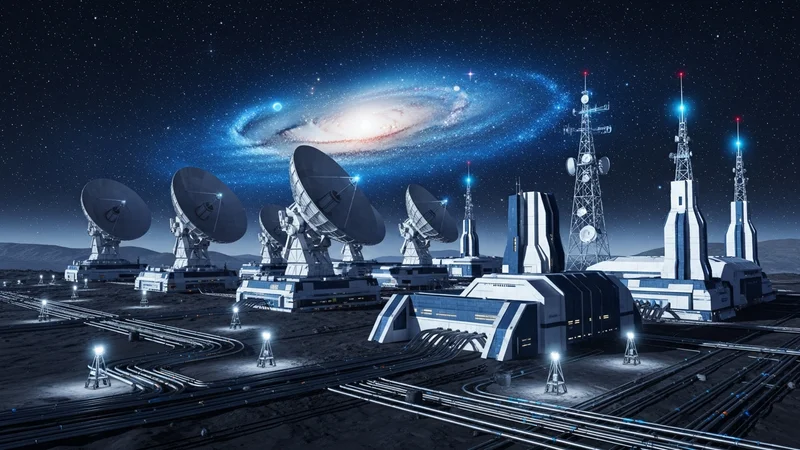
Data Centers in Space in 2026: Top 10 Predictions, Trends and Use Cases
The concept of orbital data centers has evolved from science fiction to active development programs at major aerospace and technology companies. According to
Morgan Stanley, the space economy will reach $1.8 trillion by 2035, with orbital computing infrastructure representing a significant emerging segment. As Earth-based facilities face power constraints, cooling challenges, and regulatory complexity, space offers unlimited solar energy, natural cooling, and freedom from terrestrial limitations.
Executive Summary
McKinsey & Company projects that space-based computing could capture 5-10% of the global data center market by 2040, representing over $100 billion in annual revenue. Companies including
Microsoft,
Lumen Orbit,
Axiom Space, and
SpaceX Starlink are pioneering orbital computing solutions that promise unlimited scalability, zero carbon emissions, and revolutionary latency profiles for specific applications.
Top 10 Space Data Center Predictions, Trends and Use Cases for 2026
| Prediction/Trend |
Key Players |
Timeline |
Investment |
| 1. First Commercial Orbital Data Center |
Lumen Orbit, Microsoft |
2027-2028 |
$500M+ |
| 2. AI Training in Orbit |
NVIDIA, SpaceX, Amazon |
2028-2030 |
$2B+ |
| 3. Satellite Edge Computing |
Starlink, OneWeb, Telesat |
2025-2026 |
$1.5B+ |
| 4. Solar-Powered Computing |
ESA, NASA, JAXA |
2026-2028 |
$800M+ |
| 5. Lunar Data Centers |
NASA, Lonestar Data, ispace |
2028-2030 |
$1B+ |
| 6. Space-Based Disaster Recovery |
AWS, Azure, Google Cloud |
2027-2029 |
$3B+ |
| 7. Quantum Computing in Orbit |
IBM, Arqit, QuTech |
2029-2032 |
$500M+ |
| 8. Earth Observation Processing |
Planet Labs, Maxar, Spire |
2025-2026 |
$600M+ |
| 9. Interplanetary Internet Backbone |
SpaceX, NASA, ESA |
2030-2035 |
$5B+ |
| 10. Cryptocurrency Mining in Space |
SpaceChain, BitMEX Research |
2027-2028 |
$200M+ |
1. First Commercial Orbital Data Center (2027-2028)
Lumen Orbit is leading the race to deploy the first commercial space-based data center, with plans to launch a constellation of computing satellites by 2027. The company raised $11 million in seed funding and aims to provide AI processing capabilities in low Earth orbit.
Bloomberg reports that Lumen Orbit's satellites will feature custom-designed radiation-hardened processors capable of running AI workloads in the harsh space environment. Each satellite will provide approximately 10 kilowatts of computing power using advanced solar arrays and passive cooling systems.
Microsoft has partnered with multiple space companies to explore Azure cloud services in orbit, building on its successful partnership with SpaceX for Starlink connectivity. The company envisions hybrid architectures where orbital compute complements terrestrial data centers.
2. AI Training in Orbit (2028-2030)
The most ambitious prediction involves moving large-scale AI model training to space.
NVIDIA and aerospace partners are exploring how orbital data centers could train foundation models using unlimited solar power without the grid constraints limiting terrestrial facilities.
Financial Times analysis suggests that space-based AI training could reduce the carbon footprint of large language model development to zero while eliminating the land and power acquisition challenges slowing data center expansion on Earth.
The primary challenge remains the mass-to-orbit economics. At current launch costs of approximately $2,700 per kilogram to low Earth orbit via
SpaceX Falcon 9, deploying GPU clusters remains expensive—but Starship promises to reduce costs to $200 per kilogram, making orbital AI training economically viable.
3. Satellite Edge Computing (2025-2026)
Starlink is already deploying edge computing capabilities on its satellites, enabling data processing in orbit rather than transmitting raw data to ground stations. This approach reduces latency and bandwidth requirements for applications ranging from autonomous vehicles to IoT networks.
Reuters reports that
OneWeb and
Telesat are following similar strategies, adding computing capabilities to their broadband satellite constellations. Edge processing in orbit enables real-time analytics for maritime, aviation, and remote industrial applications.
By 2026, an estimated 5,000+ satellites will feature meaningful computing capabilities, creating a distributed orbital computing network spanning the entire planet.
4. Solar-Powered Computing at Scale (2026-2028)
Space offers one compelling advantage over terrestrial data centers: unlimited solar energy.
European Space Agency research indicates that orbital solar arrays can generate power 24/7 without atmospheric interference, weather, or night cycles—delivering 8-10 times more energy per square meter than ground-based solar.
Nature published research on space-based solar power transmission that could enable orbital data centers to beam excess energy back to Earth, creating a virtuous cycle where computing generates rather than consumes terrestrial energy resources.
NASA and JAXA are collaborating on demonstration missions to prove large-scale solar power generation in orbit, with implications for both terrestrial energy needs and orbital computing infrastructure.
5. Lunar Data Centers (2028-2030)
Lonestar Data Holdings has announced plans to deploy data centers on the Moon, beginning with archival storage and eventually expanding to active computing. The company views lunar facilities as the ultimate disaster recovery solution—immune to any terrestrial catastrophe.
Wall Street Journal reports that Lonestar has partnered with
Intuitive Machines and other lunar lander providers to deliver initial payloads by 2026, with operational capacity targeted for 2028.
ispace, the Japanese lunar exploration company, is also exploring data center partnerships as part of its broader lunar infrastructure development. The Moon's stable temperature environment (in permanently shadowed craters) and abundant water ice for cooling make it surprisingly suitable for computing infrastructure.
6. Space-Based Disaster Recovery (2027-2029)
The hyperscalers—
Amazon AWS,
Microsoft Azure, and
Google Cloud—are all exploring orbital backup facilities as the ultimate disaster recovery solution. Data stored in orbit is immune to earthquakes, floods, wars, and other terrestrial disasters.
Gartner predicts that 10% of enterprise disaster recovery workloads could leverage space-based infrastructure by 2035, particularly for organizations requiring absolute data survivability guarantees.
The economics are improving rapidly: as launch costs decline and satellite manufacturing scales, orbital backup may become cost-competitive with traditional multi-region terrestrial approaches for mission-critical data.
7. Quantum Computing in Orbit (2029-2032)
Space offers unique advantages for quantum computing. The natural vacuum and extreme cold of space reduce the cooling requirements that make terrestrial quantum computers so expensive to operate.
IBM and
Arqit are exploring orbital quantum systems.
TechCrunch reports that Arqit has already launched quantum key distribution satellites and is developing more advanced orbital quantum processing capabilities. The company's QuantumCloud platform could eventually include space-based quantum processors accessible via satellite links.
The European
QuTech consortium is researching space-based quantum networks that could provide unhackable communications infrastructure alongside quantum computing capabilities.
8. Earth Observation Processing in Orbit (2025-2026)
Today's Earth observation satellites generate terabytes of imagery daily, most of which is downlinked to ground stations for processing. Companies like
Planet Labs,
Maxar, and
Spire Global are adding AI processing directly to satellites.
Forbes reports that on-satellite AI can identify relevant imagery (ships, weather patterns, crop conditions) and transmit only actionable intelligence—reducing bandwidth requirements by 90% or more.
This trend represents the first practical application of orbital computing at scale, with thousands of satellites performing AI inference in space today and far more sophisticated capabilities planned for 2026 and beyond.
9. Interplanetary Internet Backbone (2030-2035)
As humanity expands to the Moon and Mars, interplanetary communication networks will require orbital data centers to store, process, and relay information across vast distances.
SpaceX envisions Starlink infrastructure extending to Mars, creating an interplanetary internet.
NASA and
ESA are developing Deep Space Network enhancements and laser communication systems that will enable high-bandwidth connections between Earth, lunar, and Martian data centers.
The latency challenges (4-24 minutes to Mars) require autonomous computing at each location, making orbital and planetary data centers essential for space exploration and eventual colonization.
10. Cryptocurrency Mining in Space (2027-2028)
SpaceChain has already demonstrated blockchain nodes in orbit and is developing more sophisticated space-based financial infrastructure. The unlimited solar energy and natural cooling of space make orbital cryptocurrency mining theoretically attractive.
CoinDesk analysis suggests that while current economics don't favor space-based mining, declining launch costs and increasing terrestrial energy prices could change the calculation by 2028.
Several startups are exploring proof-of-stake validation in orbit, where the lower power requirements make space-based operations more immediately viable than proof-of-work mining.
Key Use Cases Driving Space Data Center Development
Beyond predictions, specific use cases are driving immediate investment:
Global Connectivity: Orbital computing enables real-time services for maritime, aviation, and remote regions lacking terrestrial infrastructure. Starlink and competitors are already demonstrating this capability.
Autonomous Systems: Self-driving vehicles, drones, and robots require ultra-low-latency processing that orbital edge computing can provide globally, without building terrestrial data centers everywhere.
Defense and Intelligence: Military applications drive significant investment in space-based processing for reconnaissance, communications, and command-and-control systems immune to ground-based disruption.
Scientific Research: Climate modeling, particle physics, and astronomical observations generate massive datasets best processed in orbit near the collection point.
Financial Services: High-frequency trading and global payment processing could benefit from the consistent, low-latency connectivity that orbital infrastructure provides.
Challenges and Limitations
Despite the promise, significant challenges remain:
Launch Costs: Even with SpaceX Starship, deploying heavy computing equipment to orbit costs orders of magnitude more than building terrestrial facilities.
Radiation: Space radiation degrades electronics, requiring specialized (expensive) radiation-hardened components or frequent satellite replacement.
Maintenance: Unlike terrestrial data centers, orbital facilities cannot be easily repaired or upgraded once deployed.
Bandwidth: While improving, space-to-ground communication bandwidth limits the applications suitable for orbital computing.
Debris: The growing problem of space debris poses risks to any orbital infrastructure investment.
Investment Outlook
Goldman Sachs projects cumulative investment in space-based computing infrastructure will reach $15 billion by 2030, driven by both commercial ventures and government programs. The sector remains high-risk but offers potentially transformative returns for early investors.
The convergence of declining launch costs, advancing satellite technology, and growing demand for sustainable computing infrastructure positions space data centers as one of the most intriguing frontiers in technology. While widespread deployment remains years away, the foundations are being laid today for a future where computing literally reaches for the stars.