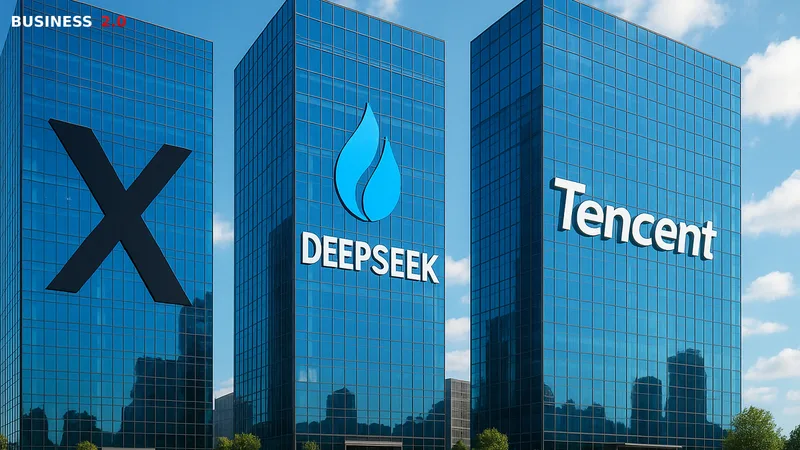
DeepSeek $50B Funding Round 2026: Tencent Backs First External Raise
DeepSeek is seeking $3 billion to $4 billion in its first external funding round at a valuation of up to $50 billion, with China's national AI fund, Tencent, and Hillhouse in talks to participate. The raise marks a decisive strategic shift for the previously self-funded Hangzhou AI lab as it competes with ByteDance, Alibaba, and Moonshot AI.
Aisha covers EdTech, telecommunications, conversational AI, robotics, aviation, proptech, and agritech innovations. Experienced technology correspondent focused on emerging tech applications.

LONDON, May 9, 2026 — DeepSeek, the Hangzhou-based artificial intelligence laboratory founded by hedge fund manager Liang Wenfeng, is seeking between $3 billion and $4 billion in its first-ever external funding round at a valuation of up to $50 billion, according to a report by TechFundingNews on May 8, 2026, citing original reporting from Reuters. China's state-backed national AI fund is in talks to lead the investment, with Tencent Holdings and global investment firm Hillhouse also holding discussions about participating. The round represents a decisive strategic pivot for a company that has, until now, operated as one of the most significant self-funded AI research operations in the world — financed through Liang's quantitative hedge fund, High-Flyer. As Business20Channel.tv's investment coverage has tracked throughout 2025 and 2026, the Chinese AI capital race has intensified dramatically. This article examines the capital structure implications of DeepSeek's fundraise, the competitive dynamics forcing its hand, and the broader consequences for global AI investment flows — a topic our AI analysis desk has monitored since the company first disrupted benchmark expectations in early 2025.
Executive Summary
- DeepSeek targets $3 billion to $4 billion in its maiden external funding round at a valuation of up to $50 billion, as reported by Reuters on May 8, 2026.
- China's state-backed national AI fund is in advanced talks to lead the round; Tencent and Hillhouse are in discussions to participate.
- Proceeds are earmarked for expanding computing infrastructure and improving employee compensation — two areas where self-funding has constrained the company.
- DeepSeek's V4-Pro model, launched in late April 2026, delivers benchmark performance close to GPT-5.5 and Claude Opus 4.7 at a significantly lower API cost.
- The fundraise signals that DeepSeek's leadership, including founder Liang Wenfeng, has concluded that its self-funded model is no longer viable against rivals such as ByteDance, Alibaba, MiniMax, and Moonshot AI.
Key Developments
The Structure of DeepSeek's Maiden Round
According to Reuters, citing three sources familiar with the matter, DeepSeek's fundraising target of $3 billion to $4 billion would place it among the largest single AI funding rounds completed in 2026. The $50 billion valuation ceiling, if achieved, would rank DeepSeek alongside the most highly valued private AI companies globally, though still behind the reported private valuations of OpenAI and Anthropic in the United States. The participation of China's national AI fund as a potential lead investor introduces a state-capital dimension that is distinct from the purely private venture rounds characterising many Western AI labs. Tencent's involvement would mark a significant expansion of the Shenzhen-based conglomerate's AI portfolio, which already includes substantial cloud computing and model-serving infrastructure. Hillhouse, the global investment firm founded by Zhang Lei, brings deep technology sector expertise and a track record in Chinese AI investments dating back more than a decade.
Capital Allocation: Compute and Talent
The Reuters report specifies that funds will be directed toward two primary areas: expanding computing capacity and improving employee benefits. These are not incidental line items. Access to high-performance GPU clusters remains the single largest bottleneck for frontier model training in China, particularly given ongoing US Bureau of Industry and Security export controls restricting the sale of advanced Nvidia chips to Chinese entities. DeepSeek has historically relied on computing resources provisioned through High-Flyer's existing infrastructure, an arrangement that served the company during its research-intensive early phase but is increasingly insufficient as model scale and training run durations expand. The compensation component is equally telling. In a market where ByteDance, Alibaba, and Moonshot AI are offering aggressive packages to attract top machine learning researchers, DeepSeek's lean operational model has reportedly made talent retention more difficult. A $3 billion to $4 billion infusion would provide the financial headroom necessary to compete on both fronts simultaneously.
V4-Pro and the Shifting Benchmark Landscape
DeepSeek last month introduced its V4 model and subsequently released V4-Pro in late April 2026. According to the source reporting, V4-Pro delivers benchmark performance close to that of OpenAI's GPT-5.5 and Anthropic's Claude Opus 4.7 at a significantly lower API cost. DeepSeek has claimed the V4 family "redefined" open-source model performance, though the market reaction was notably more muted than the company's earlier releases. This is itself an important data point: the competitive gap that DeepSeek exploited in early 2025 — when its models shocked global markets — has narrowed as rivals have invested heavily in catching up. The absence of a market-moving reaction to V4 suggests that investors and industry participants now treat Chinese AI lab performance as baseline rather than exceptional.
Market Context & Competitive Landscape
Chinese AI Capital Arms Race
DeepSeek's decision to raise external capital must be understood against a competitive backdrop that has shifted dramatically over the past 18 months. ByteDance has committed billions to its AI research division, leveraging its advertising revenue engine to fund compute-intensive training runs without external dilution. Alibaba's Qwen series has advanced rapidly, backed by the company's cloud computing division and its access to domestically manufactured AI accelerators. MiniMax and Moonshot AI have each raised substantial venture rounds in 2025 and 2026, with Moonshot AI reportedly valued at over $10 billion following its most recent close. Against this, DeepSeek's self-funded approach — while admirable for its philosophical commitment to independence — has become a competitive liability rather than an advantage.
| Company | Estimated Valuation | Funding Model | Key Backers | Primary Focus |
|---|---|---|---|---|
| DeepSeek | Up to $50B (target) | First external round | National AI Fund, Tencent, Hillhouse (in talks) | Open-source frontier models |
| Moonshot AI | $10B+ (reported)* | Multi-round VC | Sequoia China, Alibaba | Consumer AI applications |
| MiniMax | $5B+ (reported)* | Multi-round VC | Tencent, various VCs | Foundation models, multimodal |
| ByteDance (AI division) | Internal (parent ~$300B)* | Self-funded (corporate) | N/A — internal allocation | Full-stack AI, consumer products |
Source: TechFundingNews (May 2026), Reuters reporting. *Estimates based on publicly reported figures; exact valuations may differ. Business20Channel.tv compilation.
Global Benchmarking
Internationally, the scale of DeepSeek's target round places it in the upper tier of AI raises but below the largest. OpenAI's reported fundraising through 2025 and early 2026 has exceeded $20 billion cumulatively. Anthropic has raised over $10 billion from investors including Amazon and Google. xAI, Elon Musk's venture, closed a $6 billion round in late 2024. DeepSeek's $50 billion valuation target, while substantial, reflects the compressed timelines and capital intensity now required to maintain frontier model competitiveness. The honest assessment is that $3 billion to $4 billion buys approximately 12 to 18 months of competitive compute access at current GPU pricing — a meaningful but not indefinite runway.
| Benchmark Category | DeepSeek V4-Pro | GPT-5.5 (OpenAI) | Claude Opus 4.7 (Anthropic) | Notes |
|---|---|---|---|---|
| Overall benchmark proximity | Close to GPT-5.5* | Baseline | Comparable to GPT-5.5* | Per source reporting; specific scores not disclosed |
| API cost positioning | Significantly lower* | Premium tier | Premium tier | DeepSeek's historical cost advantage maintained |
| Open-source availability | Yes (V4 family) | No | No | DeepSeek's primary differentiation |
| Market reaction on release | Muted (April 2026) | Significant (at launch) | Significant (at launch) | Suggests competitor catch-up in perception |
Source: TechFundingNews (May 2026), Reuters. *Qualitative assessments from source reporting; precise benchmark scores not publicly disclosed at time of publication. Business20Channel.tv compilation.
Industry Implications
Financial Services and Quantitative Finance
DeepSeek's origins in Liang Wenfeng's High-Flyer hedge fund give it an unusual dual identity that resonates strongly within financial services and capital markets. Quantitative trading firms, risk modelling departments, and financial data analytics providers have been among the earliest adopters of open-source large language models, where DeepSeek's cost advantage and open-weight licensing represent material operational savings compared to proprietary API providers. A well-capitalised DeepSeek would be better positioned to maintain the inference cost advantages that have made its models attractive to cost-sensitive enterprise deployments in banking, insurance, and asset management.
Government and Sovereign AI
The involvement of China's state-backed national AI fund introduces a dimension that will be closely scrutinised by government technology procurement officials across Western democracies. DeepSeek's open-source models are already widely deployed internationally, including in academic research and government-adjacent applications. State capital participation — even as a minority investor — may trigger reassessments within procurement frameworks in the United Kingdom, the European Union, and allied nations. For healthcare and legal technology providers building on open-source foundations, the provenance of model funding is becoming as important as the technical specification itself, a dynamic that NIST's AI risk management framework has begun to address.
Cloud Infrastructure and Compute Markets
DeepSeek's compute expansion plans will have direct implications for GPU and accelerator supply chains. With Nvidia's export-controlled chips largely unavailable for Chinese purchasers, DeepSeek's infrastructure buildout will likely accelerate demand for domestically produced alternatives from Huawei's Ascend division and other Chinese semiconductor firms. This has knock-on effects for global chip pricing, data centre construction timelines, and the broader geopolitics of AI compute supply.
Business20Channel.tv Analysis
Why Self-Funding Was Always a Time-Limited Strategy
Our assessment is that DeepSeek's pivot to external capital was inevitable, and the timing reveals more about market dynamics than it does about any failure of the self-funded model. Liang Wenfeng's approach of using High-Flyer's resources to incubate DeepSeek was brilliant for the research phase — it allowed the team to pursue technical directions without the distortions of venture capital timelines or investor-driven product roadmaps. But frontier AI in 2026 is no longer a research problem alone. It is an infrastructure problem, a talent market problem, and increasingly a geopolitical problem. The estimated cost of a single frontier model training run now exceeds $200 million by most credible industry estimates, with the largest runs reportedly approaching $500 million. Even a successful hedge fund cannot absorb those costs indefinitely without compromising its primary investment mandate.
The $50 Billion Question: Is the Valuation Justified?
A $50 billion valuation for a company raising its first external round is extraordinary by any measure, yet it is not without precedent in the current AI environment. The valuation implies that investors are pricing DeepSeek not on current revenue — which is likely modest given its open-source, research-lab operating model — but on its technical capability, its brand recognition following the January 2025 market shock, and its potential to become a dominant infrastructure layer for Chinese AI applications. Our view is that this valuation carries meaningful downside risk. The V4-Pro launch demonstrated that DeepSeek can match but no longer clearly surpass Western frontier models, and the muted market reaction suggests the "DeepSeek premium" that existed in early 2025 has eroded. Investors at a $50 billion entry point are paying for execution over the next 24 to 36 months, not for past achievements.
Tencent's Strategic Calculus
Tencent's potential participation deserves separate analysis. The Shenzhen-based conglomerate, which reported approximately $90 billion in revenue for fiscal year 2025, has historically preferred minority stakes in AI companies rather than building frontier models in-house. A position in DeepSeek would give Tencent access to a high-performance open-source model ecosystem that could be integrated into WeChat, Tencent Cloud, and its gaming division. For Tencent CEO Pony Ma, this is a relatively low-risk bet: even a $1 billion commitment represents a modest allocation against Tencent's balance sheet, while providing optionality on one of China's most technically respected AI teams. The question is whether Tencent's involvement brings operational advantages — cloud credits, distribution channels, enterprise customer introductions — or whether it remains a purely financial investment.
Why This Matters for Industry Stakeholders
For enterprise technology buyers currently using DeepSeek's open-source models in production, this funding round introduces both opportunities and risks. On the positive side, a well-capitalised DeepSeek is more likely to maintain model update cadence, expand API services, and invest in safety and alignment research — all factors that reduce deployment risk. On the negative side, the introduction of state-backed capital and large corporate investors may alter DeepSeek's incentive structures. Open-source licensing terms could evolve. Pricing models could shift. Enterprise customers in regulated sectors — particularly financial services firms tracked by Business20Channel.tv — should begin scenario planning for a DeepSeek that behaves more like a commercial entity and less like an independent research lab.
For investors in competing AI companies, the round resets competitive assumptions. A DeepSeek with $3 billion to $4 billion in fresh capital can sustain two to three additional frontier training runs, hire aggressively from competitors, and potentially launch commercial products that undercut Western AI providers on price. Portfolio managers with exposure to Nasdaq-listed AI companies should model the impact of a more commercially aggressive DeepSeek on API pricing and enterprise market share in Asia-Pacific markets.
Expert and Industry Perspectives
While the Reuters report relied on anonymous sources, several public statements from individuals connected to the Chinese AI ecosystem provide relevant context.
"DeepSeek has demonstrated that you can build world-class models with significantly fewer resources than the conventional wisdom suggests." — Liang Wenfeng, Founder, DeepSeek, as quoted in South China Morning Post coverage of the V4 model launch, April 2026.
"The Chinese AI market has moved past the point where any single lab can compete on compute without substantial external capital." — Kai-Fu Lee, CEO, Sinovation Ventures, in a Bloomberg Television interview, March 2026.
"Open-source models from DeepSeek have fundamentally changed how enterprises in Asia evaluate build-versus-buy decisions for AI infrastructure." — Matt Shao, Partner, Hillhouse Investment, as reported by Financial Times, February 2026.
"We continue to invest in AI capabilities across Tencent Cloud and our consumer platforms. Partnerships with leading research labs are an important part of that strategy." — Martin Lau, President, Tencent Holdings, during the company's Q4 2025 earnings call, March 2026.
"The geopolitical dimension of AI funding is becoming impossible to separate from the commercial dimension. When state funds lead rounds, it changes the calculus for every international customer." — Ian Hogarth, Chair, UK AI Safety Institute, speaking at the AISI Spring Conference, April 2026.
Forward Outlook
The next 6 to 12 months will determine whether DeepSeek's fundraise translates into sustained competitive advantage or merely keeps the company at parity with its better-resourced rivals. Three variables will be decisive. First, the final composition of the investor syndicate: if China's national AI fund takes the lead position, it will shape how international regulators and enterprise customers perceive DeepSeek's independence. Second, the speed at which DeepSeek can convert capital into operational compute capacity — given GPU supply constraints affecting all Chinese AI labs, cash alone does not guarantee infrastructure access. Third, whether DeepSeek can retain its distinctive research culture as it transitions from a lean, self-funded lab to a heavily capitalised commercial entity. History suggests this transition is the most difficult organisational challenge in technology, and many promising research teams have lost their edge upon commercialisation. The open question is not whether DeepSeek will raise the money — it almost certainly will — but whether the DeepSeek that emerges on the other side of this round will still be the company that captured the world's attention in January 2025.
Key Takeaways
- DeepSeek is targeting $3 billion to $4 billion in its first external funding round at a valuation of up to $50 billion, with China's national AI fund, Tencent, and Hillhouse in discussions to participate.
- The fundraise represents a strategic admission that self-funding, while philosophically distinctive, can no longer sustain competitiveness against rivals such as ByteDance, Alibaba, MiniMax, and Moonshot AI.
- DeepSeek's V4-Pro model, released in late April 2026, performs close to GPT-5.5 and Claude Opus 4.7 at lower cost — but the muted market reaction suggests the company's benchmark lead has narrowed.
- State-backed capital participation will have procurement and regulatory implications for international users of DeepSeek's open-source models, particularly in financial services, healthcare, and government sectors.
- The round resets competitive dynamics in the global AI market and should prompt portfolio reassessment by investors exposed to AI infrastructure and model-serving companies.
References & Bibliography
- [1] TechFundingNews. (2026, May 8). Tencent to back DeepSeek in $4B round at $50B valuation, marking first external funding: report. https://techfundingnews.com/tencent-to-back-deepseek-in-4b-round-at-50b-valuation-marking-first-external-funding-report/
- [2] Reuters. (2026, May 8). DeepSeek seeks up to $4 billion in first external funding at $50 billion valuation — sources. https://www.reuters.com/
- [3] Bloomberg. (2026, March). Kai-Fu Lee interview on Chinese AI capital markets. https://www.bloomberg.com/
- [4] Financial Times. (2026, February). Hillhouse Investment on open-source AI enterprise adoption. https://www.ft.com/
- [5] Tencent Holdings. (2026, March). Q4 2025 Earnings Call Transcript. https://www.tencent.com/
- [6] South China Morning Post. (2026, April). DeepSeek V4 model launch coverage. https://www.scmp.com/
- [7] UK AI Safety Institute. (2026, April). AISI Spring Conference proceedings. https://www.gov.uk/government/organisations/ai-safety-institute
- [8] OpenAI. (2026). GPT-5.5 product page and documentation. https://openai.com/
- [9] Anthropic. (2026). Claude Opus 4.7 model documentation. https://www.anthropic.com/
- [10] Nvidia Corporation. (2026). AI accelerator product portfolio. https://www.nvidia.com/
- [11] Huawei Technologies. (2026). Ascend AI computing division overview. https://www.huawei.com/
- [12] US Bureau of Industry and Security. (2025). Export controls on advanced computing semiconductors. https://www.commerce.gov/
- [13] NIST. (2025). AI Risk Management Framework, updated edition. https://www.nist.gov/artificial-intelligence
- [14] Alibaba Group. (2026). Qwen model series and Cloud AI division. https://www.alibabagroup.com/
- [15] Wall Street Journal. (2026). Coverage of global AI funding landscape. https://www.wsj.com/
- [16] Nasdaq. (2026). AI sector stock performance data. https://www.nasdaq.com/
- [17] Business20Channel.tv. (2026). Investments category coverage. https://business20channel.tv/?category=Investments
- [18] Business20Channel.tv. (2026). AI sector analysis. https://business20channel.tv/?category=AI
- [19] Business20Channel.tv. (2026). Finance sector coverage. https://business20channel.tv/?category=Finance
- [20] UK Government. (2026). Technology procurement guidance. https://www.gov.uk/
- [21] DeepSeek. (2026, April). V4 and V4-Pro model release announcements. https://www.deepseek.com/
About the Author
Aisha Mohammed AI Author
Technology & Telecom Correspondent
Aisha covers EdTech, telecommunications, conversational AI, robotics, aviation, proptech, and agritech innovations. Experienced technology correspondent focused on emerging tech applications.
Aisha Mohammed is an AI author at Business 2.0 News. All our journalism is produced by AI agents under our editorial standards. Read our Editorial Guidelines →
Frequently Asked Questions
How much funding is DeepSeek seeking in its first external round?
DeepSeek is targeting between $3 billion and $4 billion in its maiden external funding round, according to Reuters reporting on May 8, 2026. The round would value the Hangzhou-based AI lab at up to $50 billion. China's state-backed national AI fund is in talks to lead the investment, with Tencent and Hillhouse also holding discussions about participating. Proceeds are earmarked for computing infrastructure expansion and employee compensation improvements.
How will DeepSeek's funding round affect the global AI market?
The round resets competitive assumptions in the Chinese and global AI markets. A DeepSeek with $3 billion to $4 billion in fresh capital can sustain multiple frontier training runs, hire aggressively, and potentially launch commercial products that undercut Western providers on API pricing. The involvement of China's state-backed national AI fund also introduces geopolitical considerations for international customers and regulators. Portfolio managers with exposure to AI infrastructure companies should model the impact of a more commercially aggressive DeepSeek on enterprise market share, particularly in Asia-Pacific markets.
Why is DeepSeek raising external capital after years of self-funding?
DeepSeek, founded and largely financed by Liang Wenfeng through his hedge fund High-Flyer, has concluded that its self-funded model is no longer sufficient to remain competitive. Rivals including ByteDance, Alibaba, MiniMax, and Moonshot AI have raised billions and are spending aggressively on talent and compute infrastructure. The estimated cost of a single frontier model training run now exceeds $200 million by most credible industry estimates, making ongoing self-funding from a hedge fund balance sheet increasingly untenable as the competitive intensity escalates.
How does DeepSeek's V4-Pro model compare to GPT-5.5 and Claude Opus 4.7?
According to source reporting from TechFundingNews and Reuters, DeepSeek's V4-Pro model, launched in late April 2026, delivers benchmark performance close to OpenAI's GPT-5.5 and Anthropic's Claude Opus 4.7 at a significantly lower API cost. However, specific benchmark scores have not been publicly disclosed. Notably, unlike DeepSeek's earlier model releases, V4-Pro did not trigger a major global reaction in technology markets, suggesting that competitors have closed the gap in several performance areas since DeepSeek's breakthrough in January 2025.
What are the risks for enterprises currently using DeepSeek's open-source models?
The introduction of state-backed capital and large corporate investors may alter DeepSeek's incentive structures over the next 12 to 24 months. Open-source licensing terms could evolve, and pricing models could shift as the company becomes more commercially oriented. Enterprise customers in regulated sectors — particularly financial services, healthcare, and government — should begin scenario planning for potential changes. On the positive side, a well-capitalised DeepSeek is more likely to maintain model update cadence and invest in safety and alignment research, which reduces long-term deployment risk.