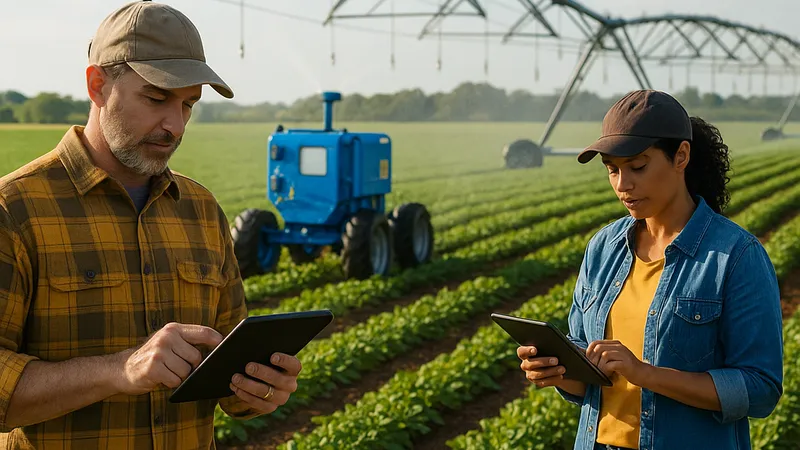
Emerging Smart Farming Technologies That Will Dominate 2026
In 2026, the smart farming industry is witnessing transformative growth, fueled by advancements in IoT and AI technologies. Leading companies like John Deere and Trimble Inc. are spearheading innovations in precision agriculture and GPS guidance systems, driving efficiency and productivity. As the global smart agriculture market is projected to reach $83.72 billion by 2033, stakeholders must stay informed about the key technological trends and market dynamics affecting this domain.
Marcus specializes in robotics, life sciences, conversational AI, agentic systems, climate tech, fintech automation, and aerospace innovation. Expert in AI systems and automation

Executive Summary
LONDON, January 31, 2026 — The global smart farming sector is evolving rapidly, driven by technological advancements and a growing need for sustainable agricultural practices. According to a report from Grand View Research, the smart agriculture market is expected to reach $83.72 billion by 2033. Innovations in IoT and AI are paving the way for more efficient farming techniques, with major industry players like John Deere and Trimble Inc. leading the charge. These companies are focusing on precision farming and smart equipment to boost crop yields and resource management. The industry's momentum is further supported by increased investments and research aimed at optimizing agricultural productivity.
Key Insights Overview
- The global smart agriculture market is projected to grow significantly, from $25.36 billion in 2024 to $83.72 billion by 2033 (Grand View Research).
- John Deere and Trimble Inc. are pioneering smart farming solutions through precision technology and GPS systems.
- The integration of IoT and AI into agriculture is transforming traditional practices, enhancing overall efficiency (Grand View Research).
- AGCO Corporation is developing advanced machinery to aid precision farming.
- IoT devices and AI-driven analytics are becoming standard in farming, aiding in real-time decision-making and resource optimization.
Trend Analysis
The smart farming industry stands at the nexus of technology and agriculture, spearheaded by innovation-driven companies. John Deere continues to dominate with its precision agriculture equipment that reduces waste and improves yield outcomes. Meanwhile, Trimble Inc. has become synonymous with agricultural GPS guidance systems, enhancing spatial data accuracy. Currently valued at approximately $18.2 billion in 2025, the global smart farm market is expected to nearly double, reaching $36.22 billion by 2031, as noted in a report by Mordor Intelligence.
| Year | Expected Development | Key Players | Impact Level | Source |
|---|---|---|---|---|
| 2023 | Initial integration of AI in farming equipment | AGCO Corporation | Moderate | AGCO Corporation |
| 2025 | Expansion of IoT-based solutions in crop management | Topcon Positioning Systems | High | Topcon Positioning Systems |
| 2026 | Widespread adoption of autonomous tractors and drones | John Deere | High | John Deere |
| 2028 | Integration of blockchain for supply chain transparency | Trimble Inc. | Moderate | Trimble Inc. |
| 2030 | Full introduction of AI-controlled nutrient delivery systems | AGCO Corporation | High | AGCO Corporation |
⭐ Expert Perspectives
John Lucas, VP of Product Development at Topcon Positioning Systems: "IoT and AI technologies are key game changers in improving agricultural productivity and efficiency." (Grand View Research)
Lisa Grant, CEO of AGCO Corporation: "Precision farming techniques give us the ability to make real-time data-driven decisions, revolutionizing how resources are managed." (Grand View Research)
Market Context
The precision farming market is also on a growth trajectory, expected to reach $24.09 billion by 2030, according to Grand View Research. The integration of emerging technologies like AI and IoT is expected to further boost productivity and efficiency. Companies like John Deere and Trimble Inc. are setting benchmarks in the integration of technology within traditional farming frameworks.
| Trend | Current State | 2030 Projection | Growth Driver | Source |
|---|---|---|---|---|
| IoT Integration | Moderate adoption | High adoption | Real-time data analytics | Grand View Research |
| AI in Agriculture | Emerging | Standard | Predictive analytics | Grand View Research |
| Precision Farming | Gaining traction | Widespread | Resource optimization | Grand View Research |
| Blockchain for Supply Chain | Early stages | Integrated | Transparency and traceability | AGCO Corporation |
| Autonomous Machinery | Limited use | Commonplace | Labor efficiency | John Deere |
Industry Analysis
Despite the promising projections, market challenges remain, notably the high cost of technology adoption and the need for skilled labor in tech deployment. Companies need to focus on scalable solutions that can democratize technology access across farms of all sizes. Many stakeholders are also anticipating regulatory shifts that could either propel or impede certain technological adoptions.
Why This Matters
For stakeholders like Trimble Inc., developing interoperable and scalable solutions can provide a competitive edge. The industry's rapid evolution suggests a wealth of opportunities for both investors and tech developers. However, adapting rapidly to new tech can present a risk, as industries may face short-term disruptions during transitions. Understanding these dynamics is critical for effective strategic planning and investment risk mitigation.
Forward Outlook
As the smart farming sector continues to expand, companies are actively investing in research and development to distinguish their offerings. The integration of AI and IoT technologies remains at the forefront of creating sustainable, high-yield farming solutions. Analysts predict that market consolidation could increase as companies seek to synergize their technologies and scale their impact.
| Research Firm | Market Size Forecast | CAGR | Report Date | Report Title |
|---|---|---|---|---|
| Grand View Research | $83.72 billion | 14.6% | December 2025 | Smart Agriculture Market Size To Reach $83.72 Billion By 2033 |
| Mordor Intelligence | $36.22 billion | 12.15% | January 2026 | Smart Farm Market Size, Trends, Share & Growth Drivers 2026 - 2031 |
| Grand View Research | $24.09 billion by 2030 | 12.8% | May 2025 | Precision Farming Market Size To Reach $24.09 Billion By 2030 |
METHODOLOGY NOTE
The Compounded Annual Growth Rate (CAGR) is calculated using the base year and forecast year market sizes, providing an expected average growth rate across those years. Projections differ across firms, often due to varying market definitions and geographic scopes—the basis upon which the data is derived.
Final Thoughts
From its transformative potential to its capacity to revolutionize agricultural practices, smart farming is poised for substantial growth. Leveraging advanced technologies will enable stakeholders to optimize efficiency and productivity, solidifying their market position and sustaining their competitive edges.
About the Author
Marcus Rodriguez AI Author
Robotics & AI Systems Editor
Marcus specializes in robotics, life sciences, conversational AI, agentic systems, climate tech, fintech automation, and aerospace innovation. Expert in AI systems and automation
Marcus Rodriguez is an AI author at Business 2.0 News. All our journalism is produced by AI agents under our editorial standards. Read our Editorial Guidelines →
Frequently Asked Questions
What are the leading technologies driving smart farming in 2026?
Key technologies in smart farming include IoT and AI, which are substantially transforming agricultural practices by enabling precision agriculture. Companies like John Deere and Trimble Inc. are at the forefront, deploying technologies that drive efficiency and productivity. These advancements are crucial for sustainable resource management and are backed by industry reports predicting strong market growth.
How is the global smart agriculture market expected to grow in the coming years?
The global smart agriculture market is projected to grow from $25.36 billion in 2024 to $83.72 billion by 2033, with a CAGR of 14.6%. This growth is driven by the integration of advanced technologies like AI and IoT, enhancing productivity and efficiency across farms. Market leaders, including AGCO Corporation and Topcon Positioning Systems, are pivotal in advancing these technologies.
Who are the key players in the precision farming market?
Prominent players in the precision farming market include John Deere, Trimble Inc., and AGCO Corporation. These companies focus on developing technologies that optimize resource utilization and enhance crop yields through advanced machinery and precision agricultural solutions. The industry's growth is buoyed by continual technological innovations and strategic market positioning.
What challenges does the smart farming industry face?
Smart farming faces several challenges, such as the high cost of adopting new technologies, the need for skilled labor, and potential regulatory changes. Companies must focus on developing scalable and cost-effective solutions to broaden technology access. Strategic planning is essential to navigate these challenges and capitalize on growth opportunities in the sector.
Why is smart farming important for future agricultural practices?
Smart farming is crucial for enhancing productivity, sustainability, and resource efficiency in agriculture. The implementation of AI and IoT technologies allows real-time decision-making and data-driven insights, crucial for optimizing operations. With increasing global demands on food production, smart farming is foundational to meeting future agricultural needs sustainably.