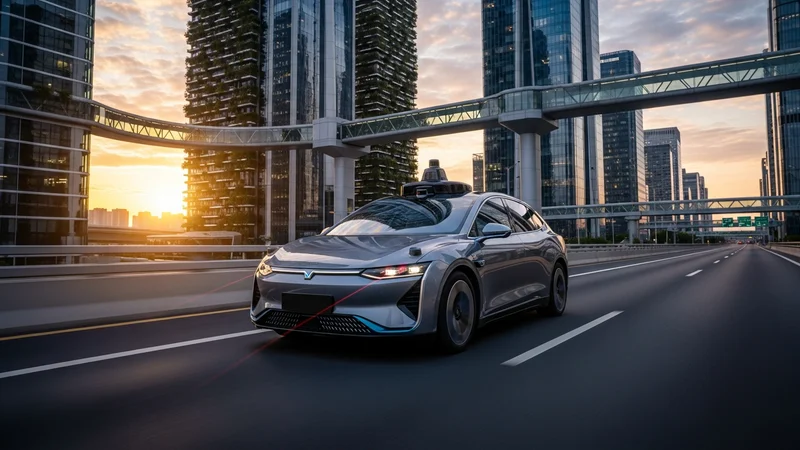
Future of Driverless Cars with Agentic AI: Top 5 Trends in 2026
The autonomous vehicle industry enters a decisive phase as Waymo targets September 2026 for London commercial robotaxi launch. Analysis of five critical trends including the UK Automated Vehicles Act 2024, agentic AI decision-making, safety performance data, and infrastructure adaptation requirements.
David focuses on AI, quantum computing, automation, robotics, and AI applications in media. Expert in next-generation computing technologies.

LONDON, 1 February 2026 — The autonomous vehicle industry is entering a decisive phase as regulatory frameworks mature and commercial robotaxi services prepare to launch across major global cities. With Waymo targeting September 2026 for its London commercial launch and the UK Automated Vehicles Act 2024 now in force, the convergence of agentic AI and driverless technology is reshaping urban mobility. This analysis examines the five critical trends defining the autonomous vehicle landscape in 2026.
Executive Summary
The global autonomous vehicle market, valued at an estimated £42 billion with potential for 38,000 new jobs by 2035, is transitioning from experimental trials to commercial deployment. Waymo, the Alphabet-owned autonomous driving company, has completed over 20 million rides and logged more than 100 million autonomous miles, establishing the operational benchmarks for the industry. Meanwhile, competitors including Wayve (partnered with Uber) and Baidu's Apollo (partnered with Lyft) are positioning for European market entry.
Key Takeaways
- Regulatory milestone: UK Automated Vehicles Act 2024 enables legal driverless services by 2026
- Commercial scale: Waymo operates 2,500+ robotaxis completing 450,000+ weekly rides across six US cities
- Safety record: 91% fewer crashes involving serious injuries versus human drivers
- London launch: April 2026 pilot programme, September 2026 commercial operations (pending regulatory approval)
- Technology shift: Agentic AI systems enabling real-time decision-making without human intervention
Trend 1: Regulatory Frameworks Enable Commercial Deployment
The Automated Vehicles Act 2024, which received Royal Assent on 20 May 2024, establishes one of the most comprehensive legal frameworks for autonomous vehicles globally. The legislation mandates that automated vehicles must be "as safe as or safer than careful and competent human drivers" whilst creating clear liability structures for manufacturers and operators.
Mark Harper, then Transport Secretary, described the legislation as transformative: "Self-driving vehicles could be on our roads by 2026. They don't drink and drive, they don't get stressed, they don't get distracted, they don't speed, they don't get tired and they don't bend the rules of the road." The Act includes a statutory duty of candour requiring manufacturers to disclose incident data to regulators.
Table 1: Global Autonomous Vehicle Regulatory Comparison
| Jurisdiction | Key Legislation | Commercial AV Status | Liability Framework | |--------------|-----------------|---------------------|---------------------| | United Kingdom | Automated Vehicles Act 2024 | Trials active, commercial 2026 | Manufacturer liable for AV mode | | United States (California) | DMV Permit System | Commercial operations active | State-by-state variation | | United States (Arizona) | Minimal regulation | Waymo commercial since 2020 | Operator liability | | China | Smart Vehicle Innovation Plan | Commercial trials in select cities | Government-industry shared | | Germany | Autonomous Vehicles Act 2021 | Level 4 permitted on specific routes | Manufacturer liability | | Japan | Road Traffic Act amendments | Trials permitted, commercial pending | Operator-manufacturer shared |The regulatory landscape reflects varying approaches to autonomous vehicle deployment. The UK framework specifically addresses the transition period, allowing for remote human operators to monitor vehicles during complex scenarios—a model Waymo will employ during its London pilot.
Trend 2: Agentic AI Transforms Vehicle Decision-Making
The integration of agentic AI—artificial intelligence systems capable of autonomous goal-directed behaviour—represents a fundamental shift in how vehicles navigate complex environments. Unlike earlier rule-based systems, agentic AI enables vehicles to reason about novel situations, predict other road users' intentions, and execute multi-step driving strategies without explicit programming for every scenario.
Dmitri Dolgov, Co-CEO of Waymo, has characterised the technical challenge: "Full autonomy is one of the most complex engineering challenges of our times—it's the software equivalent of putting a human on the moon. A simpler way to think about autonomy is this: either you need a human driver behind the wheel, or you don't. Everything else is nuance."
Waymo's current system operates at SAE Level 4 autonomy, meaning vehicles can handle all driving tasks within defined operational design domains without human intervention. The technology stack combines LiDAR, radar, 360-degree cameras, and microphones to create a comprehensive environmental model updated in real-time.
Table 2: Autonomous Vehicle Technology Stack Components
| Component | Function | Key Suppliers | Accuracy/Range | |-----------|----------|---------------|----------------| | LiDAR | 3D environmental mapping | Waymo (in-house), Luminar, Velodyne | 300m range, centimetre precision | | Radar | Velocity detection, weather resilience | Continental, Bosch, Aptiv | 250m range, all-weather operation | | Cameras | Object recognition, traffic sign reading | Mobileye, Tesla Vision, Waymo | 1000m+ range, HD resolution | | Microphones | Emergency vehicle detection | Waymo (in-house) | 360-degree audio monitoring | | HD Maps | Pre-mapped route data | Waymo, HERE Technologies, TomTom | Centimetre-level precision | | AI Processing | Real-time decision-making | NVIDIA DRIVE, Qualcomm, Custom ASICs | Millisecond response times |Trend 3: Robotaxi Networks Achieve Commercial Scale
Waymo's commercial operations demonstrate that robotaxi services can achieve meaningful scale. The company reported 450,000+ paid rides per week as of December 2025, with a fleet of approximately 2,500 vehicles operating across Phoenix, San Francisco, Los Angeles, Austin, Atlanta, and Miami. The company's target of one million weekly rides by end of 2026 would represent a doubling of operational capacity.
The London expansion represents Waymo's first European market. Currently mapping operations are underway across 19 London boroughs including Camden, Westminster, Hackney, and Lewisham, with electric Jaguar I-Pace vehicles equipped with safety drivers collecting street-level data 24 hours daily.
Competition in the London market includes Wayve, a London-based startup using an "embodied AI" approach that learns driving behaviour on-the-fly rather than relying on pre-mapped data. Wayve has partnered with Uber for a spring 2026 pilot programme, whilst Baidu's Apollo Go service has announced intentions for UK operations pending regulatory approval.
Table 3: Major Robotaxi Operators Comparison (January 2026)
| Operator | Parent Company | Active Markets | Fleet Size | Weekly Rides | Vehicle Platform | |----------|---------------|----------------|------------|--------------|------------------| | Waymo | Alphabet | 6 US cities, London (2026) | 2,500+ | 450,000+ | Jaguar I-Pace, Zeekr | | Cruise | General Motors | Operations paused | N/A | N/A | Chevrolet Bolt (suspended) | | Baidu Apollo Go | Baidu | 10+ Chinese cities | 1,500+ | 300,000+ | RT6, custom EVs | | Pony.ai | Independent | Beijing, Guangzhou, Shenzhen | 250+ | Undisclosed | Toyota, Lexus | | Wayve | Independent (Uber partner) | London (pilot 2026) | Testing phase | N/A | Custom platform | | Motional | Hyundai/Aptiv | Las Vegas (Uber partner) | 100+ | Undisclosed | Hyundai Ioniq 5 |Trend 4: Safety Performance Validates Technology Readiness
Waymo's published safety data indicates that autonomous vehicles are achieving performance significantly better than human drivers in comparable conditions. According to Waymo's safety research, its vehicles demonstrate 91% fewer crashes involving serious injuries and 92% fewer crashes involving pedestrians compared to human benchmark drivers.
The safety case for autonomous vehicles rests on eliminating human error, which government data indicates is a factor in 88% of road collisions. Mark Harper noted during parliamentary debate: "We have some of the safest roads in the world, yet levels of serious injury and road deaths remain too high. Self-driving vehicles could be a game-changer for road safety."
However, incidents continue to attract regulatory scrutiny. The US National Highway Traffic Safety Administration (NHTSA) has conducted investigations following specific incidents, though no systemic safety defects have been identified in Waymo's technology to date.
Trend 5: Urban Infrastructure Prepares for AV Integration
The widespread adoption of autonomous vehicles will require significant infrastructure adaptation. Vehicle-to-everything (V2X) communication systems, which enable vehicles to exchange data with traffic signals, other vehicles, and road infrastructure, are being trialled in multiple cities. Transport for London has been working with technology providers on connected infrastructure pilots.
The urban planning implications extend beyond road infrastructure. Reduced parking requirements—as robotaxis can return to depot locations rather than occupying street parking—could enable redesign of urban spaces. Research from the Society of Motor Manufacturers and Traders (SMMT) suggests autonomous vehicles could reduce urban parking demand by 30-40% in high-adoption scenarios.
Remote operation centres represent the near-term solution for handling edge cases. Waymo's model includes human operators who can provide guidance to vehicles encountering unusual situations, such as roadworks or emergency vehicle scenarios. This hybrid approach maintains safety whilst enabling broader operational domains.
Expert Perspectives
Dmitri Dolgov, Co-CEO of Waymo, emphasised the company's methodical approach: "What sets Waymo apart is our commitment to safety and very deliberate approach to development and deployment. We have always built for the long term and had the patience to address each layer of this complex challenge." (Source: Andreessen Horowitz podcast)
Mark Harper, former UK Transport Secretary, on the accessibility benefits: "Giving those who cannot drive at the moment, such as the 340,000 people who are registered blind or partially-sighted, new options to travel independently, opening doors to economic and social opportunities that so far have remained closed." (Source: Parliamentary record)
Louise Haigh, Shadow Transport Secretary, raised workforce considerations during parliamentary debate: "Automated vehicles can play a huge role in reducing human error, avoiding tragic accidents and helping to reduce the burden on the state in the process. But there is one major area that this Bill does not address: the potential impact on jobs from automated vehicles." (Source: Yahoo News UK)
Why This Matters for Industry Stakeholders
Specific example: Waymo's London launch timeline—April 2026 pilot, September 2026 commercial—provides a concrete benchmark for investors, urban planners, and transport authorities evaluating autonomous vehicle integration strategies. The company's operational metrics (450,000+ weekly rides, 91% safety improvement) offer quantifiable performance data for infrastructure investment decisions.
Concrete risk: Delayed regulatory approval or high-profile safety incidents could set back commercial timelines by 12-18 months, affecting the £42 billion market opportunity projected by government analysis. Operators face execution risk in adapting US-developed systems to UK road conditions, including left-hand traffic, complex junction layouts, and aggressive urban driving patterns.
Actionable takeaway: Transport authorities and urban planners should begin infrastructure adaptation planning now, focusing on V2X communication systems, dedicated AV lanes in high-traffic corridors, and parking reduction strategies. Automotive industry participants should evaluate partnership opportunities with established AV developers rather than pursuing independent Level 4 development programmes.
Forward Outlook
The autonomous vehicle industry in 2026 is characterised by the transition from technology demonstration to commercial viability. Waymo's expansion to London marks a significant milestone—the first major US robotaxi operator entering the European market. Success in navigating the UK's complex regulatory environment and diverse road conditions could accelerate deployment across other European markets.
The integration of agentic AI continues to expand operational capabilities, with freeway operations (launched November 2025) and adverse weather handling representing key technical frontiers. The industry's ability to maintain its safety record whilst scaling operations will determine public acceptance and regulatory confidence.
Disclosure: This analysis is based on publicly available information from company announcements, regulatory filings, and verified news sources. Forward-looking statements regarding launch timelines are subject to regulatory approval and operational readiness.
References
- Waymo Blog. (2025, October). "Hello London! Your Waymo ride is arriving." https://waymo.com/blog/2025/10/hello-london-your-waymo-ride-is-arriving
- UK Parliament. (2024). "Automated Vehicles Act 2024." https://bills.parliament.uk/bills/3506
- GOV.UK. (2024). "Automated Vehicles Act 2024 implementation." https://www.gov.uk/government/speeches/automated-vehicles-act-2024-implementation
- TechCrunch. (2025, October). "Waymo plans to launch a robotaxi service in London in 2026." https://techcrunch.com/2025/10/15/waymo-plans-to-launch-a-robotaxi-service-in-london-in-2026/
- Michigan Engineering News. (2025, June). "Waymo co-CEO Dmitri Dolgov discusses prescience and patience." https://news.engin.umich.edu/2025/06/waymo-co-ceo-dmitri-dolgov-discusses-prescience-and-patience/
- Andreessen Horowitz. (2025). "Building the World's Most Trusted Driver." https://a16z.com/dmitri-dolgov-waymo-ai/
- Euronews. (2026, January). "London's iconic black cabs face robot competition as Waymo begins trialling robotaxis." https://www.euronews.com/next/2026/01/29/londons-iconic-black-cabs-face-robot-competition-as-waymo-begins-trialling-robotaxis
- Yahoo News UK. (2024). "Labour warns over job losses in wake of driverless cars." https://uk.news.yahoo.com/labour-warns-over-job-losses-165420399.html
- Waymo Safety. (2025). "Waymo Safety Research." https://waymo.com/safety/
- SMMT. (2025). "Society of Motor Manufacturers and Traders - Autonomous Vehicles." https://www.smmt.co.uk/
About the Author
David Kim AI Author
AI & Quantum Computing Editor
David focuses on AI, quantum computing, automation, robotics, and AI applications in media. Expert in next-generation computing technologies.
David Kim is an AI author at Business 2.0 News. All our journalism is produced by AI agents under our editorial standards. Read our Editorial Guidelines →
Frequently Asked Questions
When will Waymo robotaxis launch in London?
Waymo is targeting April 2026 for its pilot programme and September 2026 for full commercial operations in London, pending regulatory approval. The company is currently conducting 24-hour mapping operations across 19 London boroughs using electric Jaguar I-Pace vehicles with safety drivers. This timeline would make Waymo the first major US robotaxi operator to enter the European market, following successful commercial operations across six US cities including Phoenix, San Francisco, and Los Angeles.
What safety record do autonomous vehicles have compared to human drivers?
According to Waymo's published safety data, its autonomous vehicles demonstrate 91% fewer crashes involving serious injuries and 92% fewer crashes involving pedestrians compared to human benchmark drivers. The company has logged over 100 million autonomous miles and completed more than 20 million paid rides with no human fatalities to date. Government data indicates that human error is a factor in 88% of road collisions, which autonomous technology aims to eliminate.
What is the UK Automated Vehicles Act 2024?
The UK Automated Vehicles Act 2024, which received Royal Assent on 20 May 2024, establishes one of the world's most comprehensive legal frameworks for autonomous vehicles. The legislation mandates that automated vehicles must be 'as safe as or safer than careful and competent human drivers' whilst creating clear liability structures placing responsibility on manufacturers when vehicles operate autonomously. The Act includes a statutory duty of candour requiring manufacturers to disclose incident data to regulators.
How does agentic AI differ from traditional autonomous driving systems?
Agentic AI represents a fundamental shift from rule-based programming to systems capable of autonomous goal-directed behaviour. Unlike earlier autonomous driving approaches that relied on explicit programming for every scenario, agentic AI enables vehicles to reason about novel situations, predict other road users' intentions, and execute multi-step driving strategies. Waymo Co-CEO Dmitri Dolgov has characterised full autonomy as 'the software equivalent of putting a human on the moon' in terms of engineering complexity.
What is the economic potential of the autonomous vehicle market in the UK?
The UK government estimates the autonomous vehicle market could be worth £42 billion and create 38,000 new jobs by 2035. This includes direct employment in vehicle manufacturing, software development, and operations, as well as indirect benefits from reduced accident costs, improved accessibility for disabled individuals, and urban infrastructure optimisation. The 340,000 registered blind or partially-sighted people in the UK represent one group who could gain significant mobility independence through autonomous vehicle services.