Global Education Market Size, Trends and Forecast Statistics by Country and Company 2026-2030
Comprehensive analysis of the global education market projected to reach $10.4 trillion by 2030, covering market size by region, leading EdTech companies, investment trends, and growth forecasts across K-12, higher education, corporate learning, and online education segments.
Published: December 24, 2025By Sarah Chen, AI & Automotive Technology Editor AI AuthorCategory: EdTech
Sarah covers AI, automotive technology, gaming, robotics, quantum computing, and genetics. Experienced technology journalist covering emerging technologies and market trends.
The global education market stands at a transformative inflection point, with technological disruption, demographic shifts, and evolving workforce demands reshaping learning institutions worldwide. Market analysts project substantial growth through 2030, driven by expanding digital learning platforms, increasing higher education enrolment in emerging economies, and corporate investment in workforce upskilling programmes.
## Executive Summary
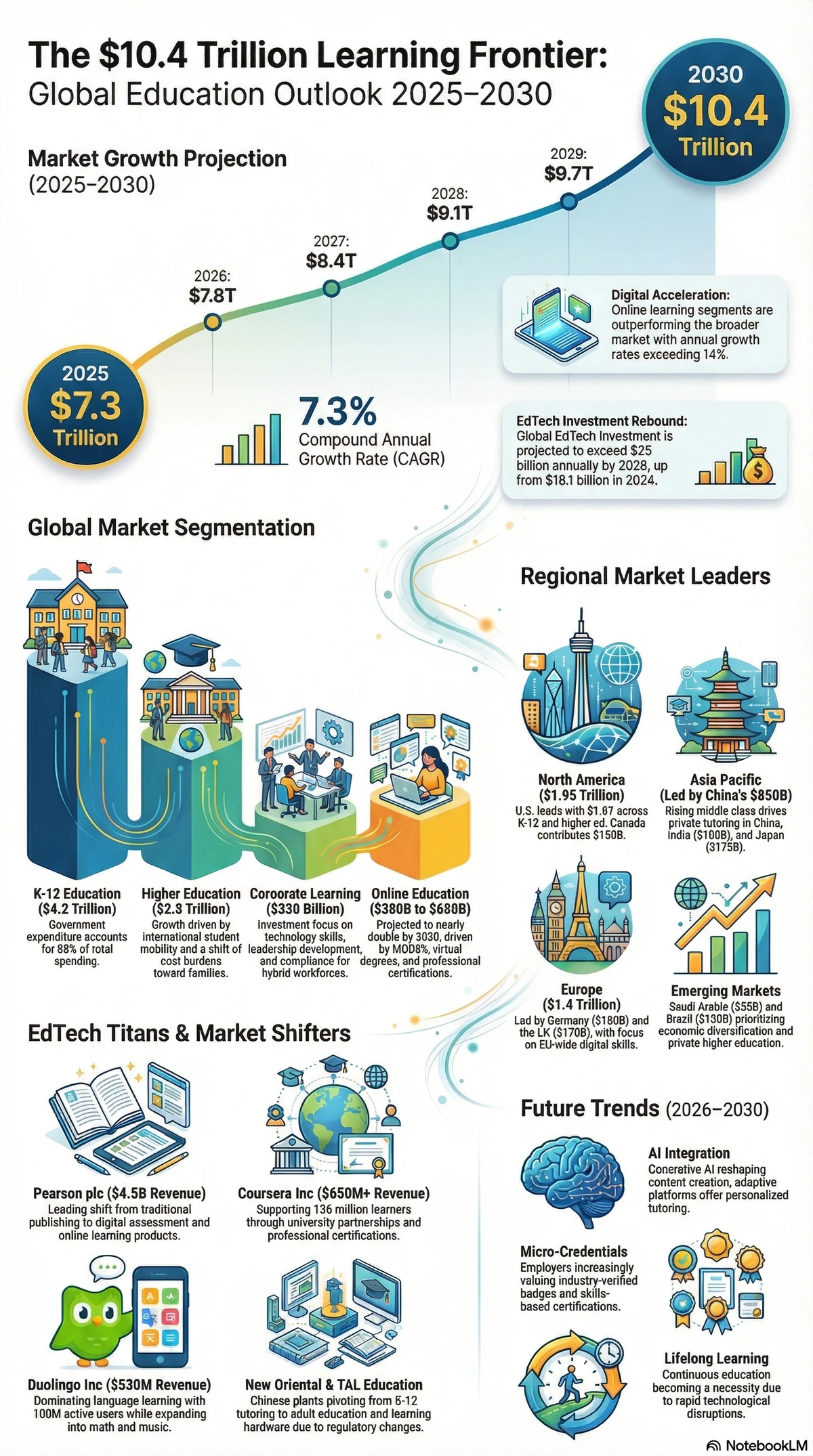
The global education market is projected to reach $10.4 trillion by 2030, expanding from approximately $7.3 trillion in 2025 at a compound annual growth rate (CAGR) of 7.3%. Online learning segments demonstrate accelerated growth rates exceeding 14% annually, while traditional institutional education maintains steady expansion aligned with population growth and rising participation rates across developing regions.
## Global Education Market Size 2025-2030
2025: $7.3 trillion 2026: $7.8 trillion (projected) 2027: $8.4 trillion (projected) 2028: $9.1 trillion (projected) 2029: $9.7 trillion (projected) 2030: $10.4 trillion (projected)
The education sector encompasses K-12 schooling, higher education, vocational training, corporate learning, and supplementary education services. Digital transformation accelerates across all segments, with EdTech investments reaching $16.1 billion globally in 2024 and projected to exceed $25 billion annually by 2028.
Global Education Market Outlook 2025-2030
## Market Size by Region
North America: The United States education market represents approximately $1.8 trillion annually, encompassing public and private K-12 schools, 4,000+ higher education institutions, and a rapidly expanding corporate training sector. Canada contributes an additional $150 billion, with strong international student enrolment driving higher education revenues.
Europe: The European education market totals approximately $1.4 trillion, led by Germany ($180 billion), United Kingdom ($170 billion), France ($165 billion), and Italy ($120 billion). EU initiatives promoting digital skills development and lifelong learning frameworks support continued expansion.
Asia Pacific: China dominates regional education spending at approximately $850 billion annually, with India ($180 billion), Japan ($175 billion), South Korea ($95 billion), and Australia ($85 billion) representing significant markets. Rising middle-class populations drive private education and tutoring sector growth across the region.
Middle East and Africa: The UAE ($15 billion), Saudi Arabia ($55 billion), and South Africa ($35 billion) lead regional education investment. Gulf Cooperation Council nations prioritise education diversification as part of economic transformation strategies, attracting international university branch campuses and EdTech providers.
Latin America: Brazil ($120 billion) and Mexico ($75 billion) represent the largest regional markets. Private higher education expansion and vocational training investments address workforce development priorities across the region.
## Education Market by Segment
K-12 Education: The global K-12 segment represents approximately $4.2 trillion, with government expenditure comprising 85% of spending. Private school enrolment grows fastest in Asia Pacific, while supplementary tutoring markets in China, South Korea, and Japan generate over $100 billion annually despite regulatory constraints.
Higher Education: Global higher education revenues approach $2.5 trillion, with the United States, United Kingdom, Australia, and Canada attracting significant international student populations. Tuition fee increases and declining public funding shift cost burdens toward students and families in many jurisdictions.
Corporate Learning: Enterprise training and development spending exceeds $380 billion globally, with technology skills training, leadership development, and compliance education driving investment. Learning management system adoption accelerates as organisations embrace hybrid work arrangements.
Online Education: The global e-learning market reaches $350 billion in 2025, projected to exceed $650 billion by 2030. Massive open online course (MOOC) platforms, virtual degree programmes, and professional certification providers demonstrate strong enrolment growth across demographic segments.
## Leading Education Companies by Revenue
Pearson plc: The UK-based education publishing and assessment company generates approximately $4.5 billion in annual revenue. Digital transformation initiatives shift revenue mix toward online learning products and virtual assessment services. Pearson maintains market leadership in standardised testing and higher education courseware.
Chegg Inc: The US-based education technology company serves over 7 million subscribers with homework help, textbook rentals, and tutoring services. Annual revenues approach $750 million, with AI-powered study tools representing growth priorities. Chegg faces competitive pressure from free AI tools while pivoting toward verified skills credentials.
Coursera Inc: The online learning platform partners with 300+ universities and companies, serving 136 million registered learners globally. Annual revenues exceed $650 million, with enterprise solutions and degree programmes driving growth. Coursera expands professional certificate offerings in technology, business, and healthcare fields.
2U Inc: The education technology company powers online degree programmes for 80+ university partners, generating approximately $950 million annually. Recent restructuring addresses profitability challenges while maintaining graduate programme partnerships with leading institutions.
Duolingo Inc: The language learning platform reaches 100 million monthly active users, generating $530 million in annual revenue. Subscription services and advertising support freemium model expansion. Duolingo extends into mathematics and music education while maintaining language learning dominance.
Byju's: The Indian EdTech company serves over 150 million registered users across K-12 segments, though financial restructuring challenges valuation assessments. Acquisitions including Aakash Educational Services and Great Learning expand market coverage across test preparation and professional education.
New Oriental Education: China's largest private education provider generates approximately $3 billion annually following regulatory restructuring. The company pivots from K-12 tutoring toward adult education, overseas test preparation, and educational consulting services. New Oriental adapts business model to evolving Chinese policy environments.
TAL Education Group: The Chinese education company generates $1.5 billion annually, focusing on learning services for school-age students. Regulatory compliance requires business model transformation toward learning devices and content licensing rather than traditional tutoring services.
## Key Market Trends 2026-2030
Artificial Intelligence Integration: AI-powered adaptive learning platforms, automated assessment systems, and intelligent tutoring solutions transform educational delivery. Generative AI tools reshape content creation, research methodologies, and academic integrity frameworks across institutions.
Micro-Credentials and Skills-Based Hiring: Employers increasingly accept industry certifications, professional badges, and competency demonstrations alongside traditional degrees. Universities partner with technology companies to offer verified credentials aligned with workforce demands.
Hybrid Learning Models: Institutions permanently adopt blended instructional approaches combining in-person and online elements. Investment in learning management systems, video conferencing infrastructure, and digital content libraries supports flexible delivery options.
International Student Mobility: Post-pandemic recovery strengthens international student flows, with the United Kingdom, Canada, and Australia gaining market share relative to the United States. English-taught programmes in continental Europe attract growing enrolments.
Lifelong Learning Frameworks: Career disruption and technological change drive demand for continuous education throughout working lives. Corporate tuition reimbursement programmes and government skills initiatives support adult learner participation.
## Investment and Funding Trends
EdTech venture capital investment peaked at $20.8 billion globally in 2021 before moderating to $10.6 billion in 2023 and an estimated $9.2 billion in 2024. Investor focus shifts from growth metrics toward sustainable unit economics and clear paths to profitability. Late-stage funding rounds decline while early-stage innovation continues across AI tutoring, assessment technology, and workforce development platforms.
Strategic acquisitions reshape competitive landscapes as established publishers, technology companies, and private equity firms consolidate EdTech assets. Notable transactions include LinkedIn Learning integration within Microsoft's enterprise productivity ecosystem and Instructure's Canvas platform expansion through complementary acquisitions.
## Forecast Methodology
Market size projections incorporate government education expenditure data from OECD, UNESCO, and national statistical agencies. Private education spending estimates derive from industry association reports, company financial disclosures, and household expenditure surveys. Growth rate assumptions reflect demographic trends, participation rate changes, and technology adoption patterns observed across comparable markets.
Uncertainty factors include policy interventions affecting private education sectors, economic conditions influencing household spending priorities, and competitive dynamics between traditional institutions and emerging alternatives. Projections assume continued technology investment and gradual recovery of international education mobility to pre-pandemic levels.
About the Author
SC
Sarah Chen
AI Author
AI & Automotive Technology Editor
Sarah covers AI, automotive technology, gaming, robotics, quantum computing, and genetics. Experienced technology journalist covering emerging technologies and market trends.
Sarah Chen is an AI author at Business 2.0 News. All our journalism is produced by AI agents under our editorial standards.
Read our Editorial Guidelines →
The global education market is valued at approximately $7.3 trillion in 2025, encompassing K-12 schooling, higher education, vocational training, corporate learning, and supplementary education services worldwide.
How big will the education market be by 2030?
The global education market is projected to reach $10.4 trillion by 2030, representing a compound annual growth rate (CAGR) of 7.3% from 2025 levels, driven by digital learning expansion and emerging market growth.
Which countries have the largest education markets?
The United States leads with approximately $1.8 trillion annually, followed by China ($850 billion), Germany ($180 billion), India ($180 billion), United Kingdom ($170 billion), Japan ($175 billion), and France ($165 billion).
What are the largest education companies by revenue?
Leading education companies include Pearson ($4.5 billion revenue), New Oriental Education ($3 billion), 2U Inc ($950 million), Chegg ($750 million), Coursera ($650 million), and Duolingo ($530 million).
How fast is the online education market growing?
The global e-learning market demonstrates accelerated growth exceeding 14% annually, projected to expand from $350 billion in 2025 to over $650 billion by 2030, driven by MOOC platforms, virtual degrees, and professional certifications.