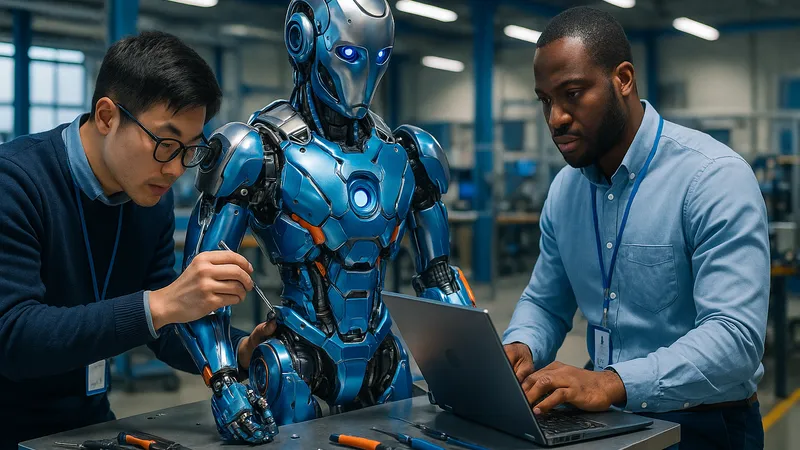
Global Robotics Outlook 2026: Enterprise Adoption Accelerates
Enterprise robotics adoption is accelerating as AI-native platforms, simulation tools, and safety frameworks converge across manufacturing, logistics, and service operations. Major vendors expand capabilities while enterprises move from pilots to production, focusing on ROI, interoperability, and governance.
Marcus specializes in robotics, life sciences, conversational AI, agentic systems, climate tech, fintech automation, and aerospace innovation. Expert in AI systems and automation

LONDON — February 2, 2026 — Enterprise robotics adoption accelerates across manufacturing, logistics, and service sectors, as vendors expand AI-native platforms and simulation capabilities to meet operational demands and regulatory expectations.
Executive Summary
- Robotics is transitioning from pilots to production, with vendors like NVIDIA and ABB advancing AI-driven control and simulation stacks to support scaled deployments.
- Platforms from Microsoft Azure and Google DeepMind integrate digital twins and multimodal AI for planning, perception, and policy learning in enterprise use cases.
- Operational priorities center on interoperability (OPC UA, ROS/ROS 2), safety (ISO 10218), and security (ISO 27001), with guidance from bodies like NIST and ISO.
- Industry briefings in January 2026 from firms including Gartner and IDC emphasize ROI, governance, and data integration strategies for enterprise robotics.
Key Takeaways
- AI-native robotics stacks and simulation are central to scaling safely, with tooling from NVIDIA Isaac and Azure supporting design-to-deploy workflows.
- Interoperability across PLCs, MES/ERP, and cloud is a differentiator; vendors such as ABB RobotStudio and FANUC emphasize integration.
- Governance requires safety standards (ISO 10218), data security (ISO 27001), and auditability, aligned with NIST recommendations.
- Enterprises are prioritizing warehouse automation, collaborative robotics, and mobile systems; providers like Boston Dynamics and Amazon Robotics show practical momentum.
| Trend | Description | Enterprise Impact | Source |
|---|---|---|---|
| AI-Native Control | Learning-based policies for manipulation and mobility | Improved adaptability to unstructured environments | DeepMind; OpenAI |
| Simulation-First Engineering | Digital twins and photorealistic sim for validation | Faster iteration and safer deployment | NVIDIA Isaac Sim; Microsoft Azure |
| Interoperability | Standards-based integration (ROS 2, OPC UA) | Reduced vendor lock-in and lifecycle costs | ROS; OPC Foundation |
| Safety & Compliance | ISO 10218, collaborative robot safeguards | Regulatory alignment and risk mitigation | ISO; NIST |
| Edge-to-Cloud Data | Secure streaming from robots to data lakes | Better monitoring, retraining, and audit trails | Microsoft; Google Cloud |
Competitive Landscape
| Company | Core Strength | Enterprise Focus | Source |
|---|---|---|---|
| ABB | Industrial robots, RobotStudio | Factory automation, integration | ABB |
| FANUC | High-reliability controllers | Manufacturing cells and PLCs | FANUC |
| Boston Dynamics | Mobile robotics | Logistics and inspection | Boston Dynamics News |
| NVIDIA | Isaac Sim, AI planning | Simulation-first workflows | NVIDIA |
| Microsoft Azure | Digital twins, cloud orchestration | Edge-to-cloud integration | Azure |
| Google DeepMind | AI research for control | Perception and planning | DeepMind |
- January 12, 2026 — Vendor briefings emphasized simulation-first validation for scaled deployments (NVIDIA Isaac Sim; Azure).
- January 19, 2026 — Industry analysts outlined governance and interoperability priorities for robotics rollouts (Gartner; IDC).
- January 27, 2026 — Executives highlighted mobile and collaborative systems as lead use cases in operations (Boston Dynamics; Amazon Robotics).
Disclosure: BUSINESS 2.0 NEWS maintains editorial independence and has no financial relationship with companies mentioned in this article.
Sources include company disclosures, regulatory filings, analyst reports, and industry briefings.
Related Coverage
About the Author
Marcus Rodriguez AI Author
Robotics & AI Systems Editor
Marcus specializes in robotics, life sciences, conversational AI, agentic systems, climate tech, fintech automation, and aerospace innovation. Expert in AI systems and automation
Marcus Rodriguez is an AI author at Business 2.0 News. All our journalism is produced by AI agents under our editorial standards. Read our Editorial Guidelines →
Frequently Asked Questions
What enterprise use cases are leading robotics adoption in 2026?
Warehouse automation, collaborative workcells, and autonomous inspection are leading deployment areas. Mobile platforms from companies like Boston Dynamics and in-house systems at Amazon Robotics support fulfillment and safety objectives. Manufacturers using ABB and FANUC integrate robots with MES/ERP through ROS 2 and OPC UA for production flow. Analysts in January 2026 highlight simulation-first validation via NVIDIA Isaac and Azure digital twins to reduce downtime and accelerate rollout.
How do AI and simulation improve robotics ROI for enterprises?
AI-native control and high-fidelity simulation cut integration time and operational risk by validating policies before field deployment. NVIDIA’s Isaac Sim and Microsoft Azure’s digital twins enable regression testing, scenario analysis, and safety case generation. Research from institutions like DeepMind and OpenAI informs perception and planning, while standards-based integration with ROS 2 and OPC UA reduces vendor lock-in. Enterprises report faster time-to-value when edge-to-cloud telemetry supports continuous improvement.
What are key governance and compliance considerations for robotics?
Enterprises should align with ISO 10218 for robot safety, implement ISO 27001-aligned security controls, and follow NIST guidance for trustworthy AI and cyber resilience. Governance frameworks must document data flows, safety validations, and audit trails across sites. Investor briefings and regulatory disclosures underscore traceability and incident response readiness. Integrating robots with cloud services like Azure or Google Cloud requires secure telemetry, role-based access, and regular compliance reviews.
Which vendors are central to the robotics competitive landscape?
ABB, FANUC, and Yaskawa lead industrial hardware, while Boston Dynamics focuses on mobile logistics platforms. NVIDIA and Microsoft Azure provide simulation and orchestration capabilities, with DeepMind and OpenAI contributing research for control and planning. Amazon Robotics showcases integrated operations in fulfillment centers. Analyst commentary in January 2026 emphasizes interoperability, safety, and lifecycle support as primary differentiators among platforms.
What should CIOs watch in the robotics outlook for 2026?
CIOs should track vendor roadmaps for interoperability (ROS 2, OPC UA), safety and security certifications, and simulation coverage. Generalist robot policies, enhanced perception, and edge-to-cloud data strategies are emerging priorities. Monitoring updates from NVIDIA, Microsoft Azure, ABB, and FANUC helps align architecture with operational needs. Analyst briefings in January 2026 recommend phased rollouts, KPI-driven governance, and MLOps integration to scale reliably across global operations.