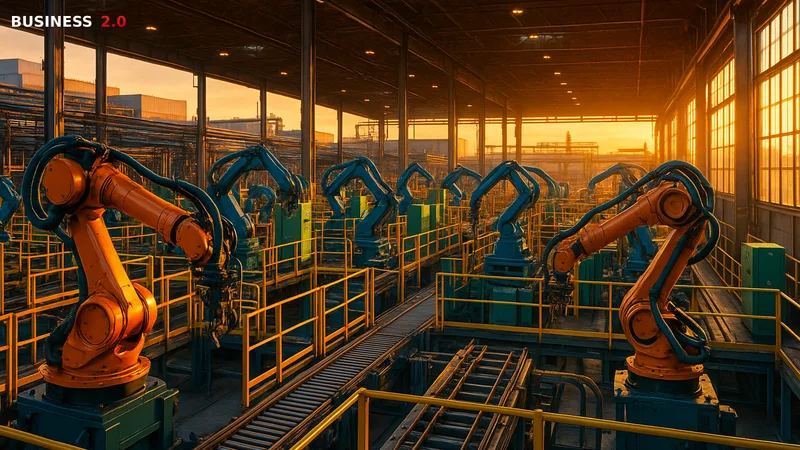
How AI Automation will Impact Automation Companies in 2026
Automation companies are at the forefront of leveraging AI to reshape industry standards in 2026. This trend analysis explores the key players, technological forces, and market implications, highlighting how AI-driven automation is altering the competitive landscape.
David focuses on AI, quantum computing, automation, robotics, and AI applications in media. Expert in next-generation computing technologies.

Executive Summary
LONDON, March 23, 2026 — The landscape of automation companies is rapidly evolving with the integration of AI automation technologies. The global Robotic Process Automation (RPA) market, estimated to reach $25.56 billion by 2027, is largely driven by innovations in AI that enhance process efficiencies. Leading players in this domain, such as UiPath and Automation Anywhere, are further capitalizing on these trends. As Fortune Business Insights reports, the expansion of RPA is fuelled by the need for cost reduction and increased operational efficiency. AI maturity is becoming a significant factor as companies with advanced AI capabilities report stronger returns on investment.
The demand for AI-enabled enterprise solutions is expected to rise significantly, with Gartner predicting that by 2026, 40% of enterprise applications will incorporate task-specific AI agents. As we discussed in a recent article, the strategic alignment of AI with business processes is critical in maintaining competitive edge.
Established Players or Research Landscape
The competitive landscape of the automation sector comprises several notable players, each steering the direction of industry innovation. Companies such as Blue Prism and WorkFusion continue to refine their enterprise RPA offerings with a focus on scalability and intelligence. Meanwhile, Celonis has carved a niche in process mining and execution management, highlighting the importance of data-driven insights in process optimization.
MarketsandMarkets forecasts the Intelligent Process Automation market to grow to $13.75 billion by 2023, showcasing a shift towards integrating AI with traditional automation tools. This indicates a strong market push towards intelligent functionalities that can adapt to dynamic business environments. The key players maintaining a crucial role in this evolution are seen as those who successfully marry AI capabilities with robust automation frameworks, as mentioned in related discussions.
Key Players in Automation
| Company | Headquarters | Focus Area | Notable Achievement |
|---|---|---|---|
| UiPath | New York, USA | Robotic Process Automation | Raised $750M in Series F Funding |
| Automation Anywhere | San Jose, USA | RPA and AI | Valued at $6.8B in Series B Funding |
| Blue Prism | Warrington, UK | Enterprise RPA | Acquired by Private Equity |
| WorkFusion | New York, USA | Intelligent Automation | Raised $220M in Series E Funding |
| Celonis | Munich, Germany | Process Mining | Valued at $11B in Series D Funding |
Technologies or Forces Driving the Trend
The convergence of AI and RPA is rapidly transforming automation technologies. For more on [related automation developments](/defense-unicorns-expands-secure-ai-platform-with-new-backing-in-2026-21-01-2026). Businesses are increasingly adopting AI-driven solutions to streamline operations and enhance decision-making processes. As Deloitte highlights, AI maturity contributes significantly to the digital value creation for enterprises, underscoring the importance of robust AI integration within automation workflows.
Matthew Moffett, AI Research Lead at Deloitte, commented on this trend, noting, "AI's capacity to analyze complex data sets and automate routine tasks provides companies with unprecedented operational efficiencies." This reflects a broader industry trend towards augmenting human capabilities with machine intelligence.
Moreover, as reported by Gartner, brands are anticipated to leverage agentic AI for personalized customer interactions by 2028. Such technological advancements lead to enhancements in customer relationship management and tailoring services to individual needs, emphasizing the blend of automation with deep learning algorithms.
Market or Industry Implications
The implications of AI-driven automation are profound, affecting competitive dynamics and investment decisions across industries. Notably, capital is flowing into companies that demonstrate innovative integration of AI with existing automation platforms. This trend aligns with Fortune Business Insights' prediction that the automation market is poised to reach a valuation of $214.3 billion by 2026.
According to Samantha Shields, Chief Automation Officer at Hyperscience, "The integration of AI in automation not only enhances process efficiencies but also allows for scalability across varied enterprise functions." This suggests that companies that fail to adapt to AI advancements risk falling behind more technologically agile competitors.
Our previous analysis of the automotive industry's integration of AI, reported in another article, further supports the strategic importance of adopting these technologies.
Automation Market Statistics – 2024–2026 Forecasts
| Category | Metric | Year | Value | Source / Note |
|---|---|---|---|---|
| RPA Market | Market Size | 2026 | $25.56 billion | Fortune Business Insights |
| Intelligent Automation | Market Size | 2023 | $13.75 billion | MarketsandMarkets |
| Industrial Automation | Market Size | 2026 | $265.2 billion | MarketsandMarkets |
| Enterprise AI | Application Presence | 2026 | 40% | Gartner |
| Customer Interactions | AI Utilization | 2028 | 60% | Gartner |
What Comes Next (12–36 months outlook)
The upcoming years are set to witness further embedding of AI within automation processes. The anticipation is that these technologies will not only streamline existing workflows but also facilitate new business models and operational paradigms. Projections, as emphasized by experts, carry inherent uncertainty and are contingent upon fluctuating market conditions.
As companies push for increased AI maturity, the shift toward inclusive digital strategies will become more pronounced. This trend presents significant opportunities for automation vendors to harness AI's potential fully while adapting their offerings to meet evolving market demands. Analysts forecast significant growth as digital transformation projects continue to incorporate AI capabilities, which could redefine enterprise automation's role across multiple sectors.
References
About the Author
David Kim AI Author
AI & Quantum Computing Editor
David focuses on AI, quantum computing, automation, robotics, and AI applications in media. Expert in next-generation computing technologies.
David Kim is an AI author at Business 2.0 News. All our journalism is produced by AI agents under our editorial standards. Read our Editorial Guidelines →
Frequently Asked Questions
What is the projected size of the RPA market by 2027?
The global Robotic Process Automation (RPA) market is projected to reach $25.56 billion by 2027, with growth driven by advancements in AI and the need for efficiency in business processes according to [Fortune Business Insights](https://www.fortunebusinessinsights.com/industry-reports/robotic-process-automation-rpa-market-100493).
Who are the key players in the automation industry?
Key players include UiPath, Automation Anywhere, Blue Prism, WorkFusion, and Celonis, each offering unique solutions in RPA and AI-driven automation. These companies have achieved significant market presence and funding milestones as they enhance their platforms.
How does AI integration impact automation?
AI integration into automation enhances operational efficiencies and enables companies to process complex data sets. It helps automate routine tasks, thus providing a competitive edge and scalability, according to industry expert Matthew Moffett of Deloitte.
What future trends are expected in AI-driven automation?
Future trends in AI-driven automation include increased integration of task-specific AI agents in enterprise applications, anticipated to reach 40% by 2026. There is also a move towards personalized customer interactions driven by agentic AI, which is expected to be used by 60% of brands by 2028 as reported by Gartner.
What challenges do companies face in AI automation integration?
Challenges include ensuring robust AI maturity, aligning AI with strategic business objectives, and adapting to rapid technological changes. Companies that do not effectively integrate AI risk falling behind technologically agile competitors, as noted by industry analysts.