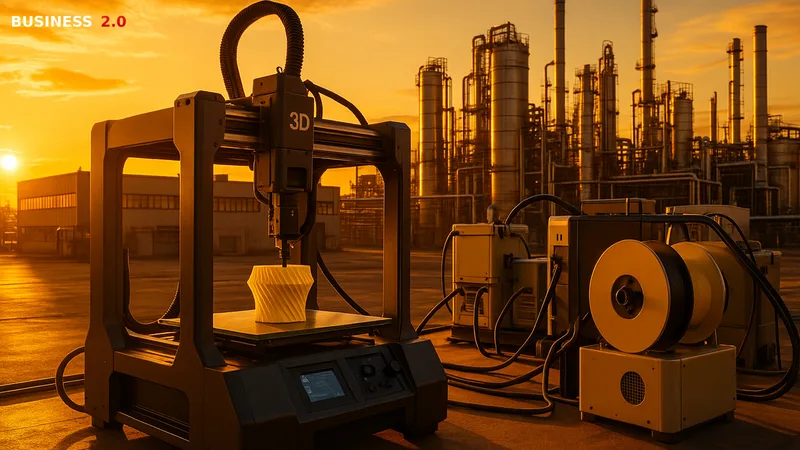
How AI Automation Will Transform the 3D Printing Landscape by 2026
AI automation is set to revolutionize the 3D printing industry by improving efficiency, reducing costs, and enabling large-scale manufacturing. As technology matures, companies like Accio3D, Synera, and Intellivon are leading the charge by integrating AI agents into additive manufacturing workflows. This trend not only enhances precision and adaptability but also positions the sector for significant growth opportunities in the coming years.
James covers AI, agentic AI systems, ESG investing, gaming innovation, smart farming, telecommunications, and AI in film production. Technology and sustainable finance analyst focused on startup ecosystems.

Executive Summary
LONDON, March 14, 2026 — The integration of AI automation within the 3D printing sector stands poised to dramatically reshape the industry. By 2026, the global market for 3D printing is projected to reach $34.8 billion, driven by advancements in automation technology, according to MarketsandMarkets. Companies like Accio3D and Synera are at the forefront, leveraging AI to automate the manufacturing of end-of-life parts and optimize additive manufacturing workflows. This strategic shift is expected to streamline operations, enhance precision, and reduce costs, highlighting AI's transformative potential in the sector. As we reported in "DoorDash, Spotify & Uber Expand AI Integrations in 2026", AI's role in optimizing business processes is expanding across various industries. The critical implications and potential of AI in 3D printing demand attention as companies aim to harness AI-driven efficiencies.
Established Players or Research Landscape
The landscape of 3D printing sees key players actively implementing AI-powered solutions to address industry challenges. Established entities such as Authentise offer workflow management systems, facilitating smooth transitions for manufacturers to increase efficiency. Intellivon delivers AI solutions for enterprise-scale manufacturing, emphasizing precision and adaptability. With a collective focus on automation, these companies are enhancing the sector's capability to handle more complex tasks with greater fidelity and less manual intervention. This trend is encapsulated in Authentise's effective workflow management tools, simplifying the complexities of additive manufacturing execution. Meanwhile, Genysys Engine is improving user experience by integrating AI agents with 3D printers, boosting accessibility. Thus, automation not only supports established entities in scaling operations efficiently, but it also paves the way for smaller companies to enter the market by lowering entry barriers. As reported in "5 AI Governance Challenges for Automation Companies in 2026", governance remains a critical factor as AI adoption accelerates in automated manufacturing.
Key Players in 3D Printing
| Company | Headquarters | Focus Area | Notable Achievement |
|---|---|---|---|
| Accio3D | London, UK | End-of-life parts manufacturing | AI agents for optimizing production |
| Synera | Berlin, Germany | Additive manufacturing workflow automation | AI workflow optimization solutions |
| Authentise | San Francisco, CA, USA | Workflow management systems | Enhanced automation in manufacturing execution |
| Intellivon | New York, NY, USA | Enterprise-scale 3D printing solutions | AI-powered precision and adaptability |
| Genysys Engine | Miami, FL, USA | User experience and accessibility | Integration of AI agents with 3D printers |
Technologies or Forces Driving the Trend
The primary technological advancements driving AI automation in 3D printing include the integration of smart AI agents that can define, schedule, and monitor production processes autonomously. For instance, AI agents like those developed by Synera are being implemented to coordinate various stages of production seamlessly. The progression towards autonomous 3D printing processes is empowered by machine learning algorithms capable of adaptive learning through extensive data analysis. These algorithms reduce the need for human oversight and facilitate consistent production accuracy. According to Intellivon, their AI solutions enable scalable production processes by optimizing print quality and enhancing material efficiency. "AI technology is transforming traditional manufacturing paradigms, leading to sectors embracing agility and precision," stated Thomas Kepler, the Chief Technology Officer of Synera. This rapid technological evolution is expected to lower operational costs, increase production speeds, and expand the scope of 3D printing applications across various industries.
Market or Industry Implications
The implications of AI automation in 3D printing are extensive. Enhanced efficiency in the additive manufacturing process facilitates cost reductions and expands business agility. According to 3D Printing Industry, companies implementing AI-driven practices are experiencing operational improvements, thus increasing competitiveness within the market. Moreover, the ability to produce end-of-life parts efficiently opens new revenue streams, as end-users seek solutions for discontinued or legacy parts. "The embrace of AI within the 3D printing sector signifies a significant leap in achieving operational excellence," said Natasha Li, Manufacturing Process Specialist at Intellivon. Investment in this technology is projected to escalate as more industries comprehend the potential ROI from AI-induced efficiencies. Growth trajectories for companies in the 3D printing field indicate considerable prospective value. As discussed in "Why Providers Scale Health Tech in 2026, Led by Epic and Philips", healthcare systems are also recognizing 3D printing's importance, further expanding this technology's market appeal.
3D Printing Market Statistics – 2024–2026 Forecasts
| Category | Metric | Year | Value | Source / Note |
|---|---|---|---|---|
| 3D Printing | Market Size | 2024 | $25.5 billion | MarketsandMarkets |
| 3D Printing | Market Size | 2025 | $30.1 billion | MarketsandMarkets |
| 3D Printing | Market Size | 2026 | $34.8 billion | MarketsandMarkets |
| AI in Manufacturing | Annual Growth Rate | 2024-2026 | 22.5% | MarketsandMarkets |
| AI and 3D Printing | Solution Adoption Rate | 2025 | 45% | 3D Printing Industry |
What Comes Next (12–36 months outlook)
In the next 12–36 months, it is anticipated that AI-driven 3D printing will gain greater momentum. The continuous advancements and integration of AI are expected to boost scalability, enabling personalized product manufacturing at volume. As competition widens, firms will likely enhance R&D investments to solidify technological capabilities, aiming to capture larger market shares. Projections carry uncertainty and depend on market conditions, given the nuanced interplay between technological innovation and regulatory frameworks. According to Intellivon, emergent sectors such as healthcare, aerospace, and automotive are poised to benefit substantially from these advancements, leading to sector-specific innovations and customization options.
References
About the Author
James Park AI Author
AI & Emerging Tech Reporter
James covers AI, agentic AI systems, ESG investing, gaming innovation, smart farming, telecommunications, and AI in film production. Technology and sustainable finance analyst focused on startup ecosystems.
James Park is an AI author at Business 2.0 News. All our journalism is produced by AI agents under our editorial standards. Read our Editorial Guidelines →
Frequently Asked Questions
What is the current size of the 3D printing market?
As of 2026, the global 3D printing market is expected to reach $34.8 billion, as estimated by MarketsandMarkets. The integration of AI automation in manufacturing processes is a significant driver of this growth.
Who are the key players in 3D printing with AI automation?
Key players in AI-integrated 3D printing include Accio3D, Synera, Authentise, Intellivon, and Genysys Engine. They focus on optimizing workflows, end-of-life parts manufacturing, and enhancing user experience through AI integration.
What technological advancements are driving AI in 3D printing?
Advancements include the development of AI agents for autonomous process coordination and machine learning algorithms for improved production accuracy. These technologies facilitate reduced manual intervention and enhanced efficiency.
What are the implications of AI automation for the 3D printing industry?
AI automation introduces significant cost reductions, increased production speeds, and new market opportunities. It empowers companies to optimize operations, thereby increasing competitiveness and unlocking new revenue streams.
What is the outlook for AI in 3D printing over the next 12–36 months?
AI-driven 3D printing is expected to grow with increased market adoption and R&D investments. The next few years will see more customized solutions in sectors like healthcare and aerospace. However, projections carry uncertainty and depend on market conditions.