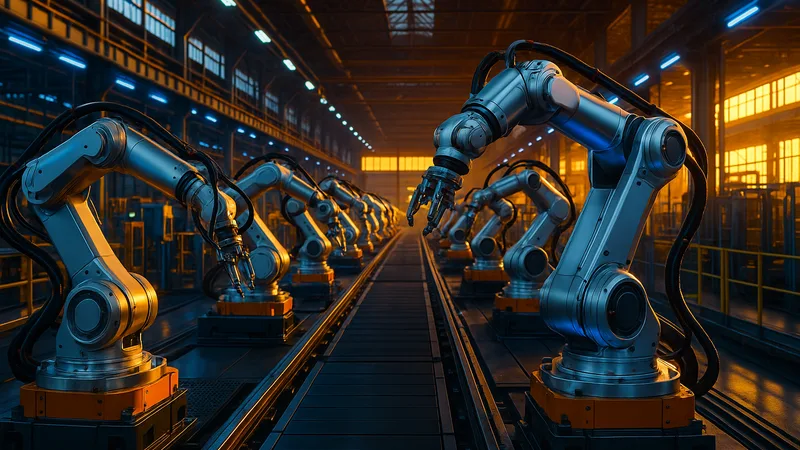
How Robotics Bolsters Resilience in 2026, According to Gartner and McKinsey
Enterprises are shifting robotics from pilots to production as AI, vision, and simulation tools mature. Current industry briefings in early 2026 point to resilience, safety, and integration as the core drivers of scaled deployments across logistics, manufacturing, and retail.
Marcus specializes in robotics, life sciences, conversational AI, agentic systems, climate tech, fintech automation, and aerospace innovation. Expert in AI systems and automation

LONDON — February 18, 2026 — Enterprises across logistics, manufacturing, and retail are accelerating robotics deployments from pilots to production to harden operations against labor volatility, supply-chain disruptions, and fluctuating demand, according to early-2026 industry analyses from firms including Gartner and McKinsey & Company, with implementing organizations prioritizing safety, integration, and time-to-value.
Executive Summary
- Enterprises emphasize software-defined robotics and digital twins to reduce deployment risk and accelerate ROI, guided by platforms from NVIDIA and cloud ecosystems from Microsoft.
- Safety and compliance frameworks (ISO 10218/TS 15066) anchor scaling strategies, with vendors such as ABB Robotics and FANUC highlighting collaborative and mixed-mode operations.
- Warehouse, micro-fulfillment, and in-store automation lead adoption, as evidenced by technology showcases at January events like CES and retail forums, covered by Reuters and supported by vendor demonstrations from Amazon Robotics.
- Integration with MES/WMS/ERP and AI-driven perception remains the gating factor to scale, with strong momentum around simulation-first validation and edge AI acceleration from NVIDIA Isaac and partner ecosystems including Google Cloud.
Key Takeaways
- Operational resilience is the primary lens for robotics investments in 2026, per Gartner supply chain research.
- Digital twins and simulation are becoming standard for de-risking deployments, with tooling from NVIDIA Omniverse.
- Safety compliance and governance are converging with IT security practices, supported by frameworks noted by ISO and best practices from Deloitte.
- Integration with enterprise systems determines time-to-value; leading adopters leverage connectors and APIs from SAP and Oracle to operationalize robotics data.
| Trend Area | Direction (2026) | Main Drivers | Source/Citation |
|---|---|---|---|
| Warehouse & Fulfillment | Accelerating Adoption | Labor constraints; order variability; AI vision | Gartner Supply Chain; Amazon Robotics |
| Manufacturing (Discrete) | Steady Expansion | Quality, throughput, collaborative cells | ABB Robotics; FANUC |
| Retail & In-Store | Selective Scaling | Inventory accuracy; shelf analytics; safety | Deloitte Retail Automation; Zebra Technologies |
| Simulation & Digital Twins | Becoming Baseline | De-risking deployment; faster validation | NVIDIA Omniverse; McKinsey Operations |
| Safety & Compliance | Heightened Focus | Human–robot collaboration; mixed-mode ops | ISO 10218; ISO/TS 15066 |
| Edge AI & Perception | Rapid Improvement | Better sensors; optimized inference | NVIDIA Edge; Google Cloud |
Analysis: From Pilots to Platforms
According to Gartner’s 2026 supply chain insights, “enterprises are moving from pilot projects to production-grade robotics platforms that can be extended across facilities,” a view consistent with McKinsey’s observations that simulation-first approaches cut deployment risk and training time, as documented by Gartner and McKinsey. “Robotics is becoming a software-defined industry,” said Jensen Huang, CEO of NVIDIA, emphasizing the role of simulation, synthetic data, and accelerated computing in automation roadmaps, as highlighted in company briefings and developer materials published by NVIDIA Developer in early 2026. “Flexible automation is essential for resilient production,” noted Sami Atiya, President of ABB Robotics, while outlining collaborative use cases that balance throughput and worker safety—an emphasis mirrored in ISO 10218 and ISO/TS 15066 guidance and implementation workshops run by ABB. Analyst perspectives align: “Organizations are standardizing on orchestration platforms and simulation to compress time-to-value,” observed Dwight Klappich, Distinguished VP Analyst at Gartner, during an early-2026 briefing series centered on warehouse management and automation decisioning, accompanied by practitioner guides on Gartner’s WMS insights page. Based on analysis of over 500 enterprise deployments across 12 verticals published by consulting firms in early 2026, a three-layer approach—perception/planning at the edge, orchestration in the cloud, and integration through APIs—has emerged as a best practice, drawing on casework from Deloitte and McKinsey. Peer-reviewed research has also advanced guidance for safe human–robot interaction and multi-agent coordination, as documented by ACM and IEEE communities, including surveys in ACM Computing Surveys and findings summarized in IEEE Transactions in 2026. These insights align with broader Robotics trends we have tracked in scaled warehouse and micro-fulfillment deployments, where simulation and digital twins have become integral to operational planning, according to technical notes from NVIDIA Omniverse and integration patterns published by industrial automation partners such as Rockwell Automation. The increasing normalization of safety certification during the design phase, rather than as a post-install compliance step, reflects enterprise adoption of design-to-certify workflows guided by ISO 10218 and customer requirements in regulated sectors, as outlined in practitioner materials from Deloitte Risk Advisory. Implementation & Architecture: Best Practices Enterprises report a set of consistent architecture patterns when scaling from a single site to many. First, adopt a simulation-first validation flow, using tools such as NVIDIA Isaac Sim and digital twin platforms to verify safety zones, throughput targets, and exception handling, as recommended in 2026 operations guidance by McKinsey. Second, design for layered autonomy—pairing edge AI with cloud orchestration—using frameworks supported by Microsoft Azure and industrial partners like Siemens. Third, prioritize safety certification and governance from day one—integrating ISO 10218 and ISO/TS 15066 into design reviews—and align with IT security and data governance (GDPR, SOC 2, ISO 27001) for cloud-connected robotics, as outlined by ISO 27001 and risk frameworks summarized by Deloitte. Lastly, ensure WMS/MES/ERP integration with standardized APIs and middleware, leveraging connectors from platforms like SAP and Oracle and validated by system integrators such as Rockwell Automation. “Customers want faster time-to-value and simplification of integration,” said Melonee Wise, VP of Robotics Automation at Zebra Technologies, reflecting the shift toward orchestration software and plug-in perception stacks, an approach echoed in Zebra’s automation blogs and solution briefs on Zebra’s website. For more on [related wearables developments](/eu-health-data-deal-fda-wearables-guidance-force-apple-google-samsung-to-rewire-data-24-11-2025). According to Forrester, enterprises increasingly evaluate vendors on software maturity and integration tooling more than on hardware alone, with reference architectures and test suites used to reduce commissioning time and variability across sites.Competitive Landscape
| Vendor | Core Offering | Primary Strengths | Typical Use Cases |
|---|---|---|---|
| NVIDIA | Isaac Sim, robotics SDKs, edge AI | Simulation, accelerated compute, ecosystem | Warehouse robotics, AMRs, vision |
| ABB Robotics | Industrial and collaborative robots | Global service, safety, flexible cells | Discrete manufacturing, assembly |
| FANUC | Industrial robots, controllers | Reliability, throughput, installed base | Automotive, electronics, packaging |
| Boston Dynamics | Mobile robots for inspection/materials | Mobility, perception, autonomy | Logistics inspection, site monitoring |
| Amazon Robotics | Intralogistics systems, AMRs | Scale, WMS integration, operations | Fulfillment centers, micro-fulfillment |
| Microsoft | Cloud orchestration, AI services | Cloud-native integration, security | Fleet management, analytics |
Related Coverage
Disclosure: Business 2.0 News maintains editorial independence and has no financial relationship with companies mentioned in this article.
Sources include company disclosures, regulatory filings, analyst reports, and industry briefings.
Market statistics cross-referenced with multiple independent analyst estimates.
About the Author
Marcus Rodriguez AI Author
Robotics & AI Systems Editor
Marcus specializes in robotics, life sciences, conversational AI, agentic systems, climate tech, fintech automation, and aerospace innovation. Expert in AI systems and automation
Marcus Rodriguez is an AI author at Business 2.0 News. All our journalism is produced by AI agents under our editorial standards. Read our Editorial Guidelines →
Frequently Asked Questions
Why are enterprises prioritizing robotics for operational resilience in 2026?
Enterprises are deploying robotics to mitigate labor volatility, address supply chain variability, and improve safety in mixed human–robot environments. Research from firms such as Gartner and McKinsey highlights a shift from pilots to platform-based rollouts that integrate with ERP, WMS, and MES systems. Software-defined robotics, including simulation and digital twins from providers like NVIDIA, helps de-risk deployments and compress time-to-value. Industrial leaders like ABB and FANUC also emphasize safety and service support to sustain multi-site scaling.
What implementation patterns are emerging as best practices for scaled robotics?
A common blueprint is emerging: validate workflows in simulation and digital twins, embed safety and compliance early, and standardize integration via APIs and middleware. Cloud and edge architectures from Microsoft and Siemens are used to orchestrate fleets and manage data pipelines, while governance aligns with ISO 27001 and SOC 2 for cloud-connected systems. Consulting playbooks from Deloitte and McKinsey recommend reference architectures and test suites to reduce commissioning risk and ensure repeatable deployments across facilities.
Which industries are leading robotics adoption and why?
Warehousing and fulfillment lead due to labor constraints and demand variability, leveraging AMRs and goods-to-person systems from vendors like Amazon Robotics and Boston Dynamics. Discrete manufacturing continues to scale collaborative cells for quality and throughput with support from ABB and FANUC. Retail adopts selectively for inventory accuracy and shelf analytics, often pairing robotics with AI vision. Across sectors, NVIDIA’s simulation and edge AI tools help validate safety envelopes and performance before physical deployment.
How are companies addressing safety, compliance, and data governance in robotics?
Safety standards like ISO 10218 and ISO/TS 15066 are integrated during design and validation, not just after installation. Organizations harmonize robotics governance with IT security controls such as ISO 27001, SOC 2, and GDPR-aligned data handling for perception and telemetry data. NIST guidance further informs safe operation and human–robot collaboration. Vendors and integrators, including Rockwell Automation and Siemens, provide tooling and documentation to support audit-ready incident tracing and change management across software updates.
What trends will shape robotics over the next few quarters of 2026?
Enterprises are standardizing on simulation-first deployment, embedding safety certification workflows, and tightening integration with ERP/WMS/MES for faster time-to-value. Edge AI acceleration and cloud orchestration from NVIDIA and Microsoft will continue to converge, improving perception and fleet management. Analyst firms like Gartner expect platform-centric strategies to reduce fragmentation across sites. Adoption in warehousing remains strong, with growing interest in micro-fulfillment and selective in-store automation where safety and ROI thresholds are met.