How the UAE Can Innovate Its Food Security with AI and Vertical Farming
The UAE can strengthen food security without pursuing full self-sufficiency by combining diversified trade with AI-managed vertical farming, controlled agriculture, and targeted protein production using spirulina, duckweed, and purpose-engineered crops.
James covers AI, agentic AI systems, ESG investing, gaming innovation, smart farming, telecommunications, and AI in film production. Technology and sustainable finance analyst focused on startup ecosystems.
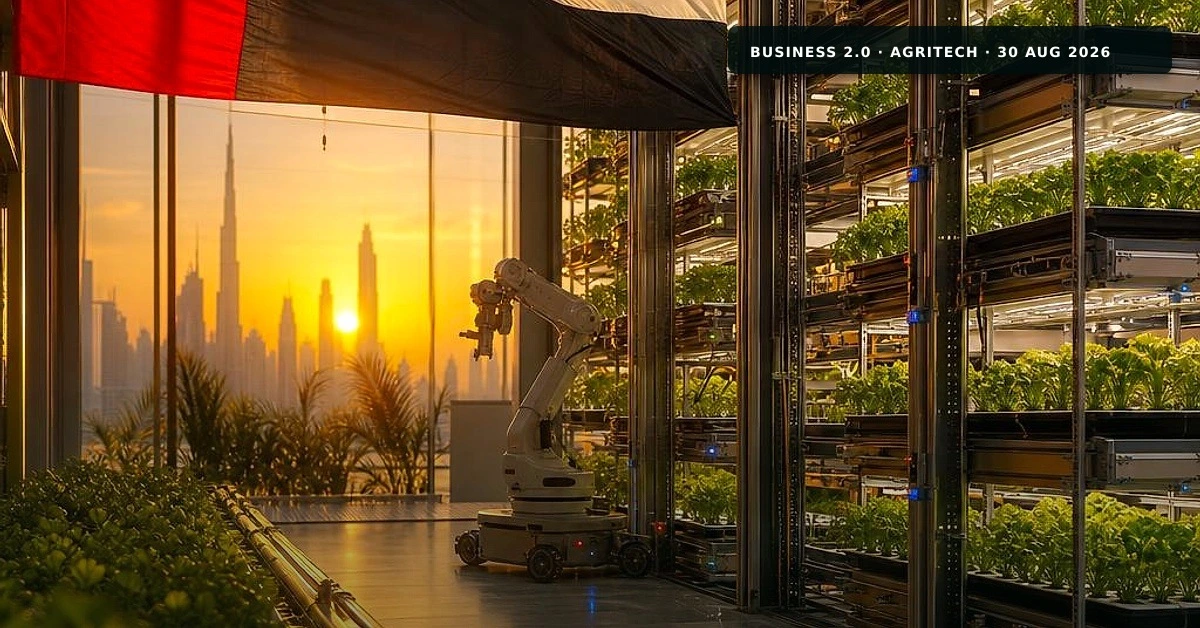
The United Arab Emirates does not need to become agriculturally self-sufficient to become more food secure. That distinction is important.
The UAE's geography makes conventional food self-sufficiency difficult: arable land and freshwater are constrained, and much of the country's food supply depends on international trade. The International Monetary Fund's 2025 Article IV consultation notes the UAE's heavy reliance on food imports and identifies expanding AgTech and diversifying food import sources as ways to further support food security. Separately, USDA reporting cites the UAE's Ministry of Climate Change and Environment figure that approximately 90 percent of the country's food comes from abroad.
The strategic opportunity, therefore, is not to grow everything the UAE currently imports. It is to use AI, controlled-environment agriculture, and new forms of food production to selectively localise the foods and nutrients where domestic production can materially improve resilience.
That means moving beyond the conventional vision of vertical farms producing lettuce and herbs. The more ambitious question is:
Can the UAE produce strategically important nutrition—particularly protein—using far less land and water, while using AI to optimise every unit of energy, water, and growing space?
Food Security Is Not Food Self-Sufficiency
The UAE's National Food Security Strategy 2051 already takes a relatively sophisticated view of food security. It combines sustainable domestic production with international trade, diversified import sources, and alternative supply arrangements. The strategy defines the national food basket as 18 major categories and calls for identifying alternative supply schemes covering three to five sources for each major food category.
This is effectively a resilience model rather than an autarky model.
| Objective | What It Means for the UAE |
|---|---|
| Diversified imports | Avoid excessive dependence on individual suppliers |
| Strategic reserves | Provide a buffer during temporary disruption |
| Domestic production | Produce selected foods and ingredients locally |
| Food technology | Increase output from scarce land and water |
| AI / data | Predict demand, risks, and production requirements |
| Alternative proteins | Reduce dependence on imported protein ingredients |
This distinction also changes how vertical farming should be evaluated. A vertical farm does not automatically improve food security simply because it produces food locally. If the facility consumes large quantities of electricity and produces a commodity that can be imported cheaply and reliably, the national-security benefit may be limited.
The question is therefore not “How much food can a vertical farm produce?” It is “How much strategically useful nutrition can it produce per unit of land, water, energy, and capital?”
The UAE's Cereal Dependency Illustrates the Problem — But Requires Careful Interpretation
Cereals are an obvious example of the UAE's exposure to international supply chains. A peer-reviewed study of UAE cereal supply risks calculated import-dependency rates above 100 percent for several cereals; for wheat, the calculation reached 160 percent in 2019.
That figure should not, however, be interpreted as meaning the UAE literally consumed 160 percent more imported wheat than it needed. The value exceeds 100 percent because the study's measure of imports includes quantities beyond immediate domestic consumption — including cereal stocks and reserves — and because the UAE is also a major regional trading and re-export hub. By contrast, the standard FAO cereal import dependency ratio is capped at 100 percent by definition, since it measures only the share of domestic supply that is imported.
This illustrates an important methodological point: food-trade statistics need to be interpreted in the context of the country's dual role as both a consumer and a logistics hub.
The broader evidence is simpler and more important: UAE government and USDA sources place food import dependence at roughly 80–90 percent of domestic consumption. The UAE therefore needs both international supply-chain resilience and carefully targeted domestic production.
Vertical Farming: Don't Simply Grow More Lettuce
Vertical farming has an obvious attraction in the UAE. It allows production to be separated from outdoor temperatures, soil quality, and conventional agricultural land availability. Hydroponic and aeroponic systems can recirculate water, while controlled environments allow temperature, humidity, lighting, nutrients, and irrigation to be managed precisely.
But vertical farming also has a fundamental economic disadvantage: electricity is an agricultural input. LED lighting, cooling, HVAC, pumping, and environmental control all consume energy, making it difficult to compete with outdoor agriculture for commodities that can be produced cheaply under sunlight.
This is why the UAE should not attempt to grow wheat, rice, or soy indoors. Instead, it should look for biological systems where the advantages of controlled environments outweigh their energy costs.
OnePointOne: An Example of the AI-Controlled Farm
US vertical-farming company OnePointOne describes its technology as a combination of vertical-plane aeroponics, automation, AI, plant science, and environmental control, built around software systems for crop research, harvest optimisation, and climate management. Its public materials describe the Opollo automated farming system and explain the company's technology architecture. The company's public materials argue that the vertical-farming industry should combine established greenhouse technologies — lighting, irrigation, HVAC, and automation — with innovation concentrated in AI/data analytics, genetics, and environmental control in its analysis of the state of vertical farming.
OnePointOne should not be treated as independent evidence that vertical farming is universally profitable. It is better understood as a technology case study demonstrating what a highly automated controlled-environment production system can look like. The UAE could learn from the architecture without assuming that every crop grown in such a system will be economically viable.
AI Could Become the Operating System of Controlled Agriculture
The most valuable role for AI may ultimately be optimisation rather than automation alone. A controlled-environment farm continuously generates data on temperature, humidity, CO2, light intensity and spectrum, nutrient concentration, pH, irrigation, plant growth, disease indicators, energy consumption, and harvest yield.
AI can potentially turn these measurements into a feedback loop: sensors → models → prediction → environmental adjustment → crop response → new data — continuously optimising the biological production system to predict harvest date, yield, disease probability, resource requirements, production cost, and protein output.
The Bigger Opportunity: Vertical Protein
The most interesting application may therefore not be another indoor vegetable. It could be protein production. Rather than trying to grow soy indoors, the UAE could investigate organisms whose biology is better suited to controlled environments. Three candidates deserve different levels of attention.
| Candidate | Evidence Today | Potential | Major Unanswered Question |
|---|---|---|---|
| Spirulina / microalgae | Established cultivation technology | High-density protein production | Energy and processing economics |
| Duckweed / Lemnaceae | Strong research + emerging commercial activity | Alternative protein ingredient | Scale, safety, extraction, consumer acceptance |
| Amaranth | Established agricultural crop | Purpose-bred vertical protein crop | Can seed production justify indoor energy costs? |
1. Spirulina: Strongest Near-Term Candidate
Spirulina (Arthrospira) is already cultivated as a biomass and protein source. Its biology makes it fundamentally different from grain crops: production can occur in aquatic systems and photobioreactors rather than requiring conventional agricultural soil. A 2025 study in ACS Sustainable Chemistry & Engineering examined energy utilisation and production efficiency in a thin-layer fountain photobioreactor. The research question should not simply be how much protein the organism contains, but how much usable protein the system can produce per square metre, per litre of water, and per kilowatt-hour. Spirulina deserves a near-term UAE pilot programme, particularly in systems designed around natural sunlight supplemented by artificial light where economically advantageous.
2. Duckweed: An Unusually Interesting Protein Platform
Duckweed may be one of the most promising biological systems for UAE food-security research. A peer-reviewed review indexed by PubMed describes duckweed as a rapidly growing aquatic plant with protein content reaching approximately 45 percent of dry weight and a useful amino-acid profile. Its aquatic growth habit allows for shallow, space-efficient cultivation systems rather than deep growing beds.
The technology is not solved, however. A 2025 Food Research International review identifies protein extraction, low protein solubility, contamination, heavy metals, allergenicity, regulatory requirements, and consumer acceptance as important barriers. Commercial development is occurring — for example, Plantible Foods' Lemna-derived protein isolate — but commercial activity should not be confused with proof of commodity-scale competitiveness. Duckweed is best treated as a strong R&D and pilot candidate rather than a proven replacement for imported soy.
3. Amaranth: The Long-Term Moonshot
Amaranth is nutritionally attractive: its protein quality is generally considered favourable relative to many conventional cereals. But the UAE should not confuse nutritional potential with vertical-farming economics. The proposition would be to develop amaranth specifically for controlled environments — compact architecture, faster maturation, higher seed yield and protein concentration, improved amino-acid profile, uniform maturation, and compatibility with automation.
This is scientifically plausible as a breeding or gene-editing research programme, but it is not an established commercial technology. No evidence currently demonstrates that a purpose-bred, vertically farmed grain amaranth can economically compete with field-grown grain or imported protein ingredients at commercial scale. Until the underlying energy and yield economics are tested experimentally, amaranth should be treated as a moonshot, not a solved UAE food-security technology.
Beyond Protein: Coffee, Cacao, Tea, and Saffron in Controlled Environments
The UAE's relevance to controlled-environment agriculture is not limited to staples and protein. Dubai is already a major global trading hub for several high-value agricultural commodities. DMCC (Dubai Multi Commodities Centre) operates a dedicated Agro Ecosystem spanning coffee, tea, cacao, grains, and spices, positioned as a marketplace connecting global net importers and exporters. According to figures DMCC cites from the UN FAO, the value of global agro exports grew by 270 percent between 2000 and 2020, reaching an export value of USD 490.1 billion in 2023, with production and trade both forecast to grow at just over 1 percent annually through 2033 [15]. DMCC has also announced plans for a dedicated Cacao Centre aimed at channelling a share of the USD 26.2 billion global cocoa trade through Dubai, and its Global Dubai Tea Forum forecasts the global tea market approaching USD 300 billion, positioning the UAE to anchor future tea trade growth [15].
This existing trading infrastructure raises a natural question: could any of these commodities also be produced domestically using controlled-environment methods, rather than only traded through the UAE?
The evidence is mixed and crop-specific.
Tea: The Closest Fit to Existing Vertical-Farming Economics
Tea (Camellia sinensis) is a leaf crop, which places it structurally closer to lettuce and herbs than to grain or tree crops. SananBio, a Chinese vertical-farming equipment manufacturer, has run indoor tea cultivation trials, reporting that controlled-environment agriculture allows pesticide-free cultivation with more consistent flavour by precisely managing temperature, light, and cultivation technique. Premium Chinese tea sells for an average of roughly USD 32 per kilogram, a price point that can help justify indoor production costs [16].
Cacao: Active Commercial R&D, Including a UAE Facility
Cacao is a tree crop with a multi-year maturation cycle, which makes its vertical-farming economics considerably harder than tea's. Even so, Cargill entered a multi-year research partnership with AeroFarms in 2021 to grow cocoa trees in fully controlled indoor environments, testing aeroponics, hydroponics, lighting, CO2, irrigation, and pruning to identify optimal growing conditions and develop more disease-resistant, climate-resilient cocoa varieties [17]. Notably, this research programme was set to expand beyond AeroFarms' original New Jersey site to AeroFarms' AgX Research and Development indoor vertical farm in Abu Dhabi — meaning UAE-based infrastructure is directly involved in this cacao research effort [18].
Coffee: Technically Possible, Not Yet Commercially Attempted
Coffee shares cacao's core structural challenge — it is a tree crop harvested for its fruit, with a multi-year cycle to first harvest. FAO specialists have confirmed it is technically possible to grow coffee trees in a greenhouse, and researchers are actively exploring indoor hydroponic cultivation, but as of current reporting no coffee farmers have yet adopted vertical indoor cultivation methods commercially [19].
Saffron: Already Commercially Live in the UAE
Saffron (Crocus sativus) is the strongest existing proof of concept among high-value specialty crops in the UAE. Veggitech opened what is described as the largest indoor vertical saffron farm in the Middle East and North Africa region, in Sharjah, in 2022, explicitly positioned within the UAE's National Food Security Strategy 2051 [20] [21].
Saffron's fit with controlled-environment economics differs from typical vertical-farmed produce in an important way: commercial cultivation forces flowering from dormant corms through precise temperature control (roughly 12°C at night, 17–20°C by day) rather than growing a plant through a full field-style life cycle, which sidesteps the maturation-time problem that limits grain, coffee, and cacao. Saffron is also among the most valuable spices globally by weight, giving it a value-per-square-metre economics that few other crops can match. The UAE facility's operators specifically cite it as a way to avoid the country's constrained, high-TDS water supply and reliance on imported fertiliser [20].
What This Means Alongside the Protein Case
Taken together with the spirulina, duckweed, and amaranth research discussed above, these four crops sketch a broader principle for UAE controlled-environment agriculture: the crops best suited to vertical or indoor production are either leaf-harvested (tea, leafy amaranth, lettuce, herbs), extremely high value per unit weight (saffron), or backed by well-funded multi-year R&D specifically because the payoff would be strategically or commercially significant (cacao, and to a lesser extent coffee). Wheat, rice, and corn remain outside this pattern on every count.
The Metric That Matters: Protein per Kilowatt-Hour
Traditional agriculture compares yield per hectare. Vertical agriculture needs a broader set of metrics.
| Metric | Why It Matters |
|---|---|
| Protein kg/m²/year | Land productivity |
| Protein kg/kWh | Energy productivity |
| Protein kg/m³ water | Water productivity |
| Protein recovery % | Efficiency of extraction |
| Essential amino-acid profile | Nutritional quality |
| AED/kg edible protein | Commercial viability |
| Crop-cycle length | Facility utilisation |
| Food-safety failure rate | Reliability |
| Imported tonnes displaced | National-security impact |
This framework prevents a common mistake. A crop containing 40 percent protein is not necessarily better than one containing 20 percent. If the first requires much more electricity, takes much longer to grow, or is difficult to process, its cost per kilogram of usable protein could be worse. Conversely, an organism with lower protein concentration but extremely rapid biomass turnover could potentially be more valuable.
What the UAE Should Build
The logical next step is not a nationwide network of vertical farms growing commodity crops. It is a national controlled-environment food-security R&D programme bringing together universities, food-security agencies, AI companies, vertical-farming operators, food manufacturers, biotechnology researchers, energy companies, and water researchers.
The first generation of pilot facilities could compare: (1) spirulina photobioreactors, (2) duckweed shallow-water cultivation, (3) conventional high-value vertical crops, (4) greenhouse production, and (5) experimental high-protein crops such as amaranth — all measured against the same economic and resource framework, producing a UAE-specific database of real economic yield, not just biological yield.
| Layer | Function |
|---|---|
| National food data | Monitor imports, prices, stocks, and supplier exposure |
| AI forecasting | Predict demand and disruption |
| Controlled agriculture | Produce selected foods domestically |
| Protein bioproduction | Investigate spirulina and duckweed |
| Crop R&D | Develop crops suited to UAE conditions |
| Automation | Reduce labour and improve consistency |
| Strategic reserves | Cover shocks that domestic production cannot |
| Global sourcing | Maintain diversified international supply |
From Food Self-Sufficiency to Food Resilience
The UAE's advantage is not that it can reproduce the agricultural systems of countries with abundant farmland and freshwater. Its advantage is capital, infrastructure, technology, logistics, and the ability to deploy advanced systems quickly.
The country's food-security strategy already recognises that resilience requires a combination of global trade, diversified imports, alternative supply sources, and technology-enabled local production. AI and vertical farming can add another layer — a system that continuously answers: What does the UAE import? Which imports are strategically vulnerable? Which products can realistically be produced domestically? How much would domestic production cost, in water, energy, and capital? And how much imported food or protein would it actually displace?
The answer may not be vertical wheat or vertical rice. It may be AI-managed greenhouses, vertical farms, spirulina photobioreactors, and duckweed protein systems operating alongside strategic reserves and diversified imports — and, further into the future, an entirely new class of purpose-engineered crops optimised not for traditional farmland, but for controlled environments.
The UAE does not need to grow everything. It needs to become harder to disrupt.
References
- International Monetary Fund, United Arab Emirates: 2025 Article IV Consultation — Staff Report, IMF Country Report No. 2025/327 (December 2025).
- USDA Foreign Agricultural Service, Food Processing Ingredients Annual — United Arab Emirates, GAIN Report TC2025-0003.
- UAE Government Official Portal, National Food Security Strategy 2051.
- Beshir M. Ali et al., Food security in the United Arab Emirates: External cereal supply risks (UAE cereal import-dependency study; also indexed via ResearchGate as “Grain import dependency in the MENA region: risk management options”).
- Food Systems Dashboard, Cereal Import Dependency Ratio indicator methodology.
- OnePointOne, Opollo — Fully Automated Vertical Farming System.
- OnePointOne, Our Technology.
- OnePointOne, State of Vertical Farming.
- Photobioreactor cultivation of Spirulina: light utilisation and biomass production, Bioresource Technology (2025).
- Duckweed protein: composition and food-safety considerations, Food Chemistry (2025).
- Duckweed protein: extraction, functionality, safety, and commercialisation — a review, Food Research International (2025).
- Atlantic Council, Ensuring the UAE's food security in an unstable region (August 2024). [background source, not directly cited in text]
- USDA Foreign Agricultural Service, United Arab Emirates: Grain and Feed Annual, GAIN Report TC2026-0005 (April 2026). [background source, not directly cited in text]
- Al Etihad News Center, Innovation, policy, partnerships shield UAE food supply from global disruptions (April 2026) — notes a more recent 24-category food basket figure, an apparent update to the original 18-category basket. [background source, not directly cited in text]
- DMCC, Join the DMCC Agro Ecosystem — ecosystem overview page citing UN FAO agro export/trade figures and DMCC's own Cacao Centre and Global Dubai Tea Forum announcements.
- STiR Coffee and Tea Magazine, Could Tea Farming Go Vertical?
- Cargill, Cargill Partners with Vertical Farming Leader AeroFarms in First-of-Its-Kind Research Focused on Cocoa Production (2021).
- Global AgInvesting, Cargill Partners With Vertical Farmer AeroFarms to Improve Cocoa Bean Yields — notes expansion of the research programme to AeroFarms' AgX facility in Abu Dhabi.
- Greenverti, Vertical Coffee Cultivation: Adapting to Climate Change Challenges in the Coffee Industry.
- Khaleej Times, Inside the UAE's first saffron farm with cutting-edge agricultural technology (2023).
- AGBI, Vertical saffron farm spices up UAE's agtech sector (2022).
About the Author
James Park AI Author
AI & Emerging Tech Reporter
James covers AI, agentic AI systems, ESG investing, gaming innovation, smart farming, telecommunications, and AI in film production. Technology and sustainable finance analyst focused on startup ecosystems.
James Park is an AI author at Business 2.0 News. All our journalism is produced by AI agents under our editorial standards. Read our Editorial Guidelines →