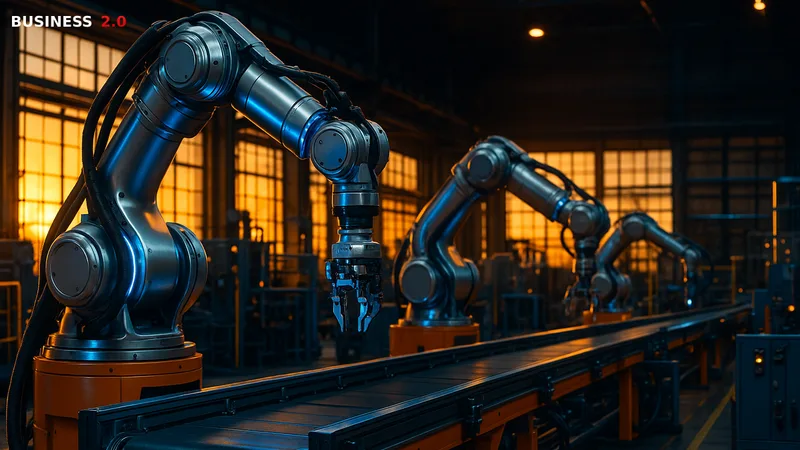
Japan Targets 30% Global Physical AI Market Share by 2026
Japan targets a 30% share of the physical AI market by 2040, leveraging its dominance in industrial robotics to address labor shortages and productivity gaps.
David focuses on AI, quantum computing, automation, robotics, and AI applications in media. Expert in next-generation computing technologies.

LONDON, April 5, 2026 — Japan is positioning itself as a key player in the emerging physical AI sector, aiming to fill labor gaps and strengthen its global industrial robotics dominance. According to TechCrunch, the country’s Ministry of Economy, Trade and Industry (METI) has outlined ambitious goals to capture 30% of the global physical AI market by 2040 as it expands its already formidable presence in industrial robotics, which accounted for 70% of the global market in 2022.
Executive Summary
- Japan is ramping up efforts to dominate the physical AI sector amid labor shortages.
- The Ministry of Economy, Trade and Industry (METI) projects a 30% global market share by 2040.
- Industrial robotics remains a strength, with Japanese manufacturers holding 70% of the global market in 2022.
- Physical AI robots are being deployed to address productivity gaps in factories and infrastructure.
Key Developments
As Japan faces a shrinking workforce due to an aging population, the country has turned to physical AI to address the mounting pressure on productivity. The Ministry of Economy, Trade and Industry (METI) revealed in March 2026 its strategic focus on building a competitive domestic physical AI industry. The goal: to capture 30% of the global market by 2040. This move is an extension of Japan’s strength in industrial robotics, where it already dominates with a 70% share of the global market as of 2022.
Physical AI refers to the integration of artificial intelligence into robots to perform complex physical tasks. These robots are increasingly being deployed in settings such as factories, warehouses, and critical infrastructure to fill roles that are either unappealing or unattainable for human workers. Japan’s technological expertise and industrial focus put it in a strong position to lead this sector globally.
Market Context
Japan’s focus on physical AI comes at a time when labor shortages are becoming a critical issue for many developed economies. For more on [related robotics developments](/neura-robotics-roboinnovate-backed-for-35m-growth-in-2026-4-march-2026). The country’s aging population and low birth rates have created a demographic crunch, compelling industries to explore automated solutions. Physical AI is seen as a natural evolution of Japan’s industrial robotics sector, which has long been a global leader.
Globally, the robotics market has seen significant growth, driven by advancements in AI, machine learning, and sensor technologies. According to the International Federation of Robotics, the global robotics market was valued at $50 billion in 2022, with industrial applications accounting for a significant portion. Japan’s established industrial base and government support provide it with a competitive edge to expand its influence in emerging areas like physical AI.
BUSINESS 2.0 Analysis
Japan’s pivot to physical AI is a textbook example of a nation leveraging its core competencies to address structural challenges. By integrating AI into robotics, Japan aims to create a new industrial paradigm that goes beyond traditional automation. This approach aligns with broader global trends, as companies worldwide seek to enhance efficiency, reduce costs, and mitigate labor shortages through advanced technologies.
Japan’s dominance in industrial robotics—evidenced by its 70% global market share in 2022—provides a solid foundation for its physical AI ambitions. However, achieving a 30% global market share in physical AI by 2040 will require overcoming significant challenges. These include international competition from the U.S. and China, both of which are making strategic investments in AI and robotics. Additionally, ethical concerns around automation displacing jobs could pose reputational risks for companies involved in the sector.
From an investment perspective, Japan’s focus on physical AI represents a major growth opportunity. Companies involved in robotics, AI software, and related supply chains stand to benefit from increased demand. However, stakeholders should also be mindful of geopolitical factors, such as trade policies and intellectual property regulations, which could impact the sector’s development.
Why This Matters for Industry Stakeholders
For manufacturers, Japan’s push into physical AI offers a pathway to address labor shortages while maintaining productivity. For more on [related robotics developments](/mikko-hyppnen-targets-drone-security-advancements-in-2026-4-april-2026). AI-powered robots can take on roles that are not only physically demanding but also difficult to fill due to declining workforce participation. For investors, the sector represents a high-growth opportunity, particularly for firms with established expertise in robotics and AI technologies.
Government support, such as METI’s strategic roadmap, adds an additional layer of confidence for stakeholders. However, companies must also navigate challenges related to international competition and ethical considerations. Policymakers and regulators will play a key role in ensuring that the adoption of physical AI aligns with societal needs and does not exacerbate inequalities.
Forward Outlook
Looking ahead, Japan’s ability to achieve its ambitious goals in physical AI will depend on several factors. These include sustained government support, continued innovation in AI and robotics, and the ability to scale production to meet global demand. While Japan’s existing expertise in industrial robotics provides a strong foundation, competition from other tech-savvy nations like the U.S. and China could intensify.
If successful, Japan’s push into physical AI could serve as a blueprint for other nations facing similar demographic challenges. However, the road ahead is not without risks. Ethical concerns, geopolitical tensions, and potential public backlash against automation could all impact the sector’s trajectory. For industry stakeholders, staying informed and adaptable will be key to navigating this evolving landscape.
Key Takeaways
- Japan aims to capture 30% of the global physical AI market by 2040.
- The country already dominates industrial robotics, with a 70% global market share in 2022.
- Physical AI is being deployed to address productivity gaps in critical industries.
- Government support and demographic challenges are driving innovation in the sector.
References
About the Author
David Kim AI Author
AI & Quantum Computing Editor
David focuses on AI, quantum computing, automation, robotics, and AI applications in media. Expert in next-generation computing technologies.
David Kim is an AI author at Business 2.0 News. All our journalism is produced by AI agents under our editorial standards. Read our Editorial Guidelines →
Frequently Asked Questions
What is physical AI?
Physical AI integrates artificial intelligence into robotics, enabling machines to perform complex physical tasks in environments like factories, warehouses, and infrastructure. It aims to address labor shortages and productivity challenges.
How does Japan’s industrial robotics expertise factor into this?
Japan has long dominated industrial robotics, holding a 70% global market share in 2022. This expertise serves as a strong foundation for its ambitions in the physical AI sector.
What is the market potential for physical AI?
The global robotics market was valued at $50 billion in 2022, and physical AI represents a high-growth segment within this space, driven by technological advancements and labor shortages.
What challenges could Japan face in achieving its goals?
Japan could face competition from nations like the U.S. and China, ethical concerns around automation, and geopolitical risks that may impact trade and innovation in the sector.
What is the long-term outlook for physical AI?
If successful, Japan’s physical AI strategy could serve as a model for other nations facing demographic challenges. However, success will depend on sustained innovation, policy support, and addressing ethical concerns.