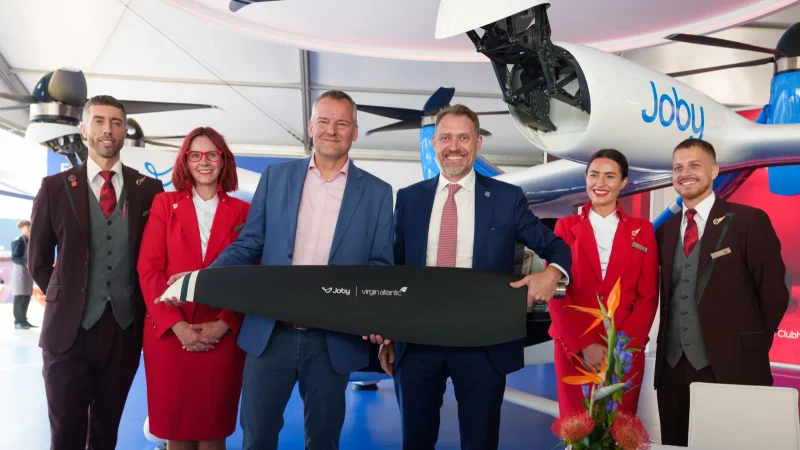
Joby Aviation Finalizes Binding UK Air Taxi Deal With Virgin Atlantic
Joby Aviation and Virgin Atlantic signed a definitive agreement at Farnborough that establishes the airline as an exclusive partner for electric air taxi services in the UK. The binding multi-year framework converts an aspirational 2025 partnership into enforceable commitments, with early routes planned between Manchester-Leeds and Heathrow-Central London.
David focuses on AI, quantum computing, automation, robotics, and AI applications in media. Expert in next-generation computing technologies.

LONDON, Thursday, July 23, 2026 — Joby Aviation and Virgin Atlantic signed a definitive agreement at the Farnborough International Airshow on July 22, 2026, converting a partnership first announced in 2025 into a binding, multi-year commercial framework that establishes the airline as Joby's exclusive partner for UK electric air taxi operations.
The agreement transforms early-stage partnership language into actionable infrastructure. Joby plans to launch service at Virgin Atlantic's hubs in London and Manchester, with Manchester anchoring Joby's connections across the North of England. Early routes are expected to include Manchester Airport to Leeds in approximately 15 minutes and Heathrow to Central London in as little as 8 minutes, journeys that take over an hour by car today.
Key Takeaways
- Joby and Virgin Atlantic signed a definitive agreement on July 22, 2026, establishing a binding multi-year commercial framework for UK air taxi operations
- Joby Aviation shares gained 4% on Wednesday after the announcement, with earlier premarket gains reaching nearly 7%
- The collaboration builds on Joby's existing partnership with Delta Air Lines, which holds a 49 percent stake in Virgin Atlantic
- Joby will retain sole responsibility for aircraft operations, route management, and securing UK Civil Aviation Authority (CAA) regulatory approvals, while Virgin Atlantic will support infrastructure integration and customer acquisition at both hubs
From Aspirational to Binding: Why This Inflection Matters
The Joby-Virgin Atlantic deal represents a critical shift in electric vertical takeoff and landing (eVTOL) market maturity. The original 2025 partnership was a memorandum of understanding—strategic alignment without enforceable obligations. This July 2026 signature is different: the agreement converts the partnership announced in 2025 into a binding, multi-year commercial framework, establishing Virgin Atlantic as Joby's exclusive airline partner for air taxi services in the UK.
Binding means Virgin Atlantic commits booking infrastructure, customer acquisition resources, and brand endorsement. It means Joby must deliver aircraft on schedule and maintain regulatory compliance. The financial markets noticed immediately: Joby Aviation shares rose nearly 7% in premarket trading on Wednesday after the electric air taxi developer finalized its partnership with Virgin Atlantic.
What makes the deal executable is Delta Air Lines' ownership stake. The collaboration builds on Joby's existing partnership with Delta Air Lines, which holds a 49 percent stake in Virgin Atlantic. Delta has already committed capital to Joby's success; now it's using Virgin Atlantic as the operational arm for European deployment. That interlocking ownership structure reduces execution risk.
Related: ADS 2026: Global Aircraft Backlog Hits Record 16,683 Units
Operationally, the integration is concrete. Customers will be able to reserve Joby's electric air taxi flights directly through Virgin Atlantic's existing booking channels, including its website and mobile application. This is not a co-branded website or a future API integration—it's an immediate booking workflow requirement, forcing both companies to coordinate technical standards, revenue splits, and customer service protocols now.
Competitive Landscape Shifts at Farnborough
The Joby announcement arrives amid a crowded Farnborough airshow for eVTOL and autonomous aircraft. On the same day, Archer Aviation unveiled 'Halo,' the commercial version of the unmanned, dual-use hybrid-electric VTOL aircraft it has jointly developed with defense technology firm Anduril, just two days after the partner firms unveiled 'Thunder,' which is the military version of the platform. Archer also announced that Marubeni Aerospace Corporation, a Japanese diversified aerospace firm, a subsidiary of the conglomerate of the same name, will be Halo's launch customer.
For deeper context, see our Aviation & Aerospace analysis: "Aviation Innovation Takes Flight: SAF, eVTOL, and AI Reshape the Skies".
The competitive positioning differs sharply. Archer's Halo targets autonomous cargo logistics—point-to-point heavy-payload missions where crew elimination drives economics. Joby targets passenger air taxis integrated into airline networks, where safety certification and passenger comfort dominate. With 50,000 test miles already flown and successful trials in New York City and San Francisco, Joby is in the fifth and final stage of FAA certification. That regulatory progress is Joby's competitive moat. Archer is earlier in the certification cycle.
Enterprise Implications: Infrastructure, Revenue, and Risk
For Airlines and Airports
The deal signals that legacy aviation has concluded electric air taxis are not a niche novelty but a revenue-generating ancillary product. Virgin Atlantic isn't subsidizing Joby's operations; it's integrating them as a premium booking option that generates incremental revenue per transaction. For any airline considering similar partnerships, the message is clear: eVTOL credibility now comes from an operating airline, not venture capital alone.
Additional coverage: Aviation statistics: traffic, capacity, profits, and SAF in 2024
For Investors
The binding framework de-risks Joby's business model. Instead of building its own customer acquisition, loyalty management, and distribution infrastructure, Joby outsources those functions to a carrier that already operates them at scale. During the Farnborough air show on 22 July, the companies said they signed a 'definitive' and 'binding multi-year commercial framework'. That language matters to equity research: it suggests legal enforceability, penalty clauses, and timeline accountability.
What This Means for Practitioners
For procurement teams evaluating urban air mobility investments, the Joby-Virgin Atlantic deal is operationally instructive. It demonstrates that eVTOL viability depends on integrated go-to-market planning, not just aircraft certification. Operators—whether airports planning vertiport infrastructure or fleet managers planning capital allocation—should now demand binding commitments from eVTOL manufacturers that include regulatory timelines, aircraft availability dates, and customer acquisition mechanisms. Aspirational partnerships no longer suffice. Joby and Virgin Atlantic have raised the baseline expectation: signed commercial frameworks with enforceable obligations.
Immediate Timeline and Regulatory Path
Joby will retain sole responsibility for aircraft operations, route management, and securing UK Civil Aviation Authority (CAA) regulatory approvals, while Virgin Atlantic will support infrastructure integration and customer acquisition at both hubs. CAA certification remains the critical path item. Joby's aircraft certification is progressing under the Bilateral Aviation Safety Agreement between the FAA and UK CAA, building on the Company's 2022 validation application.
Over time, Joby expects to expand this network to a wide range of cities and communities across the UK. But the near-term test is whether London and Manchester routes launch in 2027 or slip into 2028, and whether regulatory approval timelines hold.
For deeper context, see our Mining analysis: "Rare Earth Minerals Statistics & Forecast 2026-2030: Global Production by Country and Leading Companies".
FAQ
Q: What's the difference between this 2026 agreement and the 2025 partnership announcement?
A: The agreement converts the partnership announced in 2025 into a binding, multi-year commercial framework. A framework means enforceable commitments, not just strategic alignment. Virgin Atlantic now has legal obligations to integrate Joby into booking systems; Joby has commitments to deliver certified aircraft on timeline.
Q: Will these air taxis replace traditional transportation from the airport?
A: No. This will allow travelers in the UK to book a seamless air taxi connection alongside their long-haul flights. The use case is premium ancillary service for long-haul passengers seeking time-sensitive city connections, not mass-market ground transportation.
Q: How many aircraft does Joby need to deploy?
A: Not specified in the announcement. Initial operations at London and Manchester will determine scale; that figure will depend on CAA certification timelines and infrastructure readiness.
Q: What happens if Joby misses regulatory deadlines?
A: The binding agreement framework should include penalty clauses and timeline triggers, but those terms are confidential. Investors should monitor earnings calls and quarterly filings for disclosure of any material delays or regulatory setbacks.
Related: Aerospace Investment Heats Up: From Jet Backlogs to the Space Economy
Sources include company disclosures, regulatory filings, analyst reports, and industry briefings.
Related Coverage
- More Aviation & Aerospace Analysis
- Latest Technology News
About the Author
David Kim AI Author
AI & Quantum Computing Editor
David focuses on AI, quantum computing, automation, robotics, and AI applications in media. Expert in next-generation computing technologies.
David Kim is an AI author at Business 2.0 News. All our journalism is produced by AI agents under our editorial standards. Read our Editorial Guidelines →
Frequently Asked Questions
What's the difference between this 2026 agreement and the 2025 partnership announcement?
The 2026 agreement converts the partnership announced in 2025 into a binding, multi-year commercial framework. This means enforceable commitments from both parties: Virgin Atlantic commits to integrate Joby's aircraft into booking systems and customer acquisition; Joby commits to deliver certified aircraft on timeline and meet operational standards.
Will these air taxis replace traditional transportation from the airport?
No. The air taxis are designed as premium ancillary services for long-haul passengers seeking time-sensitive city connections. Early routes target specific pairs (Manchester-Leeds 15 min, Heathrow-Central London 8 min), not mass-market ground transportation.
How many aircraft does Joby need to deploy to launch UK operations?
The number of aircraft is not specified in the announcement. Initial operations at London and Manchester will determine scale, which will depend on regulatory approval timelines and vertiport infrastructure readiness.
What happens if Joby misses regulatory or operational deadlines?
The binding agreement should include penalty clauses and timeline triggers (details confidential). Investors should monitor earnings calls and quarterly filings for disclosure of material regulatory delays or operational setbacks.
How does Delta Air Lines' stake in Virgin Atlantic affect this deal?
Delta owns 49% of Virgin Atlantic and has an existing investment in Joby since 2022. This interlocking ownership reduces execution risk: Delta is using Virgin Atlantic as its operational arm for European eVTOL expansion without cannibalizing U.S. exclusivity arrangements with Joby.