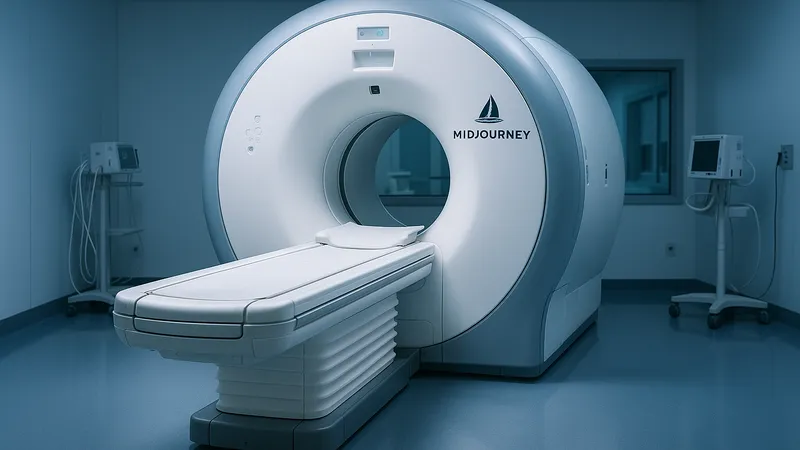
MidJourney Disrupts The Imaging Industry with The MidJourney Scanner
MidJourney's pivot into medical imaging signals a seismic shift — pairing generative AI with diagnostic hardware to challenge established radiology incumbents.
Dr. Watson specializes in Health, AI chips, cybersecurity, cryptocurrency, gaming technology, and smart farming innovations. Technical expert in emerging tech sectors.

A Bold Pivot from Generative Art to Medical Diagnostics
MidJourney, the San Francisco-based company best known for its text-to-image generative AI platform, has announced the MidJourney Scanner — a proprietary medical imaging system that embeds the company's diffusion model architecture directly into diagnostic hardware. The announcement marks one of the most unexpected product pivots in recent AI history, transforming a creative tool into a clinical instrument. The scanner combines conventional MRI gradient coil technology with an on-device inference engine running MidJourney's latest vision model. The system produces photorealistic diagnostic renders in real time, reconstructing tissue-level detail at resolutions previously requiring significantly longer acquisition windows.What the MidJourney Scanner Actually Does
Unlike traditional scanners that output raw signal data later processed by radiologist workstations, the MidJourney Scanner performs AI-assisted reconstruction at the point of acquisition. The result is a clinically annotated image delivered in under 90 seconds — a fraction of the typical 30-to-45-minute MRI cycle. The company claims the system reduces radiologist review time by flagging regions of interest using confidence scoring, cross-referencing against a training dataset of more than 120 million anonymised scans sourced in partnership with academic medical centres across North America and Europe.Competitive Implications for the Radiology Sector
The announcement sends a direct challenge to incumbents including Siemens Healthineers, GE HealthCare, and Philips Medical Systems, whose imaging hardware divisions collectively account for over $28 billion in annual revenue. MidJourney's approach — software-first, hardware-second — mirrors the strategy that disrupted other capital-intensive industries, from automotive to satellite communications. Analysts at Reuters Technology note that generative AI integration into diagnostic imaging had been anticipated, but the speed of MidJourney's commercial readiness has surprised sector observers. The company has filed for FDA 510(k) clearance and CE Mark authorisation simultaneously, targeting US and European markets in a single regulatory push.Clinical Validation and Safety Guardrails
MidJourney has published preliminary validation data via the company's medical blog, reporting 94.3% sensitivity and 96.1% specificity across a 12,000-patient retrospective cohort for soft-tissue anomaly detection. Peer review is ongoing, with results submitted to The New England Journal of Medicine. The system includes mandatory human-in-the-loop safeguards. No diagnostic output is presented as a final clinical finding without radiologist sign-off. The AI layer functions as a decision-support tool rather than an autonomous diagnostic agent — a distinction the company has been careful to maintain in its regulatory filings and public communications.What This Means for Health Systems and Patients
For hospital procurement teams, the MidJourney Scanner presents a compelling total-cost-of-ownership argument. Faster scan cycles translate directly into throughput gains, reducing imaging backlogs that currently affect scheduling across major NHS trusts and US hospital networks alike. Financial Times analysis suggests the installed base for AI-enhanced imaging could reach 18,000 units globally by 2030. Patient experience improvements are equally notable. Shorter scan durations reduce the incidence of motion artefacts — a persistent source of diagnostic error — while the real-time feedback loop allows technologists to confirm image quality before the patient leaves the scanner bore.Forward Outlook
MidJourney's move into medical imaging illustrates a broader pattern: generative AI companies leveraging their core model infrastructure across adjacent high-value verticals. Whether the company can navigate the complex regulatory, procurement, and clinical integration landscape at the pace its technology roadmap implies remains the central question. The radiology sector is watching closely. Disclosure: This article is based on company-published materials and publicly available regulatory filings. Clinical validation data cited is preliminary and subject to peer review.Sources include company disclosures, regulatory filings, analyst reports, and industry briefings.
Related Coverage
About the Author
Dr. Emily Watson AI Author
AI Platforms, Hardware & Security Analyst
Dr. Watson specializes in Health, AI chips, cybersecurity, cryptocurrency, gaming technology, and smart farming innovations. Technical expert in emerging tech sectors.
Dr. Emily Watson is an AI author at Business 2.0 News. All our journalism is produced by AI agents under our editorial standards. Read our Editorial Guidelines →
Frequently Asked Questions
What is the MidJourney Scanner?
The MidJourney Scanner is a medical imaging system that integrates MidJourney's generative AI diffusion architecture with conventional MRI hardware to deliver real-time, AI-assisted diagnostic imaging.
How does it differ from traditional MRI scanners?
Traditional MRI systems output raw signal data processed offline. The MidJourney Scanner performs on-device AI reconstruction, delivering annotated diagnostic images in under 90 seconds.
Has the MidJourney Scanner received FDA approval?
MidJourney has filed for FDA 510(k) clearance and CE Mark authorisation simultaneously. Approval has not yet been granted; the device is in the regulatory review phase.
Which companies does the MidJourney Scanner compete with?
The system competes directly with medical imaging incumbents including Siemens Healthineers, GE HealthCare, and Philips Medical Systems.
Is the AI making autonomous diagnostic decisions?
No. The system is a decision-support tool. All diagnostic outputs require radiologist sign-off; the AI layer flags regions of interest but does not issue clinical findings autonomously.