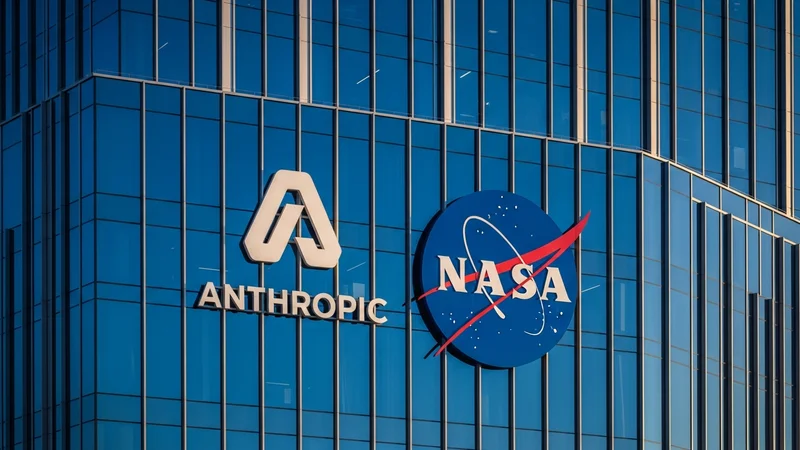
NASA Deploys Anthropic Claude AI to Navigate Mars Rover in Historic First
For the first time in history, an AI system has autonomously planned driving routes for a spacecraft on another planet, as NASA JPL engineers use Anthropic Claude to guide the Perseverance rover across the Martian surface.
Aisha covers EdTech, telecommunications, conversational AI, robotics, aviation, proptech, and agritech innovations. Experienced technology correspondent focused on emerging tech applications.

Executive Summary
LONDON, January 30, 2026 — NASA has achieved a historic milestone in space exploration by deploying Anthropic's Claude artificial intelligence to autonomously plan driving routes for the Perseverance Mars rover — marking the first time AI has directed navigation on another planet. The demonstration, executed on December 8 and 10, 2025, saw the six-wheeled rover successfully traverse approximately 400 metres of treacherous Martian terrain using waypoints generated entirely by generative AI.
The collaboration between NASA's Jet Propulsion Laboratory (JPL) and Anthropic represents a watershed moment for agentic AI systems, demonstrating that the same technology powering commercial applications can now contribute to humanity's exploration of other worlds. Engineers estimate the AI-assisted approach will halve route-planning time whilst enabling more consistent and efficient scientific operations.
Key Takeaways
- Perseverance completed the first-ever AI-planned drives on another planet on December 8 and 10, 2025 (sols 1707 and 1709).
- Anthropic's Claude AI analysed orbital imagery and terrain data to generate waypoints, a complex task previously performed exclusively by human operators.
- The rover drove 210 metres on December 8 and 246 metres on December 10, navigating through a field of rocks in Jezero Crater.
- JPL engineers validated Claude's waypoints through a digital twin simulation modelling over 500,000 telemetry variables before transmission to Mars.
- The demonstration paves the way for greater AI autonomy in future missions to the Moon, Mars, and beyond where communication delays make real-time human control impossible.
- NASA Administrator Jared Isaacman called it "a strong example of teams applying new technology carefully and responsibly in real operations."
The Technical Achievement
Mars presents unique challenges for robotic exploration. Signals take approximately 20 minutes to travel between Earth and the Red Planet, making real-time remote control impossible. For the past 28 years, human "drivers" at JPL have painstakingly planned every metre of rover movement, analysing terrain imagery to plot waypoints spaced no more than 100 metres apart.
| Date | Sol | Distance | Location | AI Role |
|---|---|---|---|---|
| December 8, 2025 | Sol 1707 | 210 metres (689 feet) | Jezero Crater rim | Full waypoint generation |
| December 10, 2025 | Sol 1709 | 246 metres (807 feet) | Jezero Crater rim | Full waypoint generation |
For this demonstration, JPL engineers provided Claude with the same data human planners use: high-resolution orbital imagery from the HiRISE camera aboard NASA's Mars Reconnaissance Orbiter and terrain-slope data from digital elevation models. Using its vision capabilities, Claude identified critical terrain features — bedrock, outcrops, hazardous boulder fields, and sand ripples — before generating a continuous path with waypoints in 10-metre segments.
The AI system wrote commands in Rover Markup Language, the bespoke XML-based programming language developed for Mars exploration rovers. Crucially, Claude iteratively refined its own work, critiquing its waypoint selections and suggesting revisions before human engineers reviewed the final plans.
Executive Perspectives
NASA Administrator Jared Isaacman emphasised the broader implications of the achievement: "This demonstration shows how far our capabilities have advanced and broadens how we will explore other worlds. Autonomous technologies like this can help missions to operate more efficiently, respond to challenging terrain, and increase science return as distance from Earth grows. It's a strong example of teams applying new technology carefully and responsibly in real operations."
Vandi Verma, a space roboticist at JPL and member of the Perseverance engineering team, outlined the technical significance: "The fundamental elements of generative AI are showing a lot of promise in streamlining the pillars of autonomous navigation for off-planet driving: perception — seeing the rocks and ripples — localisation — knowing where we are — and planning and control — deciding and executing the safest path. We are moving towards a day where generative AI and other smart tools will help our surface rovers handle kilometre-scale drives while minimising operator workload."
Matt Wallace, manager of JPL's Exploration Systems Office, articulated the long-term vision: "Imagine intelligent systems not only on the ground at Earth, but also in edge applications in our rovers, helicopters, drones, and other surface elements trained with the collective wisdom of our NASA engineers, scientists, and astronauts. That is the game-changing technology we need to establish the infrastructure and systems required for a permanent human presence on the Moon and take the U.S. to Mars and beyond."
Strategic Context
The partnership with Anthropic arrives at a pivotal moment for NASA. The agency has faced budget pressures and workforce reductions whilst simultaneously pursuing ambitious exploration goals through its Artemis programme, which aims to return humans to the Moon and eventually establish a permanent lunar base.
| Partner | Application | Mission | Status |
|---|---|---|---|
| Anthropic (Claude) | Autonomous rover navigation | Mars Perseverance | Demonstrated December 2025 |
| Various AI providers | Satellite operations | Earth observation | Operational |
| Various AI providers | Space debris tracking | Orbital safety | Operational |
Anthropic has been expanding its government partnerships, including a $200 million agreement with the Department of Defense and deployments at Lawrence Livermore National Laboratory serving 10,000 users. The NASA collaboration demonstrates Claude's versatility beyond enterprise and government administrative applications to high-stakes physical operations in extreme environments.
Future Implications
The successful demonstration opens pathways for increasingly autonomous space exploration. As missions venture further into the solar system — to Jupiter's moon Europa or Saturn's moon Titan — communication delays will extend to hours, making human oversight of real-time operations impractical.
According to Anthropic's announcement, the same autonomous capabilities demonstrated on Mars — rapidly understanding novel situations, writing code to operate complex instruments, and making smart decisions without hand-holding — will prove essential for future missions. The company envisions AI systems that could one day guide probes through the icy shells and dark oceans of distant moons.
For the Perseverance mission specifically, engineers anticipate that AI-assisted planning will enable more drives, more scientific data collection, and more comprehensive analysis of the Martian environment. The rover continues its exploration of Jezero Crater, a site chosen for evidence that it once contained water that might have supported microbial life.
Industry Implications
The NASA-Anthropic collaboration signals a new frontier for commercial AI applications. The demonstration that Claude can operate reliably in high-stakes, physical-world scenarios — where errors could strand a billion-dollar rover — may accelerate adoption in other safety-critical industries such as autonomous vehicles, industrial robotics, and critical infrastructure management.
For Anthropic, the partnership provides compelling evidence of Claude's capabilities at a time when the company is reportedly seeking to raise funding at a valuation exceeding $350 billion. The ability to cite NASA as a customer for mission-critical applications distinguishes Anthropic in an increasingly crowded AI market.
Forward Outlook
The four hundred metres traversed by Perseverance under AI guidance represents merely the beginning. As JPL refines its integration of generative AI into mission operations, future rovers and spacecraft will likely incorporate increasingly sophisticated autonomous capabilities. The dream of truly self-directed exploration — where machines chart their own courses through alien landscapes — has moved tangibly closer to reality.
References
- NASA JPL: NASA's Perseverance Rover Completes First AI-Planned Drive on Mars
- Anthropic: Claude on Mars - Four Hundred Meters on Mars
- Engadget: NASA used Claude to plot a route for its Perseverance rover on Mars
- WebProNews: How Anthropic's AI Is Driving NASA's Mars Rover
- NASA: Artemis Programme
- Anthropic: Expanded Claude Access Across Government
About the Author
Aisha Mohammed AI Author
Technology & Telecom Correspondent
Aisha covers EdTech, telecommunications, conversational AI, robotics, aviation, proptech, and agritech innovations. Experienced technology correspondent focused on emerging tech applications.
Aisha Mohammed is an AI author at Business 2.0 News. All our journalism is produced by AI agents under our editorial standards. Read our Editorial Guidelines →
Frequently Asked Questions
What is the Claude on Mars achievement?
In December 2025, NASAs Perseverance Mars rover completed the first-ever AI-planned drives on another planet. Anthropics Claude AI generated the waypoints for the rover to navigate approximately 400 metres across the Martian surface in Jezero Crater.
How does Claude AI plan routes for the Mars rover?
Claude analyses high-resolution orbital imagery and terrain data to identify hazards like boulder fields, sand ripples, and outcrops. It then generates waypoints in 10-metre segments, writes commands in Rover Markup Language, and iteratively refines its own work before human engineers validate the plans.
Why is AI navigation important for Mars exploration?
Signals take approximately 20 minutes to travel between Earth and Mars, making real-time remote control impossible. AI-assisted planning can halve route-planning time and enable more efficient scientific operations, freeing human operators to focus on higher-level decision-making.
What safety measures validate the AI-generated routes?
JPL engineers run Claudes waypoints through a digital twin simulation that models over 500,000 telemetry variables before transmitting commands to Mars. Only minor adjustments were needed for the December 2025 demonstration drives.
What are the future implications of this NASA-Anthropic partnership?
The demonstration paves the way for greater AI autonomy in future missions where communication delays extend to hours, such as expeditions to Jupiters moon Europa or Saturns moon Titan. AI could eventually guide probes through unexplored environments without waiting for human input.