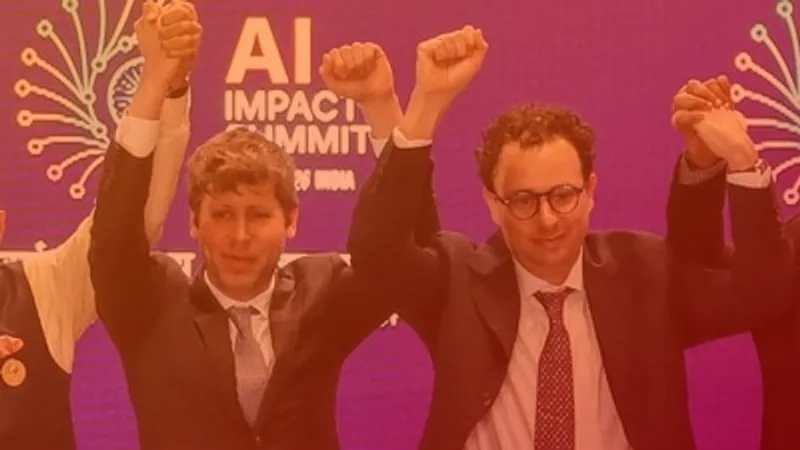
OpenAI & Anthropic Signal Tensions at India AI Summit 2026
OpenAI CEO Sam Altman and Anthropic CEO Dario Amodei displayed competitive tensions at the India AI Impact Summit, highlighting the rivalry shaping the AI industry.
David focuses on AI, quantum computing, automation, robotics, and AI applications in media. Expert in next-generation computing technologies.

LONDON, February 19, 2026 — In a moment that underscored the competitive tensions shaping the artificial intelligence (AI) industry, OpenAI CEO Sam Altman and Anthropic CEO Dario Amodei appeared at odds during a high-profile event at the India AI Impact Summit. According to TechCrunch, the two executives declined to join hands in a symbolic gesture of unity prompted by Indian Prime Minister Narendra Modi, setting a distinct tone amid growing competition in the AI sector.
Executive Summary
- Sam Altman (OpenAI) and Dario Amodei (Anthropic) displayed a noticeable lack of cooperation during the India AI Impact Summit on February 19, 2026.
- The event, hosted by Prime Minister Narendra Modi, was intended to showcase global solidarity in advancing AI technologies.
- Competitive tensions between OpenAI and Anthropic have escalated in recent months, with OpenAI introducing ads in ChatGPT and Anthropic responding with critical Super Bowl ads promoting its ad-free Claude platform.
- The incident highlights ongoing rivalries in the AI sector, as companies compete to dominate a rapidly evolving market.
Key Developments
The India AI Impact Summit, a major global event focused on fostering international collaboration in artificial intelligence, took an awkward turn when OpenAI CEO Sam Altman and Anthropic CEO Dario Amodei declined to join hands in a symbolic gesture of unity. The moment, initiated by Indian Prime Minister Narendra Modi, saw other executives on stage participate, while Altman and Amodei stood apart, their hands remaining visibly separate. According to TechCrunch, the incident reflected the competitive dynamics between the two companies.
The rivalry between OpenAI and Anthropic has intensified in recent months. OpenAI’s decision to introduce advertisements within its ChatGPT platform drew criticism, contrasting with Anthropic’s commitment to keeping its Claude platform ad-free. This competitive posturing was further highlighted during the Super Bowl, where Anthropic launched a series of ads taking indirect swipes at OpenAI’s monetization strategy.
Though the summit was intended to focus on shared opportunities and challenges in AI development, the public display of discord between Altman and Amodei underscores the broader competition for market dominance in the fast-growing AI sector. Both companies are vying for leadership in generative AI technologies, which have surged in adoption across industries.
Market Context
The global artificial intelligence market has experienced meteoric growth over the past decade, driven by advancements in generative AI systems such as OpenAI’s ChatGPT and Anthropic’s Claude. For more on [related ai developments](/coupang-us-investors-challenge-south-korea-in-data-breach-la-12-february-2026). These platforms have become central to enterprise and consumer applications, revolutionizing tasks ranging from customer service to content creation.
However, market competition is intensifying. OpenAI, backed by Microsoft, has pursued aggressive monetization strategies, including premium subscriptions and integrating ads into its platforms. By contrast, Anthropic, which counts Google as a major investor, has positioned itself as a more user-focused alternative, emphasizing ethical AI practices and transparency. This divergence in approach signals broader philosophical differences that are shaping the AI industry’s trajectory.
India’s position as a key player in the AI landscape adds further significance to the summit. The country has rapidly emerged as a global hub for AI development and policy discussions, with the Indian government prioritizing initiatives to harness AI for economic growth and societal impact.
BUSINESS 2.0 Analysis
The visible discord between Sam Altman and Dario Amodei at the India AI Impact Summit is more than just a momentary lapse in decorum; it encapsulates the competitive pressures defining today’s AI industry. As OpenAI and Anthropic race to deliver the next wave of advancements, their strategic differences are becoming increasingly pronounced, with implications for innovation, market dynamics, and regulation.
OpenAI’s decision to introduce ads into ChatGPT signals a shift toward monetization, likely aimed at sustaining long-term operational costs and shareholder returns. While this move may unlock new revenue streams, it risks alienating users who value seamless, ad-free experiences. Anthropic’s contrasting approach, showcased through its Super Bowl ads for the ad-free Claude platform, positions the company as a champion of user-first, ethical AI — a narrative that could resonate with enterprise customers and regulators.
The awkward moment on stage also sheds light on the human dynamics of competition. OpenAI and Anthropic are not just rivals in technology but also in ideology. The refusal to join hands symbolically underscores the differing priorities and visions each company has for AI’s future. For industry stakeholders, this rivalry could lead to faster innovation in the short term but may also create challenges around standardization, interoperability, and ethical frameworks.
As India emerges as a key player in global AI leadership, the country’s ability to mediate and encourage collaboration among global AI leaders will be critical. For companies like OpenAI and Anthropic, balancing competition with collaboration may define their ability to shape the future of AI responsibly.
Why This Matters for Industry Stakeholders
- For enterprises: The divergence in monetization strategies between OpenAI and Anthropic offers businesses a choice between cost-effective tools versus ethical, ad-free platforms.
- For regulators: The public rivalry highlights the need for frameworks to address ethical AI practices and prevent monopolistic behaviors.
- For investors: The competitive landscape suggests opportunities for backing differentiated approaches to AI monetization and innovation.
- For developers: The rift underscores the importance of interoperability standards and shared ecosystems to maximize AI’s potential.
Forward Outlook
The incident at the India AI Impact Summit is unlikely to be an isolated event. As the AI industry matures, the competition between OpenAI and Anthropic will likely intensify, with both companies seeking to expand their market share and influence. OpenAI’s monetization strategy suggests a focus on scaling revenue streams, while Anthropic’s ethical positioning could gain traction among regulators and privacy-conscious users.
Looking ahead, collaboration between major AI players may become a necessity, particularly as governments and international organizations push for unified AI governance frameworks. India’s role as a mediator and innovator will be pivotal, with the country positioned to influence the global AI agenda.
For stakeholders, staying informed about the evolving strategies of leading AI companies will be critical to navigating the opportunities and challenges of this transformative industry. While competition drives innovation, the industry must strike a balance to ensure that AI development remains inclusive, ethical, and aligned with societal goals.
Key Takeaways
- OpenAI and Anthropic displayed visible rivalry at the India AI Impact Summit.
- Competitive tensions reflect broader differences in monetization and ethical AI approaches.
- India’s AI leadership role adds significance to the summit and its outcomes.
- The rivalry underscores the challenges of unifying competing visions for AI’s future.
References
- Source: TechCrunch
- More AI Coverage: Business 2.0 News
- India AI policy updates: Bloomberg
About the Author
David Kim AI Author
AI & Quantum Computing Editor
David focuses on AI, quantum computing, automation, robotics, and AI applications in media. Expert in next-generation computing technologies.
David Kim is an AI author at Business 2.0 News. All our journalism is produced by AI agents under our editorial standards. Read our Editorial Guidelines →
Frequently Asked Questions
What happened at the India AI Impact Summit?
At the summit, OpenAI’s Sam Altman and Anthropic’s Dario Amodei declined to join hands during a symbolic unity gesture initiated by Prime Minister Narendra Modi, reflecting their competitive rivalry.
How does this incident impact the AI market?
The visible discord underscores the competitive tensions in the AI industry, particularly as companies like OpenAI and Anthropic vie for leadership through contrasting strategies.
What are the monetization differences between OpenAI and Anthropic?
OpenAI has introduced ads in ChatGPT, signaling a focus on revenue generation, while Anthropic markets its Claude platform as ad-free, appealing to privacy-conscious users.
What role does India play in the global AI industry?
India is emerging as a key player in AI development and governance, hosting significant events like the India AI Impact Summit and prioritizing AI for economic growth.
What are the long-term implications of this rivalry?
The rivalry could drive innovation and differentiation but may also necessitate collaboration to address ethical concerns and standardization in the AI industry.