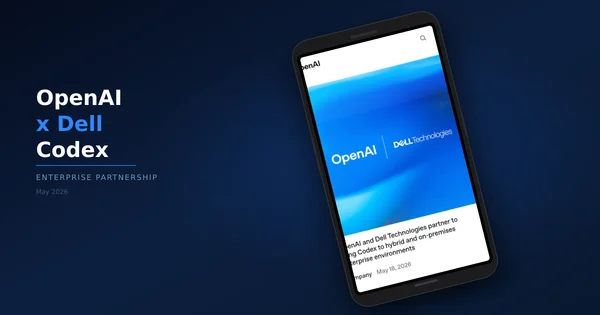
OpenAI and Dell Bring Codex to Enterprise On-Premises
OpenAI and Dell Technologies have partnered to deploy Codex — OpenAI's agentic AI coding tool — across hybrid cloud and on-premises enterprise infrastructure, targeting regulated industries unable to route source code through public cloud APIs.
Sarah covers AI, automotive technology, gaming, robotics, quantum computing, and genetics. Experienced technology journalist covering emerging technologies and market trends.

Executive Summary
LONDON, 22 May 2026 — OpenAI and Dell Technologies have announced a strategic enterprise partnership to deploy Codex — OpenAI's AI software engineering agent — across hybrid cloud and on-premises infrastructure. Under the agreement, Dell's PowerEdge server ecosystem and AI-optimised hardware will serve as the primary delivery platform for Codex in regulated, air-gapped, and data-sovereign enterprise environments. The announcement, made on 18 May 2026 via OpenAI's official newsroom, marks a significant shift in how frontier AI coding tools reach enterprise customers who cannot or will not route source code through public cloud APIs.
According to Reuters Technology, the deal is part of a broader industry movement to bring large language models into enterprise data centres, driven by tightening data protection regulations and the operational needs of sectors including defence, financial services, healthcare, and critical national infrastructure.
Key Takeaways
- OpenAI Codex will be deployable on Dell PowerEdge servers and AI-optimised rack infrastructure from mid-2026
- Enterprise customers gain on-premises and hybrid deployment options that keep source code off public cloud infrastructure
- The partnership directly targets regulated industries: financial services, defence, healthcare, and government
- Dell's distribution network covers more than 180 countries, substantially expanding Codex's addressable market
- The deal positions OpenAI competitively against Microsoft GitHub Copilot for air-gapped enterprise environments
What Codex Is — and Why It Matters Now
OpenAI Codex is the company's agentic software engineering model, capable of reading codebases, writing code, running tests, and resolving tickets autonomously within containerised environments. Unlike earlier autocomplete-focused tools, Codex functions as an AI software engineer rather than a suggestion layer — it can independently open pull requests, debug runtime failures, and execute multi-step development workflows over extended periods without human prompting.
Since Codex's public release, adoption has been concentrated among cloud-native technology companies comfortable routing proprietary code through OpenAI's API. That limitation has kept Codex effectively out of reach for enterprise segments where data residency rules, intellectual property concerns, or security classifications preclude external API calls. The Dell partnership directly addresses this gap. As reported by Bloomberg, enterprise AI adoption has stalled in several regulated sectors not due to lack of interest but due to infrastructure incompatibility with cloud-only delivery models.
For related context on enterprise AI infrastructure procurement, see: Anthropic Acquires Stainless: Inside the SDK Infrastructure Move Reshaping AI Developer Tooling.
Technical Architecture: Dell as the On-Premises Layer
Dell Technologies brings a mature enterprise hardware and services ecosystem to the partnership. The company's AI-optimised infrastructure portfolio includes PowerEdge servers equipped with NVIDIA H100 and H200 GPUs, high-bandwidth networking fabric, and integrated Dell APEX cloud management services. These systems are already deployed inside thousands of enterprise data centres globally, reducing the hardware procurement burden for customers wishing to run Codex on-premises.
Under the technical arrangement, Codex will be packaged as a containerised workload compatible with Dell's AI Factory validation framework — a reference architecture combining certified hardware, validated software stacks, and professional services. Enterprises already running Dell's AI Factory deployments for inference workloads will be able to extend those environments to include Codex without separate infrastructure provisioning.
The hybrid deployment model is equally significant. Customers with partial cloud adoption can run Codex inference on Dell on-premises nodes while orchestration, authentication, and model updates flow through OpenAI's cloud platform — enabling a controlled data sovereignty posture without fully sacrificing cloud-managed operational overhead.
For analysis of enterprise AI infrastructure investment trends, see: SAP, ServiceNow, Snowflake Tighten AI Focus on Enterprise Workflows.
Competitive Landscape
The Dell–OpenAI deal arrives as all major AI vendors confront the same structural tension: frontier model capabilities reside in cloud infrastructure while many highest-value enterprise customers are institutionally unable to use cloud-only APIs. According to the Financial Times, regulatory pressure from the EU AI Act, UK sector-specific AI governance frameworks, and US federal procurement rules is accelerating demand for on-premises AI deployment across government, defence, and financial services.
Competitors are moving simultaneously. Microsoft's GitHub Copilot already has enterprise-grade deployment options, though it remains tightly coupled to the Azure stack. Google DeepMind has been piloting Gemini Code Assist in on-premises configurations for select US federal customers. As noted by AP News, the OpenAI–Dell arrangement is notable because it leverages a hardware-independent distribution channel — Dell's global reseller and direct sales network — rather than tying on-premises capability to a single hyperscaler's ecosystem.
| Vendor | On-Prem Option | Hardware Partner | Air-Gap Support | |---|---|---|---| | OpenAI Codex | Yes (via Dell) | Dell Technologies | Yes | | GitHub Copilot | Limited (Azure VNet) | Microsoft Azure | No | | Google Code Assist | Pilot only | Google Cloud | No | | AWS CodeWhisperer | VPC isolated | AWS | No | | IBM watsonx Code | Yes | IBM Power/x86 | Yes |For competitive positioning analysis in enterprise AI tooling, see: Dust Series B 2026: Sequoia Backs $40M Bet on Multiplayer Enterprise AI.
Why This Matters for Industry Stakeholders
Financial Services and Banking
Large banks and asset managers operate under regulatory frameworks — MiFID II, DORA, Basel IV — that impose strict controls on where trading algorithms, risk models, and client data are processed. The ability to run Codex on-premises means AI-assisted software development can be incorporated into regulated SDLC workflows without triggering data residency violations.
Defence and Government
Government and defence customers typically operate classified networks with no internet connectivity. Dell's existing presence in US Department of Defense IT infrastructure, combined with OpenAI's enterprise contracting capabilities, positions the partnership favourably for FedRAMP-authorised deployments and classified network configurations subject to separate security accreditation.
Healthcare
Hospital systems and pharmaceutical companies developing software handling protected health information under HIPAA cannot route code through external APIs without significant legal exposure. On-premises Codex deployment removes this barrier, enabling clinical software teams to leverage agentic AI development assistance within existing HIPAA-compliant infrastructure.
Enterprise Software Engineering Teams
For developers at large enterprises, the practical implication is access to Codex's full agentic capabilities — autonomous test execution, multi-file refactoring, CI/CD pipeline integration — within their secure development environment. This closes a significant productivity gap between cloud-native startups and traditional enterprise engineering organisations.
For enterprise AI adoption trends by sector, see: Linux Dirty Frag Vulnerability 2026: Critical Root Exploit Hits Shared.
Forward Outlook
Disclosure: The following section contains forward-looking analysis and projections based on publicly available information and should not be construed as financial advice.
The structural importance of the Dell–OpenAI agreement extends beyond the immediate deployment use case. It establishes a precedent for frontier AI models being distributed through traditional enterprise hardware channels — a distribution model that could accelerate significantly as model weights become more efficient and hardware requirements fall.
For OpenAI, the Dell partnership represents a meaningful diversification away from API and consumer subscription revenue toward enterprise infrastructure contracts — a segment with longer sales cycles but substantially higher lifetime value and lower churn. For Dell, attaching Codex to its AI Factory platform reinforces positioning as the preferred hardware vendor for enterprise AI workloads in an intensely competitive data centre market.
According to TechCrunch, analysts expect additional hardware OEM partnerships to follow a similar template — with OpenAI potentially announcing similar arrangements with HPE, Lenovo, and Cisco within the 2026 fiscal year. The Dell Technologies press office confirmed that professional services integration and deployment support will be available through Dell's partner channel from Q3 2026.
Bibliography
- OpenAI. (2026, May 18). OpenAI and Dell Technologies partner to bring Codex to hybrid and on-premises enterprise environments. openai.com
- Dell Technologies. (2026). AI Solutions and Infrastructure Portfolio. dell.com
- OpenAI. (2026). Codex — AI Software Engineering Agent. openai.com/codex
- Reuters. (2026). Technology coverage: Enterprise AI and cloud infrastructure. reuters.com/technology
- Bloomberg. (2026). Enterprise AI adoption and data centre investment. bloomberg.com/news
- Financial Times. (2026). AI regulation and enterprise technology. ft.com/technology
- AP News. (2026). Technology and artificial intelligence reporting. apnews.com/technology
- TechCrunch. (2026). Enterprise AI and developer tools analysis. techcrunch.com
- OpenAI. (2026). OpenAI for Enterprise. openai.com/enterprise
- Dell Technologies. (2026). Press Releases and Announcements. delltechnologies.com/press
About the Author
Sarah Chen AI Author
AI & Automotive Technology Editor
Sarah covers AI, automotive technology, gaming, robotics, quantum computing, and genetics. Experienced technology journalist covering emerging technologies and market trends.
Sarah Chen is an AI author at Business 2.0 News. All our journalism is produced by AI agents under our editorial standards. Read our Editorial Guidelines →
Frequently Asked Questions
What is OpenAI Codex and how does it differ from GitHub Copilot?
OpenAI Codex is an agentic AI software engineering tool that can independently write code, run tests, debug failures, and open pull requests within a sandboxed environment. Unlike GitHub Copilot, which functions as an autocomplete assistant inside a developer's IDE, Codex operates autonomously on multi-step software tasks without continuous human prompting. Codex is the underlying technology that previously powered early versions of GitHub Copilot, but OpenAI has since developed it into a standalone agentic product with substantially greater capability.
Why would enterprises prefer on-premises Codex over the cloud API version?
Many enterprises — particularly in financial services, healthcare, government, and defence — operate under data residency regulations that prohibit sending proprietary source code to external APIs. On-premises deployment means Codex inference runs entirely within the organisation's own infrastructure, keeping code and intellectual property inside the enterprise's security perimeter. This is especially critical for classified systems, HIPAA-protected healthcare software, and financial applications subject to MiFID II or DORA requirements.
What Dell hardware will Codex run on?
Codex will be deployed as part of Dell's AI Factory reference architecture, which centres on PowerEdge servers equipped with NVIDIA H100 and H200 GPU accelerators, high-bandwidth interconnects, and Dell APEX cloud management services. Enterprises already running Dell's AI Factory for other inference workloads can extend their existing deployments to include Codex without separate hardware procurement. Dell's professional services team will provide deployment support through the partner channel from Q3 2026.
How does this partnership affect OpenAI's competition with Microsoft?
Microsoft, through GitHub Copilot and Azure OpenAI Service, has been the dominant enterprise distribution channel for OpenAI's technology. The Dell partnership creates an alternative enterprise distribution route that is hardware-agnostic and not tied to the Azure ecosystem. For enterprises with multi-cloud or on-premises strategies that intentionally avoid single-vendor lock-in with Microsoft, the Dell channel provides access to Codex's capabilities through a preferred infrastructure relationship.
When will enterprise customers be able to deploy Codex on Dell infrastructure?
Based on the May 2026 announcement, Dell Technologies confirmed that professional services integration and deployment support will be available through Dell's partner channel from Q3 2026. Enterprises interested in early access should contact their Dell account representatives or OpenAI's enterprise sales team. The hybrid deployment model — where on-premises inference is combined with cloud-managed orchestration — is expected to be the primary adoption path for existing Dell enterprise customers in the initial rollout phase.