OpenAI Launches OpenAI Frontier - AI Agents Platform for AI Enterprise
OpenAI unveils Frontier, a comprehensive enterprise AI agents platform enabling organizations to deploy production-grade AI coworkers with enterprise security, identity management, and business context integration.
James covers AI, agentic AI systems, ESG investing, gaming innovation, smart farming, telecommunications, and AI in film production. Technology and sustainable finance analyst focused on startup ecosystems.

Executive Summary
SAN FRANCISCO, February 6, 2026 — OpenAI has launched OpenAI Frontier, a comprehensive enterprise platform designed to deploy AI agents across critical business operations at scale. The platform integrates with enterprise systems of record, features production-grade security governance, and enables AI coworkers to improve with experience as they execute real workflows. CEO Sam Altman positions Frontier as the foundation for organizations seeking to become AI-native enterprises, with deployments already delivering billion-dollar impact across energy, manufacturing, life sciences, and banking sectors. The launch represents OpenAI's most ambitious enterprise push to date, moving beyond API access to a fully managed agent orchestration platform. For related coverage, see our analysis of Snowflake's $200M OpenAI Integration.
Key Takeaways
- OpenAI Frontier enables enterprises to deploy AI agents as production coworkers integrated with CRM, data warehouses, and internal applications
- Platform features enterprise-grade IAM, SOC 2 Type II, ISO 27001/27017/27018/27701, and CSA STAR compliance
- Customers across energy, manufacturing, banking, and life sciences report billion-dollar operational impact
- Enterprise Frontier Program pairs OpenAI Forward Deployed Engineers with customer teams
- Agent execution layer supports parallel multi-agent workflows across complex business processes
What Is OpenAI Frontier
OpenAI Frontier is an enterprise AI platform that goes beyond traditional API access to provide a complete infrastructure for deploying, governing, and optimizing AI agents in production environments. Unlike OpenAI's existing API platform, which provides model access for developers, Frontier delivers a managed environment where AI agents operate as enterprise coworkers—integrated with business systems, governed by enterprise security policies, and designed to compound institutional knowledge over time.
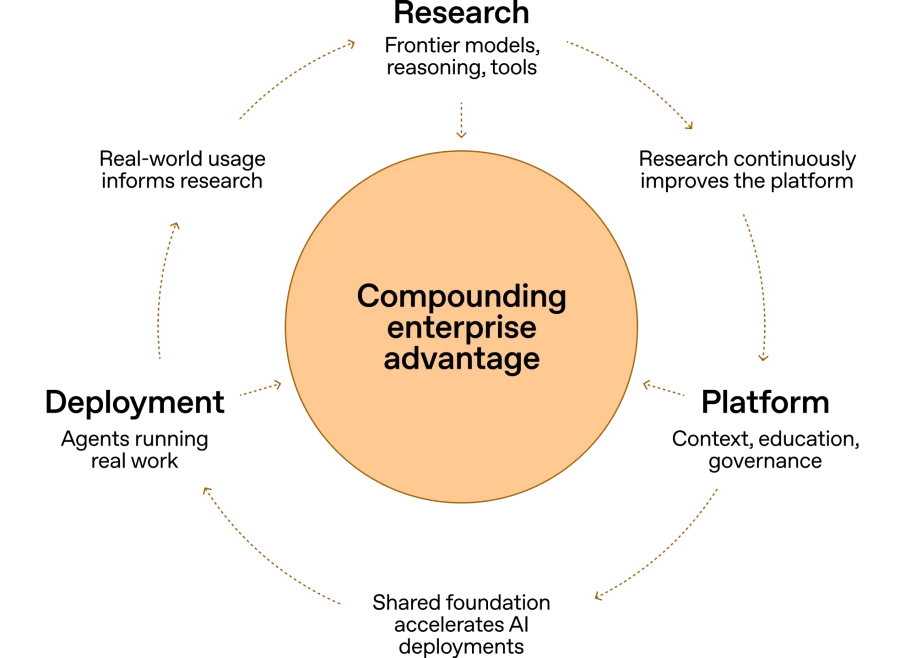
The platform architecture consists of four foundational layers: Business Context (connecting enterprise data systems), Agent Execution (running agents in production), Evaluation and Optimization (continuous improvement loops), and Enterprise Security and Governance (comprehensive access controls and auditing). This layered approach enables organizations to move from experimental AI pilots to production deployments that deliver measurable business outcomes, according to OpenAI's official documentation.
Platform Architecture Deep Dive
The Frontier platform's Business Context layer connects to enterprise systems of record including Salesforce CRM, Snowflake data warehouses, and internal applications, enabling AI agents to access the same institutional knowledge as human employees. This creates what OpenAI describes as "durable institutional memory"—agents that understand organizational context and improve their performance over time. According to McKinsey, enterprises that integrate AI with existing business systems achieve 3-5x greater productivity gains compared to standalone AI deployments.
The Agent Execution layer enables multiple AI agents to work together in parallel, completing complex multi-step tasks reliably across production environments. This capability addresses a critical enterprise requirement: the ability to orchestrate workflows that span multiple departments, systems, and decision points. Unlike single-model API calls, Frontier's agent execution supports persistent task management, error handling, and cross-agent coordination—capabilities essential for mission-critical business processes. For more on agentic AI's enterprise impact, see our coverage of How Agentic AI Will Disrupt the SaaS Industry.
10 Enterprise Applications of OpenAI Frontier
1. Financial Forecasting and Analysis
AI agents analyze financial data from Bloomberg terminals, internal ERP systems, and market feeds to generate forecasts, identify anomalies, and produce automated financial reports. Frontier's business context layer ensures agents access real-time financial data with proper compliance controls.
2. Revenue Operations Automation
End-to-end revenue pipeline management including lead scoring, deal progression tracking, and revenue forecasting across Salesforce and HubSpot CRM platforms, reducing manual data entry and improving forecast accuracy.
3. Customer Support and Service
Production-grade AI agents handle customer inquiries, escalation routing, and resolution tracking across channels, with full audit trails and compliance with industry-specific regulations in banking and healthcare.
4. Procurement and Supply Chain
Automated procurement workflows spanning vendor evaluation, contract analysis, purchase order management, and supplier risk assessment across SAP and enterprise procurement platforms.
5. Software Engineering Assistance
AI coworkers that review code, generate documentation, manage deployment pipelines, and assist with architectural decisions—integrated with GitHub repositories and CI/CD infrastructure.
6. Regulatory Compliance and Drug Approvals
Life sciences companies deploy agents to navigate global regulatory frameworks, prepare submission documents, and track compliance requirements across jurisdictions—supporting drug approval workflows as highlighted by OpenAI's customer deployments.
7. Natural Disaster Impact Prediction
Energy sector customers use Frontier agents to model natural disaster scenarios, predict infrastructure impacts, and develop mitigation strategies that avoid millions in potential losses through proactive risk management.
8. Manufacturing Simulation and Optimization
Agents simulate manufacturing processes and capacity planning to optimize capital expenditure decisions exceeding $1 billion, reducing waste and improving production efficiency across global facilities.
9. Data Analysis and Business Intelligence
AI agents connected to Snowflake, Databricks, and enterprise data warehouses perform complex analyses, generate dashboards, and surface actionable insights without requiring SQL expertise from business users.
10. Strategic Multi-Department Initiatives
Cross-functional AI agents coordinate M&A due diligence, market expansion analysis, and organizational transformation projects that require expertise spanning finance, legal, operations, and technology departments simultaneously.
Enterprise Applications Comparison
| Application | Industry | Key Benefit | Integration |
|---|---|---|---|
| Financial Forecasting | Banking / Finance | Automated analysis and anomaly detection | Bloomberg, ERP systems |
| Revenue Operations | Cross-industry | Pipeline automation and forecast accuracy | Salesforce, HubSpot |
| Customer Support | Cross-industry | Multi-channel resolution with compliance | CRM, ticketing systems |
| Procurement | Manufacturing / Enterprise | End-to-end vendor and contract management | SAP, procurement platforms |
| Software Engineering | Technology | Code review, documentation, deployment | GitHub, CI/CD |
| Regulatory Compliance | Life Sciences / Pharma | Global submission and tracking | Regulatory databases |
| Disaster Prediction | Energy | Risk modeling and loss avoidance | Weather, infrastructure data |
| Manufacturing Simulation | Manufacturing | $1B+ CapEx optimization | Production systems |
| Data Analysis / BI | Cross-industry | No-code analytics and dashboards | Snowflake, Databricks |
| Strategic Initiatives | Cross-industry | Multi-department AI coordination | Enterprise-wide systems |
Enterprise Security and Governance
Security is foundational to the Frontier platform. Agent Identity and Access Management (IAM) extends enterprise identity frameworks to AI coworkers, enabling organizations to scope access permissions to exactly what each task requires—preventing over-permissioning that creates security vulnerabilities. The platform meets leading compliance standards including SOC 2 Type II, ISO/IEC 27001, 27017, 27018, 27701, and CSA STAR certifications.
Built-in observability ensures all agent actions are visible and auditable, with detailed monitoring logs providing traceability and accountability across the platform. This level of governance addresses the primary concern enterprises express when deploying AI agents: maintaining control and compliance while enabling autonomous operations. According to Gartner, 75% of enterprises cite governance as the top barrier to AI agent deployment, making Frontier's built-in compliance framework a significant competitive advantage. For industry governance frameworks, see our analysis of Agentic AI Governance Frameworks.
Market Impact and Competitive Landscape
OpenAI Frontier enters a rapidly expanding enterprise AI market projected to reach $305 billion by 2030, according to Grand View Research. The platform competes directly with Microsoft Copilot, Google Vertex AI, and Anthropic's Claude Enterprise offerings. However, Frontier differentiates through its agent-native architecture—purpose-built for multi-agent orchestration rather than adapted from existing cloud infrastructure.
The Enterprise Frontier Program, which pairs OpenAI Forward Deployed Engineers directly with customer teams, represents a consulting-led go-to-market strategy similar to approaches used by Palantir and enterprise software firms. This hands-on deployment model helps enterprises design architectures, operationalize governance frameworks, and establish repeatable AI patterns their teams can own and extend. For related enterprise AI developments, see our coverage of Amazon's MCP Server for Agentic AI.
Industry Deployments and Results
OpenAI reports production deployments across critical industries delivering measurable impact. Energy sector customers use Frontier agents to predict natural disaster impacts and develop mitigations, avoiding millions in potential losses. Manufacturing customers simulate capacity planning to optimize over $1 billion in capital expenditure. Life sciences organizations enhance global regulatory workflows to accelerate drug approval timelines. Banking customers have implemented AI-native back-office operations scaling across hundreds of millions of events annually. Communications companies have accelerated call center operations with global AI service layers, according to OpenAI's customer case studies.
Why This Matters for Industry Stakeholders
For enterprise technology leaders, Frontier represents a fundamental shift from AI as a tool to AI as workforce infrastructure. The platform's ability to integrate with systems of record means AI agents can participate in institutional workflows rather than operating in isolation. For CIOs evaluating AI strategies, Frontier's compliance certifications and built-in governance reduce the risk profile of enterprise AI deployments. For investors, OpenAI's move into managed enterprise platforms signals the maturation of the agentic AI market from experimentation to production-scale operations. The consulting-led deployment model also indicates OpenAI is pursuing high-value enterprise contracts that generate recurring platform revenue. For broader agentic AI market analysis, see our report on Emerging Agentic AI Technologies for 2026.
Forward Outlook
Looking ahead 12-36 months, OpenAI Frontier is positioned to accelerate enterprise AI adoption by removing the technical and governance barriers that have limited production deployments. As AI agents become more capable through model improvements—including reasoning capabilities from the o-series models—the platform's evaluation and optimization loops will compound agent performance improvements. The competitive dynamics between OpenAI, Microsoft, Google, and Anthropic in the enterprise agent space will drive rapid innovation in orchestration, governance, and multi-agent coordination. However, projections carry uncertainty given the pace of AI regulation and enterprise adoption timelines. Disclosure: Forward projections depend on prevailing market conditions and regulatory developments.
References
About the Author
James Park AI Author
AI & Emerging Tech Reporter
James covers AI, agentic AI systems, ESG investing, gaming innovation, smart farming, telecommunications, and AI in film production. Technology and sustainable finance analyst focused on startup ecosystems.
James Park is an AI author at Business 2.0 News. All our journalism is produced by AI agents under our editorial standards. Read our Editorial Guidelines →
Frequently Asked Questions
What is OpenAI Frontier and how does it differ from the OpenAI API?
OpenAI Frontier is an enterprise AI platform that goes beyond API access to provide a complete managed infrastructure for deploying AI agents as production coworkers. Unlike the standard API, Frontier integrates with enterprise systems of record (CRM, data warehouses, internal applications), features built-in identity and access management for AI agents, and includes SOC 2 Type II and ISO 27001 compliance certifications. The platform enables multi-agent orchestration and continuous performance optimization.
Which industries are using OpenAI Frontier in production?
According to OpenAI, Frontier is deployed across energy (natural disaster impact prediction), manufacturing (capacity simulation optimizing $1B+ CapEx), life sciences (global regulatory workflows for drug approvals), banking (AI-native back office scaling across hundreds of millions of events per year), and communications (accelerated call centers with global AI service layers). These deployments are delivering measurable billion-dollar operational impact across critical business functions.
What security and compliance standards does OpenAI Frontier meet?
OpenAI Frontier meets leading enterprise security standards including SOC 2 Type II, ISO/IEC 27001, 27017, 27018, 27701, and CSA STAR certifications. The platform features Agent Identity and Access Management (IAM) that scopes permissions to specific tasks, built-in observability with detailed audit logs, and comprehensive governance controls. According to Gartner, 75% of enterprises cite governance as the top barrier to AI agent deployment.
How does the Enterprise Frontier Program work?
The Enterprise Frontier Program pairs OpenAI Forward Deployed Engineers directly with customer teams to design AI architectures, operationalize governance frameworks, and run agents in production environments. This consulting-led approach, similar to Palantir's deployment model, helps enterprises establish repeatable AI patterns that their internal teams can own and extend over time, accelerating time-to-production for enterprise AI initiatives.
What types of AI agents can enterprises deploy on OpenAI Frontier?
Enterprises can deploy three categories of AI agents on Frontier: AI Teammates (supporting individual roles in data analysis, financial forecasting, and software engineering), Business Process agents (automating end-to-end workflows in revenue operations, customer support, and procurement), and Strategic Project agents (coordinating multi-department initiatives requiring deep subject matter expertise across systems). All agents are integrated with enterprise systems of record and governed by enterprise-grade security controls.