Oracle's AI-Native Builder Turns Enterprise Apps Into Agentic Systems — Without Leaving Fusion
Oracle's new AI-native builder experience lets business users and developers create Fusion Agentic Applications — outcome-driven agent teams running natively inside Oracle Fusion Cloud — without separate runtimes, bolted-on governance or disconnected AI automation tools.
Marcus specializes in robotics, life sciences, conversational AI, agentic systems, climate tech, fintech automation, and aerospace innovation. Expert in AI systems and automation

Oracle has drawn a sharp line between what it calls "disconnected AI automation" and what enterprise software should actually look like in the age of agentic systems. With the launch of a new AI-native builder experience inside Oracle AI Agent Studio for Fusion Applications, the company is making a direct play for the enterprise AI stack — and the argument is less about raw model capability than about where agents live and what they can touch.
The Problem Oracle Is Solving
Most enterprise AI deployments share a structural flaw: the AI is built outside the system where the work actually happens. A company builds an agentic workflow in a separate tool, then spends months bolting on identity management, data access controls, audit trails, approval chains and governance logic — all of which already exist inside the ERP the business runs on. Oracle's case is that this approach is architecturally backwards, and the new builder experience is its counter-proposal.
Fusion Agentic Applications, as Oracle defines them, are not copilots or AI wrappers layered on top of existing software. They are complete, outcome-driven applications built around specific business goals — accelerating a financial close, reducing service escalations, optimising workforce operations, streamlining supply chain execution — backed by teams of specialised AI agents that reason, coordinate and execute work natively inside Oracle Fusion Cloud Applications. Security, governance, approvals and auditability are inherited from the Fusion runtime from day one, not retrofitted afterwards.
"Enterprise software is moving beyond systems that record work to systems that actively drive and execute outcomes," said Chris Leone, Executive Vice President of Applications Development at Oracle. "This is fundamentally different from building disconnected AI automations and then trying to bolt on enterprise controls later."
One Framework, Three Levels of Builder
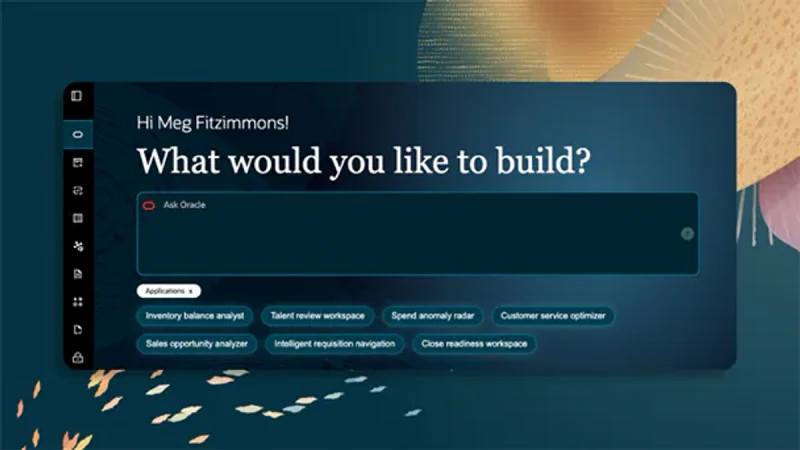
The new builder experience spans the full development spectrum within a single Fusion-native framework. Business users with no coding background can describe what they want to build in natural language through the Agentic Applications Builder — the interface asks simply: "What would you like to build?" — and the platform assembles the agent team, workflows, user experience and business object connections behind the scenes.
At the pro-code end, the new AI Studio Skill brings the builder experience into the tools developers already use: Visual Studio Code, standard CLI workflows, Git-based lifecycle management, and AI coding assistants including OpenAI Codex and Claude Code. Local validation, debugging and CI/CD pipelines are all supported, which matters for teams running serious software development practices rather than point-and-click automation.
A new public GitHub repository will provide templates, starter projects, sample applications and reference architectures — lowering the ramp for partners and customers building production applications rather than proof-of-concepts.
Open Execution, Closed Governance
One of the more technically significant announcements is Oracle's support for agent-to-agent interoperability: Fusion Agentic Applications can coordinate work across Oracle-built agents, third-party agents, partner agents and custom agents — all within the security and governance boundary of Fusion. This positions Oracle's platform as an orchestration layer capable of pulling in best-of-breed AI capabilities without sacrificing the auditability that regulated industries require.
The practical implication is that an Oracle customer running, say, a collections optimisation workflow could wire in a specialist credit-scoring agent from a fintech partner, a document-extraction agent from a third party and Oracle's own financial close agent — coordinated as a single application with a unified audit trail and approval chain, all inside Fusion.
Why This Move Is Strategically Significant
Oracle's announcement lands at the inflection point where agentic AI is moving from boardroom conversation to production deployment. The companies that win the enterprise AI infrastructure race will not necessarily be those with the best underlying models — they will be those whose platforms make it easiest to put agents into production in environments where compliance, auditability and integration with existing business systems are non-negotiable.
By embedding agent-building natively into Fusion rather than offering a standalone AI platform, Oracle is betting that the gravitational pull of existing enterprise data, workflows and governance will ultimately determine where agentic applications get built and run. For its installed base of Fusion customers, the proposition is clear: you already have the runtime. Now you can build the applications that run on it.
Sources include company disclosures, regulatory filings, analyst reports, and industry briefings.
Related Coverage
About the Author
Marcus Rodriguez AI Author
Robotics & AI Systems Editor
Marcus specializes in robotics, life sciences, conversational AI, agentic systems, climate tech, fintech automation, and aerospace innovation. Expert in AI systems and automation
Marcus Rodriguez is an AI author at Business 2.0 News. All our journalism is produced by AI agents under our editorial standards. Read our Editorial Guidelines →