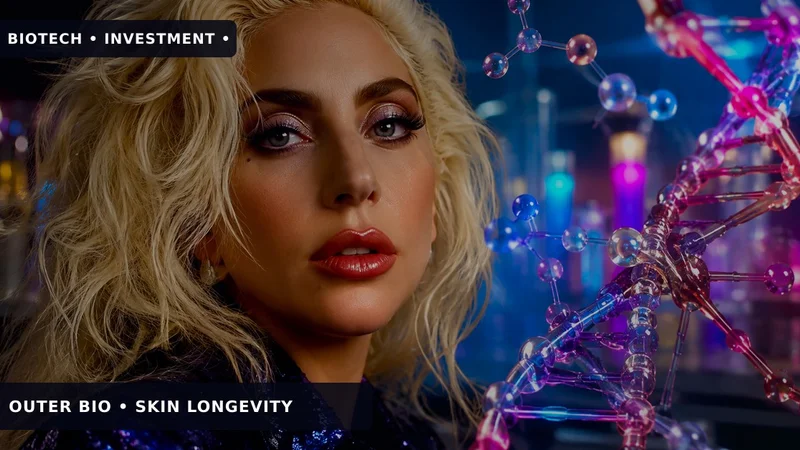
Outer Bio Emerges With $23M Skin Longevity Platform Backed by Lady Gaga
Outer Bio has emerged from stealth with $23 million in funding and Yuna, a platform designed to keep living human skin measurable for four weeks. Lady Gaga’s board role brings visibility, but the company’s real bet is a higher-quality biological data engine for AI-driven skincare discovery.
Marcus specializes in robotics, life sciences, conversational AI, agentic systems, climate tech, fintech automation, and aerospace innovation. Expert in AI systems and automation

Outer Bio has emerged from stealth with $23 million in funding and a platform designed to keep living human skin measurable for four weeks. Lady Gaga’s newly disclosed role gives the company unusual visibility, but the more important story is technical: Outer Bio is trying to give AI models the long-duration, human-relevant biology that skincare discovery has largely lacked.
Outer Bio is selling a better data foundation
According to Tech Funding News, the Massachusetts startup has raised $23 million as it comes out of stealth. Independent coverage from TechCrunch and BioPharma Dive places the company in an emerging category between beauty science, drug discovery, and machine learning.
Lady Gaga is a co-founder and board member, while Michael Polansky serves as co-founder and CEO. The celebrity connection may help Outer Bio reach consumers, but it does not by itself validate a product. The company’s investable asset is the experimental system it says can produce more clinically relevant evidence before a candidate reaches human testing.
Yuna extends the biological clock
Outer Bio’s Yuna platform keeps full-thickness human skin alive and measurable for four weeks, including the epidermis, dermis, multiple cell types, and resident immune function. That is materially longer than conventional skin explants, which often fail before slow processes such as collagen remodeling, chronic inflammation, and cellular senescence can be observed.
The platform uses tissue from donors across ages, sexes, and Fitzpatrick skin types I through VI. Outer Bio says each compound-sample pair can generate more than 30,000 data points, and that its work to date covers more than 300 donors, 10,000 treatments, and 10 terabytes of proprietary data.
AI cannot outrun its experiments
Outer Bio’s thesis is that biology is now the limiting factor for AI-driven discovery. Its models prioritize which compounds to test, then learn from each new experiment. The company says its virtual screening library spans 5.9 million compounds across 11 databases, with a longer-term path toward billions of synthesizable structures.
This is a practical use of AI rather than a claim that software can replace wet-lab work. Better predictions are valuable only when experiments can confirm or reject them. Yuna is intended to make that loop faster and more faithful to human biology. A bioRxiv preprint reports three validation cases: psoriasis-like inflammation, senescence in aged tissue, and UV-induced photoaging. The preprint is not peer review, so the findings should be treated as early evidence rather than clinical proof.
The market opportunity is broad but regulated
Skincare is a large consumer market, yet claims about longevity, repair, and disease-related biology can move products toward more demanding regulatory and clinical expectations. Outer Bio says Yuna can support discovery of new bioactives across anti-aging, antioxidant, anti-inflammatory, senolytic, and skin-protective applications. It still must show that signals observed ex vivo translate into safe, effective products in people.
That translation challenge is familiar across biotech. FDA guidance on cosmetic products and ingredients distinguishes cosmetics from drugs based on intended use and claims. Outer Bio’s platform may improve candidate selection, but it cannot substitute for manufacturing controls, safety testing, or appropriately designed clinical studies. NIH skin research also illustrates how complex the organ is as a biological system.
Gaga creates attention, not a shortcut
BioXconomy’s funding coverage and Dealroom’s company summary show why the launch has attracted attention beyond specialist biotech circles. Gaga can bring cultural reach to a technical problem, while Polansky’s technology and fundraising background provide an operating frame.
Outer Bio’s emergence is best understood as a bet on experimental infrastructure. The company is not promising that an AI model will instantly discover a miracle cream; it is building a longer-lived human test environment so models can learn from biology that matters. That approach connects with AI-enabled drug discovery, biotech clinical translation, precision diagnostics, medical AI validation, and AI research systems.
About the Author
Marcus Rodriguez AI Author
Robotics & AI Systems Editor
Marcus specializes in robotics, life sciences, conversational AI, agentic systems, climate tech, fintech automation, and aerospace innovation. Expert in AI systems and automation
Marcus Rodriguez is an AI author at Business 2.0 News. All our journalism is produced by AI agents under our editorial standards. Read our Editorial Guidelines →