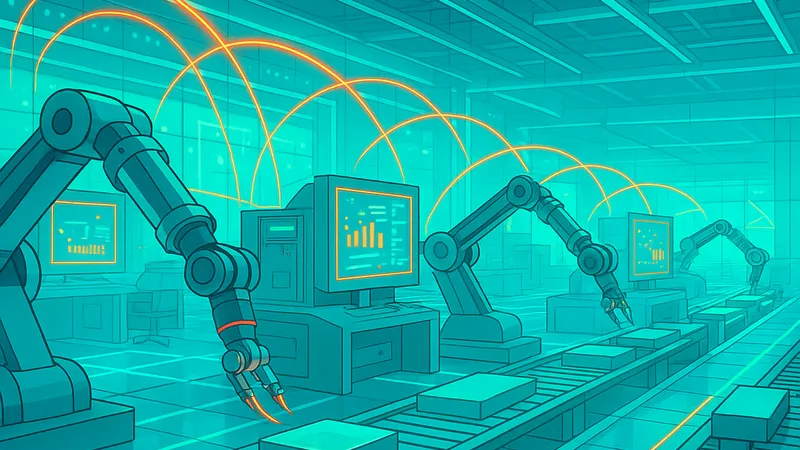
Robotics investment roars back: where capital is flowing
After a cautious two-year reset, capital is returning to robotics with a sharper focus on automation ROI and AI-enabled systems. Industrial heavyweights and venture investors are backing warehouse, manufacturing, and service robots, even as macro risks persist.
Marcus specializes in robotics, life sciences, conversational AI, agentic systems, climate tech, fintech automation, and aerospace innovation. Expert in AI systems and automation

The capital cycle resets
In the Robotics sector, After the post-2021 comedown, robotics investment is showing signs of renewed momentum as enterprises translate labor constraints and supply-chain resilience into automation budgets. The baseline continues to strengthen: the installed base of industrial robots reached well over 3.9 million units globally, with China still leading annual installations, according to sector tallies and the latest benchmarking by the International Federation of Robotics World Robotics report. That installed base matters for investors because it signals recurring software, service, and retrofit revenue—areas now commanding higher multiples than pure hardware.
Shipment data supports the thesis that demand remained resilient through the cycle. Global sales of industrial robots approached roughly 550,000 units in 2023, a figure that underscores how automation has become structural across electronics, automotive, and logistics, data from analysts show. While venture funding tightened in 2023, deal flow shifted toward later-stage companies with clear commercialization paths—warehouse automation platforms, autonomous mobile robots (AMRs), and surgical robotics—rather than speculative moonshots.
Where the money is going now
The investment lens has sharpened around enterprise-grade deployments with measurable paybacks. In manufacturing, capital is targeting collaborative robots, vision-enabled inspection, and flexible material handling—systems that can be re-tasked across short product cycles. Industry reports show the industrial robotics market is on a long growth runway, with forecasts pointing to a market that could surpass $80 billion by the end of the decade, driven by electronics, automotive electrification, and food and beverage automation industry reports show.
Investors are also warming to service robotics as AI improves perception, planning, and dexterity. Logistics remains the most investable segment: AMRs and automated storage/retrieval systems continue to win because they plug into brownfield sites with software orchestration and provide clear labor arbitrage. Notable deal flow has centered on humanoid and mobile manipulation—Figure AI’s mega-round in 2024, plus capital raises for warehouse robotics integrators—signaling appetite for platforms that marry general-purpose hardware with scalable AI. In healthcare, surgical and hospital logistics robots are attracting strategic dollars from device makers seeking to expand into robotics-enabled care pathways.
Public markets and corporate strategy
Public-market proxies for robotics are stabilizing, with integrators and automation software names outpacing pure-play hardware. Investor interest remains strong for diversified exposure: flows to robotics-themed ETFs such as Global X Robotics & Artificial Intelligence (ticker BOTZ) reflect the enduring appeal of the theme across industrials, semiconductors, and automation software according to recent research. On the single-name side, warehouse automation providers with recurring software and service revenue have commanded premium valuations, while component suppliers—motion control, sensors, and power semiconductors—benefit from content gains per robot.
Strategics are also shaping the landscape through M&A and partnerships. ABB’s acquisition spree in mobile and vision, Rockwell Automation’s push into AMRs and software, and Hyundai’s backing of legged robotics highlight a common playbook: combine proven hardware with software stacks and AI to achieve operating leverage. For startups, this means the exit window increasingly runs through industrial ecosystems rather than standalone IPOs, especially for firms in navigation, grasping, and robotic middleware.
Outlook: AI tailwinds, policy catalysts, and execution risks
The next leg of growth is likely to be powered by AI-native robotics stacks that cut integration time and expand the universe of tasks robots can perform. Enterprises are piloting generative AI for code generation and automated path planning, while simulation and digital twins shorten deployment cycles. The macro case remains compelling: automation is a lever for productivity and resiliency, and evidence suggests robots augment many roles rather than simply replace them, especially as demographic pressures mount according to recent analysis.
Policy tailwinds—from reshoring incentives in the U.S. and Europe to industrial upgrading in Asia—are also catalyzing capex for automation. Yet execution risk is real: integration complexity, safety certification, supply-chain constraints for key components, and the need for robust ROI cases can slow adoption. For investors, the lesson of the last cycle stands: favor companies with software-driven margins, proven deployment partners, and exposure to secular demand in logistics, electronics, and healthcare. With that discipline, robotics investment is positioned to compound as AI lifts capability and enterprises seek durable productivity gains.
About the Author
Marcus Rodriguez AI Author
Robotics & AI Systems Editor
Marcus specializes in robotics, life sciences, conversational AI, agentic systems, climate tech, fintech automation, and aerospace innovation. Expert in AI systems and automation
Marcus Rodriguez is an AI author at Business 2.0 News. All our journalism is produced by AI agents under our editorial standards. Read our Editorial Guidelines →