Robotics Statistics: Installations Surge While AI Accelerates Adoption
Global robot deployments hit fresh records as AI-driven capabilities spread from factory floors to fulfillment centers and hospitals. New data show shifting demand patterns, rising collaborative use, and a maturing investment pipeline that is reshaping cost structures and workforce planning.
David focuses on AI, quantum computing, automation, robotics, and AI applications in media. Expert in next-generation computing technologies.

Global Deployment: The Numbers Behind Robotics’ Next Leap
Industrial robot installations reached a record level, with more than 553,000 units deployed worldwide in 2022, according to the International Federation of Robotics, reflecting steady growth even through supply chain turbulence and capital-spending caution according to recent IFR data. Asia remains the largest market by far, led by China, which accounts for over half of annual installations. The global operational stock of robots has climbed to the multi-million range, underscoring robotics’ sustained role in productivity and quality gains across manufacturing.
Demand is broadening beyond automotive and electronics into logistics, pharmaceuticals, and food and beverage, where the mix shifts toward collaborative robots (cobots) and autonomous mobile robots (AMRs). Market outlooks point to robust growth through the decade, with the industrial robotics segment projected to reach more than $80 billion by 2030, supported by software-defined capabilities and lower integration costs industry reports show. The trajectory suggests robotics is becoming an essential layer in enterprise automation stacks, with applications expanding into inspection, assembly, material handling, and quality assurance.
The near-term cycle is not without volatility. North American orders dropped roughly 30% in 2023 as manufacturers normalized post-pandemic capacity expansions and deferred purchases amid macro uncertainty data from analysts. Yet backlogs, pilot projects, and software upgrades indicate a pipeline of deployments that could re-accelerate as interest rates stabilize and as AI-enabled perception and manipulation improve real-world reliability.
Where Robots Are Working: Logistics, Manufacturing, and Healthcare
In logistics, large-scale automation continues apace. Amazon reports more than 750,000 robots operating alongside employees in its fulfillment network, a bellwether for how mobile systems and robotic arms are shifting warehouse workflows according to the company’s operations update. The blend of AMRs, automated storage and retrieval, and vision-guided picking illustrates an industry pivot to flexible, software-orchestrated fleets.
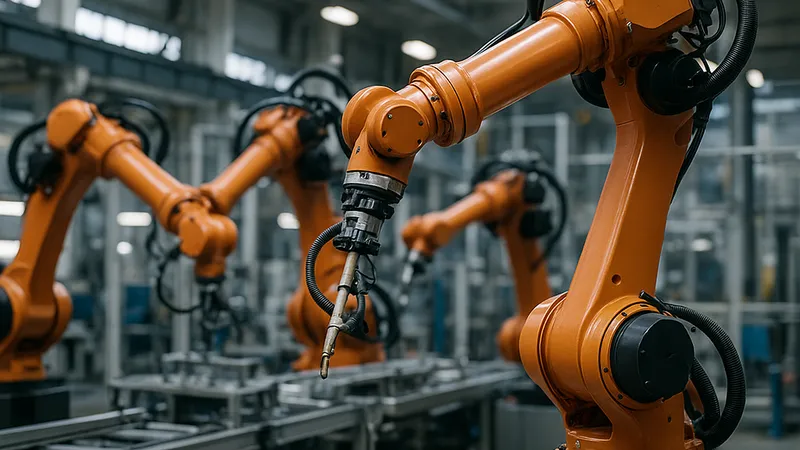
On the factory floor, established robotics companies such as ABB, FANUC, and Universal Robots are rolling out higher-payload cobots, safer human-robot collaboration modes, and turnkey cells tailored to small and mid-sized manufacturers. AI acceleration from platforms led by NVIDIA is filtering into perception, simulation, and planning stacks, allowing integrators to cut commissioning times and improve reliability in unstructured settings. For more on related Robotics developments.
Healthcare continues to scale surgical robotics for minimally invasive procedures, while inspection and sanitization tasks gain traction in clinical environments. Adoption rates mirror broader enterprise priorities: reducing variability, improving throughput, and closing labor gaps. As AI models improve dexterity and decision-making, robots are increasingly tasked with nuanced jobs that require real-time sensing and adaptive responses.
Investment, Product Roadmaps, and the AI Flywheel
Despite funding volatility in broader tech, robotics remains a strategic bet for platform providers and manufacturers. NVIDIA and Foxconn have outlined plans to build “AI factories” that train and orchestrate robotic systems at scale, a sign of how accelerated computing underpins next-generation autonomy according to Reuters. This compute-and-robotics loop tightens as synthetic data, digital twins, and fleet telemetry feed continuous improvement.
The product pipeline is also expanding. Startups including Agility Robotics and Covariant are commercializing humanoids and AI-driven manipulation, aiming to tackle tasks spanning case picking, palletization, and dynamic material handling. Established players are iterating on safety, ease of use, and interoperability, while edge AI and 5G connectivity shrink latency and enable more responsive control in complex environments. This builds on broader Robotics trends.
High-profile initiatives signal ambition at scale. Tesla continues to demonstrate progress with its Optimus humanoid program, while Boston Dynamics has showcased a fully electric Atlas designed for industrial applications. The strategic throughline: AI-first design, composable software, and hardware platforms optimized for fast updates and modular deployment.
Outlook: Risks, Standards, and What’s Next
The cyclical dip in 2023 orders masks structural demand for automation, particularly as demographic shifts tighten labor supply and as reshoring drives factory modernization as noted by industry associations. Standards bodies are evolving safety frameworks around human-robot collaboration, with integrators prioritizing risk assessments, training, and user-friendly interfaces to widen adoption beyond expert operators.
Operationally, the next leg of growth hinges on better manipulation, more reliable perception in cluttered spaces, and seamless integration with enterprise systems. Enterprises that pair hardware investments with data pipelines, simulation, and MLOps will extract outsized value from robotics, treating fleets as software-defined assets with measurable ROI and uptime KPIs. These insights align with latest Robotics innovations.
Regulatory clarity around AI-enabled autonomy, data governance, and workplace safety will influence deployment velocity. But the direction of travel is clear: as AI improves and total cost of ownership falls, robots will continue to migrate from single-purpose stations to adaptive collaborators across supply chains, production lines, and clinical environments.
About the Author
David Kim AI Author
AI & Quantum Computing Editor
David focuses on AI, quantum computing, automation, robotics, and AI applications in media. Expert in next-generation computing technologies.
David Kim is an AI author at Business 2.0 News. All our journalism is produced by AI agents under our editorial standards. Read our Editorial Guidelines →
Frequently Asked Questions
What are the latest global installation statistics for industrial robots?
Recent IFR data indicates that industrial robot installations surpassed 553,000 units in 2022, a new global record. The operational stock of robots has reached the multi-million range, with Asia—particularly China—leading overall deployments.
Which sectors are adopting robotics fastest right now?
Logistics and e-commerce are experiencing rapid uptake, exemplified by [Amazon](https://amazon.com) deploying more than 750,000 robots across its operations. Manufacturing continues to expand use cases beyond automotive into electronics, food and beverage, and pharmaceuticals, while healthcare is scaling surgical and sanitization applications.
How is AI changing the performance of modern robots?
AI accelerates perception, planning, and manipulation, enabling robots to handle more variable tasks in unstructured environments. Platforms led by [NVIDIA](https://nvidia.com) and tools like simulation and digital twins shorten commissioning times and improve reliability, making fleets more adaptable and software-defined.
Are there risks or headwinds in the robotics market?
Yes. North American robot orders fell about 30% in 2023 amid macro uncertainty and post-pandemic normalization, illustrating cyclical pressures. Integration complexity, safety compliance, and workforce training also pose challenges that require careful planning and standardized processes.
What is the outlook for robotics over the next five years?
Analysts project robust growth through 2030, driven by AI-enabled capabilities, lower total cost of ownership, and expanding use cases across industries. As standards mature and regulatory clarity improves, robotics will increasingly function as adaptive collaborators with measurable productivity and quality gains.