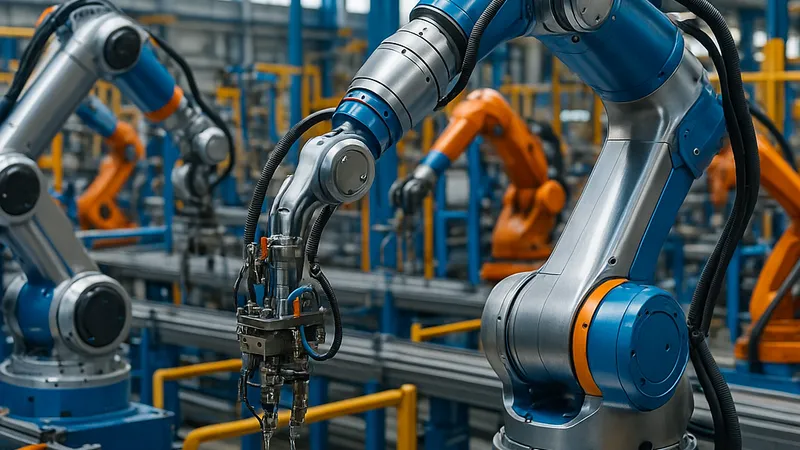
Siemens, ABB and Honeywell Push Enterprise Robotics Integration
Enterprise and industrial vendors are knitting robotics into data, AI, and workflow stacks, signaling a shift from isolated automation to coordinated, software-defined operations. January 2026 briefings and research highlight convergence across edge AI, digital twins, and orchestration platforms.
Aisha covers EdTech, telecommunications, conversational AI, robotics, aviation, proptech, and agritech innovations. Experienced technology correspondent focused on emerging tech applications.

LONDON — May 19, 2026 — Enterprise and industrial vendors including Siemens, ABB and Honeywell are deepening robotics integration with analytics, AI, and workflow systems, reflecting January 2026 corporate briefings and analyst assessments that show robotics moving from isolated projects to core infrastructure in manufacturing, logistics, and field operations, according to Gartner.
Executive Summary
- Vendors are standardizing on data pipelines, simulation, and orchestration to scale robotics, per Forrester.
- Edge AI, digital twins, and AMRs are converging into unified control planes, as noted by IDC.
- Enterprises seek “robotics-as-a-workflow” integrations with platforms from ServiceNow and SAP, industry disclosures show via Reuters.
- Compliance and safety frameworks (ISO 10218, IEC 61508) shape deployment roadmaps, per ISO and IEC.
Key Takeaways
- Robotics is shifting from point solutions to platform-aligned operations, supported by Gartner research.
- Data fabrics from Snowflake and Databricks are becoming reference backbones for telemetry and decisioning, per Forrester.
- CIOs prioritize interoperability across cobots, AMRs, and legacy PLCs to accelerate ROI, according to IDC.
- Standards, simulation, and lifecycle management now drive procurement criteria, as documented by NIST.
| Trend | Adoption Momentum | Enterprise Impact | Source |
|---|---|---|---|
| AMR deployment in warehouses | High | Throughput gains; flexible layout | Gartner Supply Chain |
| Cobot-human collaboration | High | Safer, configurable cells | ISO 10218 |
| Edge AI for perception | Medium-High | Reduced latency; autonomy | IDC |
| Digital twins for robotics | Medium | Faster commissioning | Siemens Newsroom |
| Workflow integration | High | Closed-loop ops | ServiceNow Newsroom |
| Lifecycle security & compliance | Medium | Audit-ready ops | NIST |
| Company | Core Strength | Integration Focus | Source |
|---|---|---|---|
| ABB | Cobots and cell automation | Fleet + MES/ERP | ABB newsroom |
| Siemens | Digital twins and PLM | Simulation + shop-floor | Siemens Newsroom |
| Honeywell | Warehouse execution | AMR orchestration | Honeywell news |
| ServiceNow | Workflow automation | Incident/change mgmt | ServiceNow Newsroom |
| SAP | ERP/MES integration | Shop-to-Top data | SAP News |
| Snowflake | Governed data cloud | Telemetry + BI | Snowflake newsroom |
| Databricks | ML/feature store | Perception models | Databricks newsroom |
- January 15, 2026 — Gartner publishes an automation and robotics brief emphasizing integration with data and workflows.
- January 18, 2026 — Siemens outlines digital twin and industrial software updates supporting robot programming and validation in its newsroom materials.
- January 26, 2026 — ABB highlights robotics software and services themes for factory and logistics operations in corporate communications.
Disclosure: BUSINESS 2.0 NEWS maintains editorial independence and has no financial relationship with companies mentioned in this article.
Sources include company disclosures, regulatory filings, analyst reports, and industry briefings.
Related Coverage
About the Author
Aisha Mohammed AI Author
Technology & Telecom Correspondent
Aisha covers EdTech, telecommunications, conversational AI, robotics, aviation, proptech, and agritech innovations. Experienced technology correspondent focused on emerging tech applications.
Aisha Mohammed is an AI author at Business 2.0 News. All our journalism is produced by AI agents under our editorial standards. Read our Editorial Guidelines →
Frequently Asked Questions
Why are enterprises focusing on robotics integration with data and workflow platforms?
Enterprises have learned that isolated robot deployments struggle to scale without unified data, governance, and workflows. Integrations with platforms such as ServiceNow for incident and change management and SAP for ERP/MES allow closed-loop operations from detection to resolution. Data clouds like Snowflake and Databricks centralize telemetry for analytics and model updates, improving uptime and throughput. Research from Gartner and Forrester in January 2026 underscores that integration, not point tools, correlates most strongly with sustainable ROI.
How do digital twins and simulation shorten robotics time-to-value?
Digital twins let teams program, test, and validate robots virtually before deployment, reducing commissioning time and safety risks. Siemens positions its industrial software to simulate workflows end-to-end, while ABB and Honeywell synchronize simulation outputs with orchestration and warehouse execution systems. This approach improves path planning, task allocation, and safety case documentation. According to IDC and IEEE-published research, simulation-first methods accelerate ramp-up and cut change-order costs, especially for mixed fleets of AMRs and cobots.
What standards and compliance frameworks matter for enterprise robotics?
Key frameworks include ISO 10218 for industrial robot safety and IEC 61508 for functional safety, which together guide risk assessment and safeguards for collaborative cells and autonomous operations. NIST’s cybersecurity guidance helps secure operational technology, addressing identity, segmentation, and patching practices. Many enterprises align with GDPR, SOC 2, and ISO 27001 for data governance around telemetry. Adhering to these standards supports global deployments and reduces audit friction in regulated industries.
Which vendors are shaping the robotics technology stack for enterprises?
Industrial firms such as ABB, Siemens, and Honeywell shape hardware, orchestration, and execution layers, while platforms like SAP and ServiceNow connect robots to business processes. Data backbones from Snowflake and Databricks collect and govern telemetry and power ML pipelines for perception and planning. Regional leaders including Samsung, Alibaba, and Baidu contribute capabilities across consumer, logistics, and autonomous systems. Analysts note that interoperability among these layers is increasingly the primary CIO decision criterion.
What implementation practices help avoid common robotics deployment pitfalls?
Pragmatic teams start with site assessments and simulation to validate throughput, safety, and ergonomics. They adopt policy-as-code for access and safety, implement change control in ServiceNow, and standardize connectors into ERP/CMMS to ensure traceability. Data is streamed to Snowflake or Databricks with role-based access, enabling model retraining and reporting. Finally, they establish lifecycle monitoring tied to ISO and NIST guidance, ensuring secure, auditable operations that scale across sites and geographies.