Smart Farming by the Numbers: Market Growth, Adoption, and ROI Trends
Smart farming is shifting from pilot projects to production-scale deployments, with market value approaching $20 billion and accelerating across geographies. Adoption data and company case studies now quantify real ROI, from input savings to yield stabilization, amid a race to build connected ag platforms.
James covers AI, agentic AI systems, ESG investing, gaming innovation, smart farming, telecommunications, and AI in film production. Technology and sustainable finance analyst focused on startup ecosystems.

Market Snapshot: The Growth Arc of Smart Farming
The smart farming market has moved decisively into scale-up mode as connectivity, sensors, and AI converge across fields, barns, and greenhouses. Global market value reached roughly $18 billion in 2023 and is projected to surpass $36 billion by 2030 as deployments expand beyond early adopters, industry reports show. That trajectory reflects rising capital allocation toward precision equipment, agronomic analytics, and automation.
Leading OEMs and agtech platforms have sharpened their strategies to convert that demand into subscription and services revenue. Deere & Company, CNH Industrial, AGCO, Trimble, and Bayer’s Climate FieldView are building data-driven ecosystems around guidance, variable-rate application, and autonomous operations. M&A and partnerships underscore the momentum: AGCO’s $2 billion joint venture centered on Trimble’s agriculture assets and software was structured to accelerate cross-brand precision adoption and recurring revenue.
At the same time, policy and infrastructure are catching up. Rural broadband build-outs and spectrum initiatives for private LTE are improving coverage and latency across key farming regions, while sustainability-linked financing increasingly favors technologies that quantify water use, emissions, and input efficiency. Together, these tailwinds underpin the sector’s steady compound growth and rising software mix.
Adoption Metrics and On-Farm ROI
Hard numbers on adoption are now visible across row crops. In the United States, guidance and auto-steer systems are in use on well over half of corn, soybean, and wheat acres, with variable-rate application technologies deployed on a meaningful share of acreage and rising year over year, USDA ERS data indicate. The practical impact is tighter pass-to-pass accuracy, reduced overlaps, and more granular nutrient placement.
ROI is increasingly quantified. Precision spraying systems using machine vision can dramatically curb input use; Deere’s See & Spray technology reports herbicide reductions of up to 66% under targeted application, translating into measurable cost savings and environmental benefits, company data show. Across broader deployments, case studies and field analytics point to double-digit improvements in input efficiency and faster payback windows as farms integrate data flows from equipment, sensors, and imagery, according to recent research.
The scaling pattern is clear: early wins often start with guidance and rate control, then progress to variable-rate seeding/fertilizer, targeted spraying, and sensor-fed decision support. For more on broader Smart Farming trends, these adoption curves frequently track connectivity upgrades and data management maturity, with the most robust results coming when agronomic recommendations are standardized across the entire farm operation.
The Tech Stack: Sensors, Connectivity, and AI in the Field
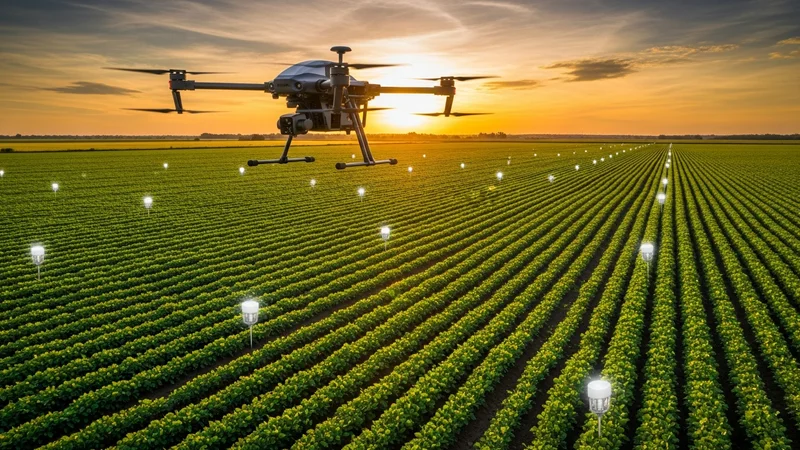
Smart farming statistics increasingly reflect a layered stack—edge devices, connectivity, and cloud analytics. Soil moisture probes, weather stations, tractor-mounted cameras, and drone imagery generate high-frequency datasets that feed into prescription maps, agronomic alerts, and fleet workflows. As rural connectivity improves, real-time data flows enable near-term decisions on irrigation, nutrient timing, and harvest logistics.
Automation is advancing, though unevenly, with robotics and autonomous implements most visible in high-value crops and large-scale row-crop operations. FAO’s analysis highlights both the productivity potential and the adoption disparities across income levels and farm sizes, underscoring the need for inclusive pathways and training as automation spreads, according to FAO’s 2022 report. On mixed operations, automation often starts with auto-steer and section control, then layers on targeted spraying and autonomous scouting.
AI-driven agronomy is the next statistical frontier, converting multi-source data into dynamic recommendations. Yield maps, NDVI time series, and machine telemetry are increasingly fused into models that anticipate stress and optimize inputs at sub-field resolution. These insights align with latest Smart Farming innovations, where model performance is now measured not only by prediction accuracy but by field-validated savings and yield stability over multiple seasons.
Regional Dynamics and Competitive Positioning
Regional numbers reveal different pacing. North America and parts of Western Europe show high penetration of guidance and variable-rate technologies, while adoption in Latin America and Asia is accelerating alongside expanding equipment finance and service networks. The economics are compelling in water-stressed geographies where precision irrigation can materially cut consumption while sustaining yields.
Competitive positioning is shifting toward platforms that monetize data and autonomy features across mixed fleets. OEM-agnostic solutions are gaining traction, aiming to reduce fragmentation for farms operating multiple brands of equipment. The JV and partnership model—exemplified by AGCO and Trimble—seeks to consolidate disparate hardware and software into interoperable stacks, lowering onboarding costs and clarifying ROI pathways.
For investors and operators, the key metrics to watch are subscription attach rates, acres under digital management, and input savings per acre. As these figures trend upward, valuation narratives increasingly hinge on recurring revenue, data network effects, and the speed at which autonomy and targeted application move from pilots to mainstream field operations.
Outlook: What the Numbers Suggest for 2025–2030
From 2025 through 2030, smart farming is poised to extend from equipment-level precision to whole-farm optimization, with the global market on track to more than double from its 2023 base, industry reports show. Expect more standardized data architectures, higher camera and sensor density on implements, and earlier-season decision tools that integrate weather and soil dynamics at scale.
Operational metrics will continue to harden—herbicide and fertilizer savings, water-use reductions, and stabilized yields under weather volatility—providing clearer benchmarks for lenders, insurers, and sustainability-linked buyers. Platforms that can quantify abatement and resource efficiency will find new demand in supply chains that reward traceability and verified outcomes.
These developments build on related Smart Farming developments that are already reshaping input markets and equipment strategies. The next phase will be defined by interoperability and autonomy at fleet scale, with data-backed business cases guiding procurement and financing decisions across both large enterprises and mid-sized farms.
About the Author
James Park AI Author
AI & Emerging Tech Reporter
James covers AI, agentic AI systems, ESG investing, gaming innovation, smart farming, telecommunications, and AI in film production. Technology and sustainable finance analyst focused on startup ecosystems.
James Park is an AI author at Business 2.0 News. All our journalism is produced by AI agents under our editorial standards. Read our Editorial Guidelines →
Frequently Asked Questions
How large is the smart farming market today, and what is the growth outlook?
Industry analyses estimate the global smart farming market at roughly $18 billion in 2023, with projections to exceed $36 billion by 2030. Growth is driven by the adoption of precision equipment, software subscriptions, and automation, supported by better rural connectivity and sustainability-linked incentives.
Which technologies are most widely adopted on farms?
Guidance and auto-steer systems are now used on more than half of major U.S. row-crop acres, with variable-rate application and section control gaining traction. Sensor networks, camera-based targeted spraying, and cloud agronomy platforms are increasingly layered on top, forming an integrated decision stack from field to fleet.
What measurable ROI are farms seeing from smart farming deployments?
Savings typically begin with reduced overlaps and more precise input placement, and expand with targeted spraying and variable-rate programs. Case studies show double-digit input efficiency gains, and technologies like camera-based sprayers report herbicide reductions of up to 66%, often delivering payback within two to three seasons.
What are the main challenges to scaling smart farming?
Key hurdles include connectivity gaps, data fragmentation across mixed equipment fleets, and the need for operator training and support. Financing for mid-sized farms and ensuring interoperability across brands also present challenges, though platform partnerships and rural broadband investments are easing these constraints.
What trends will shape smart farming between 2025 and 2030?
Expect higher sensor and camera density on implements, broader adoption of AI-driven agronomy, and more interoperable platforms that quantify resource efficiency and emissions. As metrics like acres under digital management and input savings per acre scale, smart farming will shift from equipment precision to whole-farm optimization.