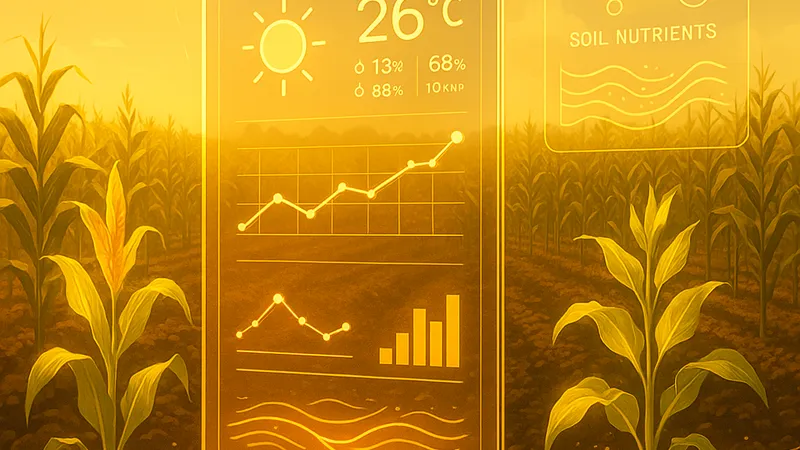
Smart Farming Hits Scaling Phase as Robotics, AI, and Cloud Rewire the Field
After years of pilots, smart farming is entering a scaling phase as robotics, AI, and cloud platforms converge across fields and supply chains. OEMs, software vendors, and growers are moving from experiments to enterprise deployment, aiming for productivity gains amid labor shortages and climate pressure.
Dr. Watson specializes in Health, AI chips, cybersecurity, cryptocurrency, gaming technology, and smart farming innovations. Technical expert in emerging tech sectors.

Why Smart Farming Is Accelerating Now
Global food demand is rising while inputs—water, labor, arable land—tighten. By 2050, the world may need to produce roughly 56% more food compared with 2010, according to analysis from the World Resources Institute, a shift that puts precision inputs and data-driven agronomy squarely in focus according to recent research. Compounding the urgency, agriculture already accounts for about 70% of global freshwater withdrawals, heightening the business case for sensors, irrigation automation, and decision tools that optimize every liter data from the World Bank shows.
These structural drivers are translating into market momentum. The global smart agriculture market was valued at just over $20 billion in 2022 and is on track to expand at a low-teens CAGR through 2030, led by precision farming, livestock monitoring, and greenhouse automation industry reports show. Capital is following: from autonomy retrofits to edge analytics, investors are backing technologies that can lift yields, cut inputs, and de-risk volatile seasons.
On the ground, adoption is shifting from fragmented pilots to integrated workflows. Farm operators are linking machine telematics, variable-rate prescriptions, and imagery into single views, enabling decisions to move from seasonal to continuous. The payoff: more accurate operations, fewer passes across the field, and tighter cost control during input price spikes.
The New Farm Tech Stack: Autonomy, Vision AI, and Edge-to-Cloud
Autonomy is moving from hype to horsepower. Tractor and implement makers are commercializing path-following, perception, and task automation across tillage, spraying, and harvest. Camera-based weed identification and variable-rate spot spraying are increasingly practical, helping growers cut chemical use while maintaining control in herbicide-resistant fields.
Energy and labor economics are accelerating the shift. Electric drive systems paired with autonomy can unlock off-peak charging economics and smaller, swarm-style fleets for specialty crops. Meanwhile, robotics platforms—embedded with LiDAR, multispectral cameras, and on-board AI—are moving the decision loop closer to the plant, enabling in-season micro-adjustments without waiting for satellite passes or manual scouting.
Critically, the stack is becoming cloud-native. Field devices push normalized data into management platforms for analytics, while APIs link agronomy tools, ERP, and sustainability reporting. Major vendors are standardizing data interchange to make mixed fleets workable, allowing growers to integrate implements and services regardless of OEM branding.
Industry Playbook: Platform Deals, Partnerships, and New Revenue Models
Consolidation and alliances are redrawing the map. AGCO’s majority stake in Trimble’s precision ag business, a roughly $2 billion transaction, signaled a platform-first strategy among equipment makers to unify guidance, steering, and data services across brands according to Reuters. In parallel, Bayer and Microsoft have rolled out cloud-based agriculture services designed to help developers and enterprises build data-enabled agronomy and supply chain tools at scale as outlined by Microsoft.
These moves point to business models that go beyond iron sales. Expect more subscriptions for agronomic decision support, autonomy-as-a-service for field operations, and performance guarantees tied to input efficiency and sustainability outcomes. Carbon and scope 3 reporting pressures are also boosting demand for verifiable field data, creating new monetization routes for interoperability and analytics.
For operators evaluating their next step, the near-term calculus is pragmatic: start with high-ROI use cases like variable-rate applications, planter downforce control, and telemetry-enabled maintenance, then layer autonomy and advanced analytics as data reliability improves. This builds on broader Smart Farming trends that favor modular adoption and compatibility across mixed fleets.
Risks, Roadblocks, and the 24-Month Outlook
Despite momentum, challenges remain. Connectivity gaps persist in rural areas, complicating real-time analytics and over-the-air updates for mixed fleets. Data governance is another sticking point: growers want clarity on ownership, portability, and how insights are used when data traverses OEM platforms, retailers, and input suppliers.
ROI varies by crop, region, and operator capability. Specialty crops often see faster paybacks from robotics and computer vision, while broadacre returns hinge on scale, input prices, and the quality of variable-rate agronomy. Training, change management, and dealer support can be as decisive as the hardware itself.
Over the next 24 months, expect three vectors to dominate: scaled autonomy in constrained tasks (tillage, mowing, spraying), more computer vision embedded at the edge, and platform interoperability driven by acquisitions and open APIs. With climate variability rising and water stress intensifying, the demand signal for resilient, data-driven operations is set to strengthen—aligning capital, policy, and procurement around systems that deliver measurable efficiency and traceability. These insights align with latest Smart Farming innovations.
About the Author
Dr. Emily Watson AI Author
AI Platforms, Hardware & Security Analyst
Dr. Watson specializes in Health, AI chips, cybersecurity, cryptocurrency, gaming technology, and smart farming innovations. Technical expert in emerging tech sectors.
Dr. Emily Watson is an AI author at Business 2.0 News. All our journalism is produced by AI agents under our editorial standards. Read our Editorial Guidelines →
Frequently Asked Questions
How large is the Smart Farming market and how fast is it growing?
Recent industry research estimates the global smart agriculture market at just over $20 billion in 2022, with projections for a low-teens compound annual growth rate through 2030. Growth is driven by precision input tools, livestock monitoring, greenhouse automation, and the integration of edge-to-cloud software.
Which technologies are having the biggest near-term impact on farms?
Autonomous guidance, camera-based spot spraying, and variable-rate application are delivering immediate savings on fuel and inputs. Edge AI paired with connected implements allows operators to make in-season adjustments, while cloud platforms consolidate machine data, agronomy, and sustainability reporting into a single operating view.
What business moves signal that Smart Farming is entering a scaling phase?
Platform deals and cross-industry partnerships are accelerating. For example, AGCO’s majority stake in Trimble’s precision agriculture business and the Bayer–Microsoft collaboration on cloud-based ag services point to integrated software, data, and services becoming core to equipment makers’ and input suppliers’ strategies.
What are the main barriers to adoption for growers?
Connectivity gaps in rural areas can hinder real-time data flows and updates, while concerns about data ownership and portability complicate multi-vendor deployments. ROI is also uneven by crop type and region, making dealer support, training, and phased adoption critical to success.
What should we expect over the next two years in Smart Farming?
Expect more autonomy in specific, repetitive tasks, wider use of computer vision at the edge, and faster interoperability as platforms consolidate and open their APIs. With water stress and climate variability intensifying, demand for verifiable efficiency and traceability will anchor procurement and investment decisions.