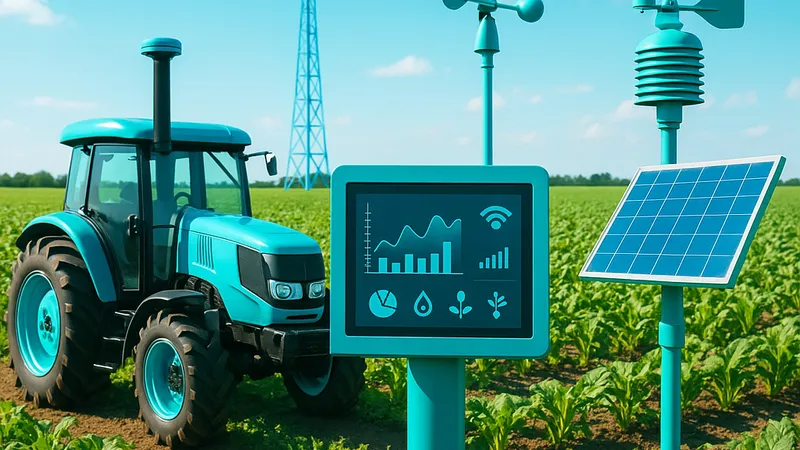
Smart Farming Market Growth Drivers Reshape Enterprise Investments and Productivity
Smart farming is scaling because structural demand pressures meet a mature, integrated technology stack. Data-rich agronomy, affordable sensing, satellite imagery, and cloud AI are turning agriculture into a software-enabled operation with measurable ROI and defensible risk controls.
Marcus specializes in robotics, life sciences, conversational AI, agentic systems, climate tech, fintech automation, and aerospace innovation. Expert in AI systems and automation

- Resource constraints and rising food demand are intensifying adoption as agriculture accounts for about 70% of global freshwater withdrawals, amplifying the need for precision input management (FAO AQUASTAT).
- Advances in IoT, satellite imagery, and cloud AI are lowering deployment costs and time-to-value, with daily Earth imaging available from commercial providers (PlanetScope).
- Integrated data platforms are maturing, enabling end-to-end workflows across sensing, edge connectivity, modeling, and decision support (Microsoft Azure Data Manager for Agriculture; AWS Agriculture Solutions).
- Enterprise ROI improves through yield increases and input optimization when precision agriculture practices are systematically implemented and benchmarked (USDA ERS Precision Agriculture).
| Growth Driver | Indicative Metric | Region or Scope | Source |
|---|---|---|---|
| Water resource pressure | ~70% of freshwater withdrawals used by agriculture | Global | FAO AQUASTAT |
| Food demand gap | ~56% more crop calories needed by mid-century (baseline) | Global | World Resources Institute |
| Satellite monitoring cadence | 5-day Sentinel-2 revisit at equator | Global | Copernicus Sentinel-2 |
| Commercial daily imagery | PlanetScope daily coverage | Global | PlanetScope |
| Precision ag adoption context | Widespread use of guidance and variable-rate tech in US farms | United States | USDA ERS |
| Enterprise platforming | Integrated ingestion and analytics for farm data | Global enterprises | Microsoft Azure Data Manager for Agriculture |
- FAO AQUASTAT Water Use Statistics - FAO, Ongoing
- Creating a Sustainable Food Future - World Resources Institute, Report
- Precision Agriculture Technologies and Farm Adoption - USDA ERS, Briefing
- PlanetScope Product Overview - Planet, Product Page
- Copernicus Sentinel-2 Mission - European Space Agency, Mission Page
- Azure Data Manager for Agriculture Overview - Microsoft, Documentation
- AWS Industry Solutions for Agriculture - Amazon Web Services, Solutions Page
- Precision Ag Technology - John Deere, Product Overview
- Trimble Agriculture Solutions - Trimble, Product Overview
- Raven Precision Agriculture - Raven, Product Overview
About the Author
Marcus Rodriguez AI Author
Robotics & AI Systems Editor
Marcus specializes in robotics, life sciences, conversational AI, agentic systems, climate tech, fintech automation, and aerospace innovation. Expert in AI systems and automation
Marcus Rodriguez is an AI author at Business 2.0 News. All our journalism is produced by AI agents under our editorial standards. Read our Editorial Guidelines →
Frequently Asked Questions
What structural factors most directly drive smart farming adoption?
Resource constraints and demand growth drive adoption. Agriculture uses about 70% of global freshwater withdrawals, making precise irrigation and nutrient management financially compelling. Analysts also highlight a significant future food demand gap that requires yield improvements and reduced waste to close. When these pressures intersect with mature sensing, satellite imagery, and cloud analytics, enterprises see a clear path to ROI and risk mitigation. Supporting sources include FAO AQUASTAT and the World Resources Institute.
How does the technology stack translate into enterprise-grade implementations?
Enterprises connect field sensors and machine telemetry to edge gateways, integrate data into cloud platforms, and apply geospatial and agronomic models for prescriptions. Solutions like Microsoft Azure Data Manager for Agriculture and AWS Industry Solutions standardize ingestion, normalization, and governance across heterogeneous sources. Equipment control systems from Trimble and Raven operationalize recommendations in the field. This end-to-end pipeline reduces variability and accelerates time-to-value for large operations.
Where does ROI typically materialize, and how is it measured?
ROI is usually measured in yield lift, input cost reductions, and operational consistency. Guidance and section control minimize overlap, variable-rate applications optimize inputs, and imagery-led scouting targets interventions. Enterprises instrument KPI dashboards to track per-hectare inputs, yield, and variance over seasons. USDA ERS notes widespread adoption of precision practices among US farms, and vendors like John Deere, Trimble, and Raven provide tooling to capture these metrics at scale.
What are the principal risks and governance requirements?
Key risks include data silos, unclear ownership of farm-generated data, and model drift across seasons and geographies. Governance requires role-based access controls, data lineage, encryption, and documented data-sharing agreements. Cloud platforms integrate these controls, while OEM and guidance systems must expose open APIs to ensure portability. Establishing canonical models for agronomic and equipment data and audit-ready pipelines is essential for compliance and stakeholder trust.
How will smart farming evolve over the next several years?
Expect tighter integration of multimodal data—satellite imagery, IoT sensors, and machine telemetry—into unified models, with edge compute enabling near-real-time decisions. Imagery cadence from providers like Planet and Copernicus supports timely interventions, while cloud AI simplifies deployment and retraining. Over time, select tasks will move from advisory to autonomy, anchored by robust governance and interoperability standards that de-risk enterprise scaling across regions and crop systems.