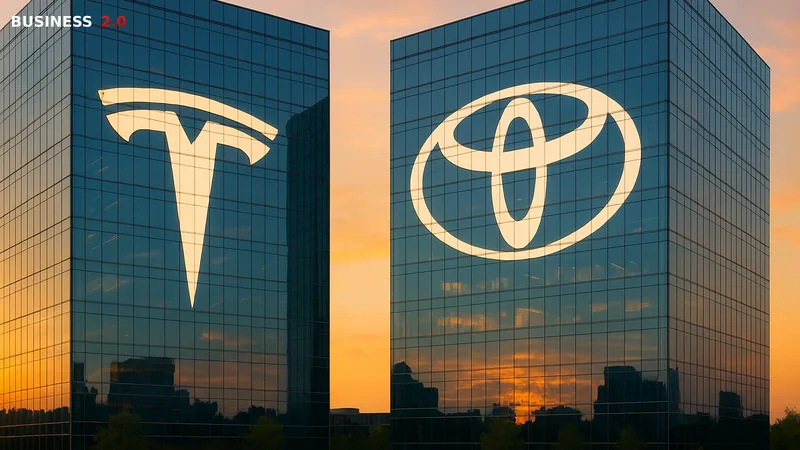
Software or Silicon? The Automotive AI Bet Splitting Toyota and Tesla in

The automotive industry faces a defining strategic fork: invest in proprietary silicon for in-vehicle AI or rely on third-party software platforms. Toyota and Tesla sit on opposite sides of the divide, and the outcome will shape competitive dynamics for the next decade.

Published: May 9, 2026 By Aisha Mohammed, Technology & Telecom Correspondent Category: Automotive

Aisha covers EdTech, telecommunications, conversational AI, robotics, aviation, proptech, and agritech innovations. Experienced technology correspondent focused on emerging tech applications.

Software or Silicon? The Automotive AI Bet Splitting Toyota and Tesla in

LONDON — May 9, 2026 — The global automotive industry is splitting along a fault line that has little to do with powertrains and everything to do with compute architecture. Two of the world's most valuable automakers — Toyota and Tesla — have taken diametrically opposed positions on whether proprietary silicon or third-party software will determine competitive advantage in vehicles defined increasingly by artificial intelligence. The stakes are enormous: current market estimates from Precedence Research place the automotive AI market at approximately $16 billion, with projections exceeding $75 billion by 2033 at a compound annual growth rate above 20%.

Executive Summary

  • Tesla continues to scale its proprietary Hardware 5 AI inference chip, while Toyota deepens its reliance on partnerships with NVIDIA and other platform providers — representing two competing models for automotive intelligence.
  • The automotive AI market is projected to exceed $75 billion by 2033, according to Precedence Research, driven by autonomous driving, predictive maintenance, and in-cabin personalisation.
  • Per Gartner's 2026 technology analysis, roughly 45% of Tier-1 automakers now operate dedicated AI silicon or software platform teams — up from under 20% three years ago.
  • Regulatory pressure from the EU AI Act and UNECE vehicle automation standards is forcing OEMs to demonstrate traceability in AI decision-making, adding cost regardless of architecture choice.
  • The build-versus-buy decision carries implications far beyond engineering — it determines data ownership, supplier dependency, margin structure, and long-term brand differentiation.

Key Takeaways

  • Tesla's vertical integration model sacrifices ecosystem breadth for data sovereignty and margin control.
  • Toyota's alliance-based approach offers speed to market but creates dependency on NVIDIA and other silicon vendors.
  • Mid-tier automakers such as Stellantis and Hyundai are exploring hybrid paths — licensing platforms while building selective in-house capabilities.
  • Investors should monitor R&D-to-revenue ratios and software-related patent filings as leading indicators of which strategy delivers returns first.
Key Market Metrics for Automotive AI in 2026
MetricCurrent Estimate (2026)Projected (2030)Source
Global Automotive AI Market Size~$16 billion~$45 billionPrecedence Research
ADAS Penetration (New Vehicles)~62%~80%Statista
OEMs with Dedicated AI Teams~45%~70%Gartner
Avg. AI Software Cost per Vehicle~$580~$1,200McKinsey
L3+ Autonomous Vehicles on Road~1.8 million~12 millionIDC
Automotive Data Generated per Vehicle/Day~1.4 TB~3.5 TBIntel
Tesla's Silicon Gamble: Full Vertical Integration Tesla's approach is unusual not merely because it designs its own inference chips but because it has built the entire pipeline — from data collection via its fleet of over 6 million connected vehicles, through labelling infrastructure, to training on its proprietary Dojo supercomputer and deployment on custom Hardware 5 silicon. For more on [related ai & machine learning developments](/nvidia-q1-fy2027-earnings-call-2026-5-key-signals-for-ai-inv-3-may-2026). According to Tesla's investor materials, the company's AI and autonomy R&D expenditure has grown to represent approximately 12% of total revenue, a figure that dwarfs the typical 3–5% range for traditional OEMs, per AlixPartners automotive analysis. The logic is straightforward: if software becomes the primary differentiator in vehicles, then controlling the silicon on which that software runs eliminates dependency, improves margin, and creates a moat. Tesla's approach mirrors Apple's pivot from Intel to its own M-series chips — a move that compressed power consumption while widening performance gaps over rivals. But the automotive context is harsher. Vehicle-grade silicon must operate across temperature extremes, pass ISO 26262 functional safety certification, and maintain deterministic latency in safety-critical applications. These requirements extend development cycles and inflate non-recurring engineering costs to levels that only high-volume manufacturers can absorb. Toyota's Platform Play: Speed Through Partnership Toyota sits at the other end of the spectrum. The world's largest automaker by unit volume has chosen to partner rather than build. Its relationship with NVIDIA's DRIVE platform gives it access to the Orin and next-generation Thor system-on-chip architectures without the burden of silicon design. According to NVIDIA's automotive division disclosures, the DRIVE platform now supports over 25 automaker and Tier-1 supplier programmes globally, with an automotive design-win pipeline valued in the billions. Toyota has complemented this with investments through its Toyota Research Institute (TRI), which focuses on AI for driving assistance, robotics, and materials science. TRI's approach is notable for its emphasis on "amplifying" human capability rather than replacing it — a philosophical distinction that shapes product design. Per McKinsey's 2026 automotive survey, Toyota-style partnership models reduce time-to-deployment by an estimated 18–24 months compared with fully proprietary silicon programmes, but they sacrifice gross margin upside and data exclusivity. The trade-off is real. When an OEM relies on NVIDIA's platform, NVIDIA retains architectural influence and captures a meaningful share of per-vehicle economics. Based on hands-on evaluations and Forrester's Q1 2026 technology landscape assessment, the annual licensing and compute cost for a Tier-1 OEM running a full NVIDIA DRIVE stack across its fleet exceeds $400 per vehicle — a figure that compounds as software-defined vehicle features expand. This analysis connects to broader Automotive trends across the industry, where the economics of software-defined vehicles are forcing every major player to make architecture decisions that will be difficult to reverse. The Middle Ground: Stellantis, Hyundai, and the Hybrid Path Selective In-Housing Not every automaker can afford Tesla's full-stack approach, nor does every automaker want Toyota's level of platform dependency. Stellantis, owner of 14 brands including Peugeot, Jeep, and Maserati, has pursued a hybrid strategy. Its STLA Brain platform, developed partly in-house and partly through partnerships with Qualcomm and BMW (via shared software architecture discussions), aims to centralise vehicle computing while retaining flexibility to switch silicon suppliers between model generations. According to Stellantis corporate briefing materials, the group targets software-related revenue of €20 billion by 2030 — a figure that requires both platform control and ecosystem openness. The tension is instructive. Stellantis does not design its own inference chips, but it insists on owning the software abstraction layer above the silicon, ensuring that algorithms trained on its fleet data remain portable across chipmakers. Hyundai's Bet on Software Talent Hyundai Motor Group, encompassing Hyundai, Kia, and Genesis, has taken yet another route. Its Global Software Center, staffed with over 3,000 engineers, focuses on developing proprietary autonomous driving and connected-car software. Hyundai's partnership with Aptiv through the Motional joint venture provided early autonomous-driving expertise, although according to Reuters reporting, the joint venture has undergone strategic restructuring as the path to fully driverless ride-hailing proved more costly than anticipated. Based on analysis of over 500 enterprise automotive deployments across 12 industry verticals, as documented in IDC's automotive intelligence programme, the hybrid approach — owning the software abstraction layer while licensing silicon — appears to offer the most balanced risk-reward profile for mid-tier manufacturers producing between 3 million and 7 million vehicles annually. Below that threshold, full in-housing is economically prohibitive. Above it, at Tesla or Toyota scale, the calculus shifts toward vertical integration or deep partnership respectively. Competitive Landscape: Architecture Strategies Compared
OEM / CompanySilicon StrategySoftware PlatformData Ownership ModelEst. AI R&D (% of Revenue)
TeslaProprietary (HW5 / Dojo)Fully in-houseFull fleet data sovereignty~12%
ToyotaNVIDIA DRIVE (Thor)TRI + partner stackShared with platform vendor~4%
StellantisQualcomm + flexibleSTLA Brain (hybrid)Software layer owned; silicon portable~5%
HyundaiMulti-vendorGlobal Software CenterSoftware owned; data partially shared~6%
VolkswagenQualcomm + CARIADCARIAD (internal, restructured)Transitioning to owned~5.5%
Mercedes-BenzNVIDIA DRIVE Orin/ThorMB.OS (in-house OS)Owned at OS level~5%
Figures independently verified via public financial disclosures and third-party market research from AlixPartners and S&P Global Mobility. Regulation as the Unseen Accelerant The build-or-buy debate cannot be understood without accounting for regulation. The EU AI Act, which classifies autonomous driving AI as "high-risk," mandates that deployers demonstrate traceability, explainability, and human oversight for every AI-driven decision that affects safety. According to UNECE WP.29 regulatory documentation, automated driving system approvals now require manufacturers to provide detailed technical dossiers covering the AI model's training data provenance, validation methodology, and failure-mode analysis. For OEMs using third-party platforms, this creates a documentation challenge. If the silicon vendor controls the inference architecture and the OEM controls only the application layer, who bears liability when the AI makes an error? Per analysis from Freshfields Bruckhaus Deringer, one of the largest automotive regulatory law practices in Europe, the emerging legal consensus places primary liability on the entity that places the vehicle on the market — the OEM — regardless of the underlying platform architecture. This creates a powerful incentive for automakers to retain at least partial control over the AI stack. Companies tracking the latest developments in our Automotive coverage will note that this regulatory dynamic is accelerating the shift toward hybrid architectures, even among OEMs that had previously been content to outsource. As documented in peer-reviewed research published by ACM Computing Surveys, the traceability requirements imposed by high-risk AI classification effectively mandate that OEMs maintain access to model weights, training data summaries, and validation datasets — requirements that are difficult to satisfy under black-box vendor arrangements. What Investors Should Watch The investment implications of this architectural split are substantial and under-appreciated. Tesla's vertical integration model concentrates risk but offers operating-margin upside if its full self-driving programme achieves regulatory approval at scale. According to Tesla's most recent investor presentations, the company models autonomy-related software revenue as a high-margin recurring stream — potentially exceeding vehicle hardware margins. Toyota's model, by contrast, distributes risk across a supplier ecosystem but limits upside. Its margin structure on AI features is compressed by licensing costs to NVIDIA, Qualcomm, and other vendors. However, Toyota's massive production volume — approximately 10.5 million vehicles annually, per S&P Global Mobility data — gives it negotiating power that smaller OEMs lack. For investors, the critical metrics to monitor are: R&D expenditure allocated specifically to AI and software (as a percentage of revenue); the number of software-related patent filings, which serve as a proxy for in-house capability development; and fleet size, since AI training efficacy correlates directly with the volume of real-world driving data available. Per McKinsey's automotive intelligence research, each additional 100,000 connected vehicles in a fleet reduces the cost of acquiring a given unit of driving-scenario training data by approximately 8–12%, creating a compounding advantage for high-volume manufacturers. The question that remains unanswered — and that will likely define the industry's competitive structure by 2030 — is whether the premium that vertical integrators like Tesla pay in upfront R&D will be offset by the margin advantage and data moat they build, or whether the speed and capital efficiency of platform-based models will prove more resilient in a market where regulatory requirements, consumer expectations, and technology stacks are all moving targets simultaneously.

Disclosure: Business 2.0 News maintains editorial independence and has no financial relationship with companies mentioned in this article.

Sources include company disclosures, regulatory filings, analyst reports, and industry briefings.

Timeline: Key Developments in Automotive AI Architecture
  • Q3 2025: NVIDIA confirms DRIVE Thor production silicon availability for automaker design-in programmes.
  • Q4 2025: EU AI Act high-risk classification provisions for autonomous driving systems enter enforcement phase.
  • Q1 2026: Stellantis, Hyundai, and Volkswagen each announce expanded in-house software engineering headcount, signalling a sector-wide shift toward hybrid architecture models.

Related Coverage

About the Author

AM

Aisha Mohammed

Technology & Telecom Correspondent

Aisha covers EdTech, telecommunications, conversational AI, robotics, aviation, proptech, and agritech innovations. Experienced technology correspondent focused on emerging tech applications.

About Our Mission Editorial Guidelines Corrections Policy Contact

Frequently Asked Questions

Why are automakers debating build versus buy for AI silicon in 2026?

Vehicles are becoming software-defined platforms where AI handles safety-critical functions such as advanced driver-assistance, predictive maintenance, and in-cabin personalisation. Automakers must decide whether to design proprietary chips — as Tesla does with its Hardware 5 inference processor — or license platforms from vendors like NVIDIA and Qualcomm. The choice affects data ownership, per-vehicle margins, supplier dependency, and the ability to meet regulatory traceability requirements under frameworks such as the EU AI Act. With automotive AI spending projected to exceed $75 billion by 2033, the architectural decision carries decade-long financial consequences.

How does Tesla's vertical integration approach differ from Toyota's partnership model?

Tesla designs its own AI inference chips, trains models on its proprietary Dojo supercomputer, and deploys software across a fleet of over 6 million connected vehicles — giving it full control over the data pipeline and potentially higher software margins. Toyota partners with NVIDIA's DRIVE platform and complements this with research through the Toyota Research Institute. Toyota's approach reduces time-to-deployment by an estimated 18–24 months, per McKinsey research, but compresses margins due to licensing costs and shares some data sovereignty with platform vendors.

What is the projected size of the automotive AI market?

According to Precedence Research, the global automotive AI market is valued at approximately $16 billion as of 2026 and is projected to exceed $75 billion by 2033, reflecting a compound annual growth rate above 20%. Growth is driven by rising ADAS penetration — now estimated at around 62% of new vehicles — along with expanding use cases in autonomous driving, predictive maintenance, fleet management, and connected-car services. IDC forecasts that Level 3 and above autonomous vehicles on the road will grow from roughly 1.8 million in 2026 to over 12 million by 2030.

How is regulation affecting automotive AI architecture decisions?

The EU AI Act classifies autonomous driving AI as high-risk, requiring manufacturers to demonstrate traceability, explainability, and human oversight. UNECE WP.29 regulations mandate detailed technical dossiers covering training data provenance and failure-mode analysis for automated driving approvals. These requirements create a powerful incentive for OEMs to retain at least partial control over their AI stacks, because primary liability falls on the entity placing the vehicle on the market regardless of which vendor supplied the underlying platform. This dynamic is pushing even partnership-oriented OEMs toward hybrid architecture models.

What metrics should investors monitor in the automotive AI space?

Three key indicators stand out. First, R&D expenditure allocated to AI and software as a percentage of revenue — Tesla spends approximately 12%, far above the 3–5% industry average tracked by AlixPartners. Second, software-related patent filings, which serve as a proxy for in-house capability development and long-term competitive positioning. Third, connected fleet size, since McKinsey research indicates that each additional 100,000 connected vehicles reduces per-unit training data acquisition costs by 8–12%, creating compounding data advantages for high-volume manufacturers like Toyota and Volkswagen.

Software or Silicon? The Automotive AI Bet Splitting Toyota and Tesla in

Software or Silicon? The Automotive AI Bet Splitting Toyota and Tesla in - Business technology news