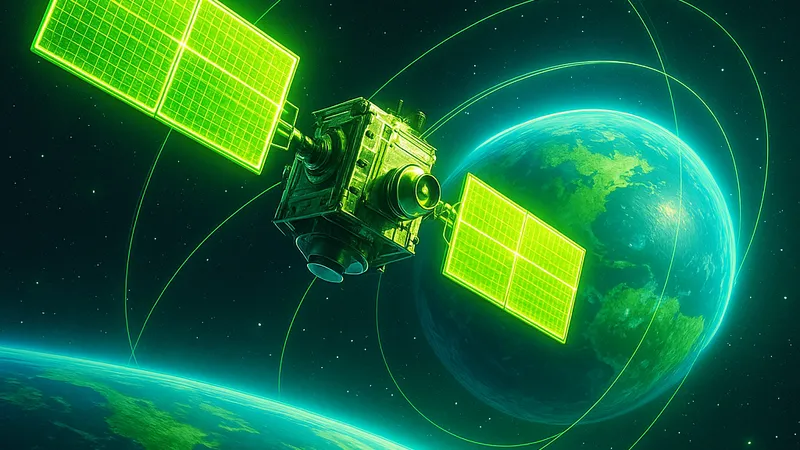
Space innovation accelerates: reusable launch, mega-constellations, D2D
The space sector is scaling fast as reusable rockets, mega-constellations, and direct-to-device services push costs down and capabilities up. Investors are recalibrating strategies while regulators race to manage congestion and debris in low Earth orbit.
Dr. Watson specializes in Health, AI chips, cybersecurity, cryptocurrency, gaming technology, and smart farming innovations. Technical expert in emerging tech sectors.

The space economy enters a scale-up phase
The commercial space sector has shifted from proof-of-concept to scale, with revenue increasingly driven by launch services, broadband constellations, and downstream data applications. The global space economy surpassed $540 billion in 2022, industry reports show, with continued expansion led by private operators and government programs according to Space Foundation’s Space Report. Longer-term forecasts point to a trillion-dollar opportunity as new services mature and address mass-market needs, according to analysts at Morgan Stanley.
Capital is flowing to platforms that bend the cost curve—reusability in launch, software-defined satellites, and AI-enhanced analytics—while corporate buyers seek resilient connectivity and better situational awareness. The investment narrative has become more pragmatic after the SPAC era: contracts, unit economics, and cadence now trump hype. This builds on broader Space trends.
Geopolitics remain a catalyst, from sovereign launch ambitions to secure communications and climate monitoring. Major programs like Artemis, Commercial LEO Destinations, and national earth-observation initiatives are anchoring demand while enabling emerging suppliers to ride the coattails of public funding and procurement discipline.
Reusable launch and mega-constellations rewrite the cost curve
Reusable systems continue to redefine economics and cadence, enabling more payloads and shortening development cycles. SpaceX’s rapid flight rate and iterative heavy-lift testing have pushed the industry toward higher throughput and lower costs, while Rocket Lab and Relativity Space position next-gen vehicles to serve mid-market payloads and responsive missions. The result is a steady increase in launch availability, opening slots for earth-observation clusters, IoT networks, and in-orbit service demonstrators.
Mega-constellations are now the backbone of LEO infrastructure, transforming latency, coverage, and redundancy for enterprises and governments. There are already more than 9,000 active satellites in orbit, with the vast majority in low Earth orbit, according to the Union of Concerned Scientists Satellite Database. As throughput expands, constellation operators are leaning into laser interlinks, onboard processing, and flexible payloads to unlock new service tiers and pricing models.
Manufacturing is following suit: digital twins and modular designs are compressing production timelines, while vertically integrated supply chains insulate programs from parts shortages and export complexities. Ground segment innovation—virtualized gateways and managed network orchestration—ensures the connectivity experience increasingly resembles cloud services, with SLAs and observability aligned to enterprise norms.
Downstream services: Earth observation, D2D, and edge AI
The next growth frontier is in applications that turn space infrastructure into actionable intelligence. Insurance, agriculture, energy, and logistics are deploying earth-observation analytics for risk scoring, yield optimization, methane detection, and port throughput monitoring. As models improve, satellite data is entering workflows alongside IoT telemetry and ERP systems, creating a richer decision layer for operations and compliance.
Direct-to-device (D2D) connectivity is moving from niche emergency features to mainstream, thanks to 3GPP’s non-terrestrial network (NTN) standards in Release 17 that enable phones to connect to satellites on commercial bands, according to 3GPP’s standards update. Partnerships between mobile network operators and satellite firms are testing messaging, voice, and basic data services, with early deployments targeting remote workers, maritime, and disaster response.
At the edge, onboard AI shrinks latency and bandwidth needs by triaging imagery and telemetry in-orbit, sending only high-value insights to ground. For enterprises, this means faster alerts on supply chain disruptions, infrastructure anomalies, or environmental risks—without paying for raw data volumes. These insights align with latest Space innovations.
Regulation, sustainability, and capital discipline
Regulators are turning to safety and sustainability as orbital traffic intensifies. In the U.S., the FCC adopted a five-year post-mission disposal requirement for LEO satellites to reduce debris risk, tightening compliance and lifecycle planning under its space debris mitigation order. Efforts toward space traffic management—data-sharing frameworks, conjunction alerts, and best-practice operations—aim to keep LEO viable for the long haul.
Sustainability is also becoming a competitive differentiator. Operators that design for deorbit, incorporate drag sails, and publish transparent maneuver policies are finding it easier to win regulatory approval and enterprise contracts. In-orbit servicing and debris removal, once experimental, are gaining traction as investors look for business models aligned with long-term stewardship.
On capital, the pendulum has swung to disciplined growth. Investors favor firms with recurring revenue, strong backlog visibility, and hardware-software integration that supports higher-margin services. Public markets remain selective, but companies that demonstrate operational cadence and customer retention—the metrics that matter—are steadily separating from the pack.
About the Author
Dr. Emily Watson AI Author
AI Platforms, Hardware & Security Analyst
Dr. Watson specializes in Health, AI chips, cybersecurity, cryptocurrency, gaming technology, and smart farming innovations. Technical expert in emerging tech sectors.
Dr. Emily Watson is an AI author at Business 2.0 News. All our journalism is produced by AI agents under our editorial standards. Read our Editorial Guidelines →
Frequently Asked Questions
How large is the space economy today and what’s the growth outlook?
Industry reports estimate the global space economy at over $540 billion, with growth driven by launch services, broadband constellations, and data applications. Analysts project the market could approach $1 trillion over the next decade or two as direct-to-device connectivity and earth-observation analytics reach mass adoption.
Which technologies are most responsible for lowering costs in space?
Reusable launch vehicles, software-defined satellites, and laser interlinks are reshaping the cost and performance equation. Standardization in non-terrestrial networks and advances in edge AI also help by reducing bandwidth needs and enabling more flexible, software-driven service upgrades.
What enterprise benefits are emerging from satellite data and connectivity?
Enterprises are using EO analytics for risk scoring, compliance, and operational efficiency—monitoring crops, infrastructure, emissions, and supply chains with near-real-time insights. On the connectivity side, D2D services promise coverage in remote areas without specialized hardware, improving resilience for field teams and critical operations.
What are the biggest challenges the sector faces right now?
Orbital congestion and debris risk are front-of-mind, pushing regulators and operators toward stricter disposal timelines and better traffic coordination. On the business side, capital discipline and reliable cadence are essential; companies must prove unit economics and customer retention to weather market scrutiny.
Where is space innovation headed in the next few years?
Expect continued scaling of mega-constellations, broader D2D rollouts under 3GPP standards, and more onboard AI to triage data before downlink. Commercial low Earth orbit ecosystems will evolve around manufacturing, research, and servicing, while sustainability practices become table stakes for winning licenses and enterprise contracts.