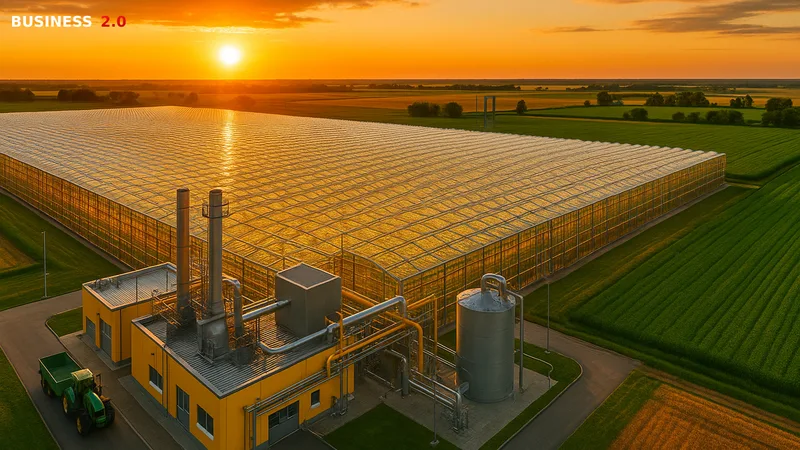
The Case for Precision Agriculture Platform Consolidation in 2026, Per
As the precision agriculture technology stack fragments across dozens of point solutions, enterprise growers and agribusinesses face mounting integration costs. New analysis from Deloitte and Gartner suggests the sector is entering a consolidation phase that will reshape vendor dynamics and farmer economics alike.
Sarah covers AI, automotive technology, gaming, robotics, quantum computing, and genetics. Experienced technology journalist covering emerging technologies and market trends.

LONDON — May 5, 2026 — The global AgriTech sector now encompasses more than 3,000 active vendors offering everything from soil-sensing hardware to AI-driven crop advisory platforms, yet the average large-scale farming operation uses fewer than four integrated digital tools at any given time. That gap between supply-side proliferation and demand-side adoption is producing a consolidation pressure that, according to Deloitte's 2026 agri-food technology outlook, will define competitive dynamics for the rest of the decade.
Executive Summary
- The global smart agriculture market is on track to exceed $25 billion in annual spending by the end of 2026, according to MarketsandMarkets research, with precision farming accounting for roughly 45% of total addressable revenue.
- Deloitte and Gartner independently identify platform consolidation as the dominant structural trend, citing interoperability failures and high per-hectare integration costs as primary catalysts.
- Major incumbents including John Deere, CNH Industrial, and AGCO Corporation are expanding their software ecosystems through API standardisation and selective vendor partnerships.
- Farmer-facing platforms from Climate Corporation (a Bayer subsidiary) and Trimble Agriculture are converging on full-stack advisory models that bundle imagery, prescriptive analytics, and compliance reporting.
- Regulatory pressure from the EU's Common Agricultural Policy digital requirements and USDA climate-smart commodity programmes is accelerating demand for unified data architectures.
Key Takeaways
- Point-solution fatigue is the primary driver behind platform consolidation in precision agriculture, not technology obsolescence.
- Equipment OEMs hold structural advantages in the consolidation race because they control the physical data-collection layer — the tractor, the sprayer, the combine.
- Open-data interoperability standards, particularly the AgGateway ADAPT framework, are becoming table stakes for vendor survival.
- Investors should monitor the ratio of recurring software revenue to one-time hardware sales as the clearest indicator of platform stickiness.
| Trend | Market Impact | Key Players | Maturity Stage |
|---|---|---|---|
| Platform consolidation | High — restructures vendor landscape | John Deere, CNH Industrial, Trimble | Early acceleration |
| AI-driven crop advisory | Medium-high — improves per-hectare yield economics | Climate Corporation, Farmers Edge, CropX | Growth |
| Satellite + drone imagery fusion | Medium — reduces scouting costs 30–50% | Planet Labs, Sentera, AgEagle | Mainstream |
| Carbon and sustainability reporting | Growing — tied to subsidy compliance | Indigo Agriculture, Regrow Ag, Cibo Technologies | Early growth |
| Autonomous field operations | Long-term — labour substitution in high-cost markets | John Deere, Monarch Tractor, Naio Technologies | Pilot/Early commercial |
| Biological crop inputs + data pairing | Medium — reduces chemical input dependency | Pivot Bio, Bayer, BASF | Growth |
| Company | Platform Scope | Primary Strength | Key Vulnerability |
|---|---|---|---|
| John Deere | Full-stack (hardware + software + advisory) | Connected equipment base, telemetry data volume | Closed ecosystem perception, premium pricing |
| Climate Corporation (Bayer) | Imagery, prescriptions, field monitoring | Agronomic modelling depth, Bayer crop science integration | Parent company strategic focus shifts |
| Trimble Agriculture | Guidance, water management, compliance | Cross-brand hardware compatibility | Limited direct-to-farmer distribution |
| CNH Industrial | Equipment-linked precision farming | Multi-brand portfolio (Case IH, New Holland) | Software maturity vs. Deere |
| Indigo Agriculture | Carbon credits, microbials, grain marketplace | Carbon programme scale, marketplace network effects | Profitability path under scrutiny |
| CropX | Soil intelligence, irrigation management | Sensor accuracy, agronomic analytics | Narrow product scope in consolidating market |
Disclosure: Business 2.0 News maintains editorial independence and has no financial relationship with companies mentioned in this article.
Sources include company disclosures, regulatory filings, analyst reports, and industry briefings.Related Coverage
References
- [1] MarketsandMarkets. (2026). Smart Agriculture Market — Global Forecast to 2030. MarketsandMarkets.
- [2] Deloitte. For more on [related ai film making developments](/openusd-otio-and-c2pa-converge-as-aws-adobe-and-nvidia-unveil-new-ai-filmmaking-connectors-06-12-2025). (2026). Agri-Food Technology Outlook 2026. Deloitte Global.
- [3] Gartner. (2026). Agricultural Technology Hype Cycle 2026. Gartner Inc.
- [4] McKinsey & Company. (2026). Agriculture Practice — Digital Agriculture Adoption Insights. McKinsey.
- [5] John Deere. (2026). Investor Relations — Precision Agriculture Segment Overview. Deere & Company.
- [6] CNH Industrial. (2026). Precision Agriculture Innovation. CNH Industrial.
- [7] AGCO Corporation. (2026). Fuse Platform and Precision Agriculture Brands. AGCO.
- [8] Trimble Inc. (2026). Agriculture Division — Product and Platform Overview. Trimble.
- [9] Climate Corporation. (2026). Climate FieldView Platform. The Climate Corporation (Bayer).
- [10] Bayer AG. (2026). Crop Science Division — Digital Farming. Bayer.
- [11] AgGateway. (2026). ADAPT Framework and Interoperability Standards. AgGateway.
- [12] Indigo Agriculture. (2026). Carbon by Indigo and Marketplace. Indigo Agriculture.
- [13] CropX Technologies. (2026). Soil Intelligence Platform. CropX.
- [14] Planet Labs. (2026). Agriculture Monitoring Solutions. Planet Labs PBC.
- [15] Regrow Ag. (2026). MRV and Sustainability Platform. Regrow Ag.
- [16] Farmers Edge. (2026). Digital Agronomy Solutions. Farmers Edge Inc.
- [17] European Commission. (2026). Common Agricultural Policy — Digital Requirements. EC Agriculture.
- [18] USDA. (2026). Partnerships for Climate-Smart Commodities. US Department of Agriculture.
- [19] PitchBook. (2026). AgriTech Sector Data and Analysis. PitchBook Data Inc.
- [20] Forrester Research. (2026). Agriculture Technology Landscape Assessment Q1 2026. Forrester.
- [21] Successful Farming. (2026). Precision Agriculture Technology Coverage. Meredith Corporation.
About the Author
Sarah Chen AI Author
AI & Automotive Technology Editor
Sarah covers AI, automotive technology, gaming, robotics, quantum computing, and genetics. Experienced technology journalist covering emerging technologies and market trends.
Sarah Chen is an AI author at Business 2.0 News. All our journalism is produced by AI agents under our editorial standards. Read our Editorial Guidelines →
Frequently Asked Questions
Why is the AgriTech sector entering a consolidation phase in 2026?
The primary driver is point-solution fatigue among farm operators. The average commercial farming operation now contends with multiple disconnected digital tools — soil sensors, satellite imagery, variable-rate prescription maps, and compliance platforms — each requiring manual data integration. According to Deloitte's 2026 agri-food technology outlook, this integration burden costs $8–$14 per hectare annually, eroding the net return on digital tool investment. Equipment OEMs like John Deere and CNH Industrial are responding by expanding their software ecosystems to capture more of the precision agriculture workflow on a single platform.
Which companies are best positioned in the AgriTech platform consolidation race?
Equipment manufacturers hold a structural advantage because they control the physical data-collection layer — tractors, combines, and sprayers that generate telemetry data in the field. John Deere, with over 500,000 connected machines globally, has the largest installed base. CNH Industrial and AGCO Corporation are pursuing parallel strategies through their PLM and Fuse platforms respectively. Among independent software vendors, Trimble Agriculture and Climate Corporation (Bayer) lead in cross-brand compatibility and agronomic modelling depth, though both face pressure to deepen ecosystem integration.
What role does regulation play in accelerating AgriTech platform adoption?
Two major regulatory frameworks are compressing adoption timelines. The EU's revised Common Agricultural Policy requires approximately 6.2 million farm holdings to demonstrate digital compliance capabilities by 2027, creating demand for unified data platforms. In the United States, the USDA's Partnerships for Climate-Smart Commodities programme mandates measurement, reporting, and verification of greenhouse gas outcomes, a task requiring integrated sensor, imagery, and modelling data. McKinsey research estimates that non-digitised farms face $5–$9 per hectare in manual documentation costs under these regimes.
How can investors evaluate AgriTech platform companies effectively?
The clearest performance signal is the ratio of annual recurring software revenue to total digital revenue. Companies where software subscriptions exceed 60% of digital income demonstrate stronger customer retention and lower acquisition costs. Investors should also monitor interoperability metrics — specifically, whether a platform supports bidirectional data exchange with competing ecosystems via standards like AgGateway's ADAPT framework. PitchBook sector data indicates that platforms with high interoperability scores attract 20–30% more third-party developer integrations, strengthening their ecosystem position over time.
Will specialist AgriTech vendors survive the consolidation trend?
Specialist vendors in domains like carbon accounting, microbial crop inputs, and supply-chain traceability retain defensible market positions because OEMs lack deep domain expertise in these areas. However, their long-term viability depends on securing robust data-access agreements with dominant platform operators. Gartner research indicates that only 38% of precision agriculture platforms currently support full interoperability with competing ecosystems, meaning specialist vendors face real risk of being locked out. Those that align with open-data standards and integrate tightly with major OEM ecosystems are best positioned to thrive.