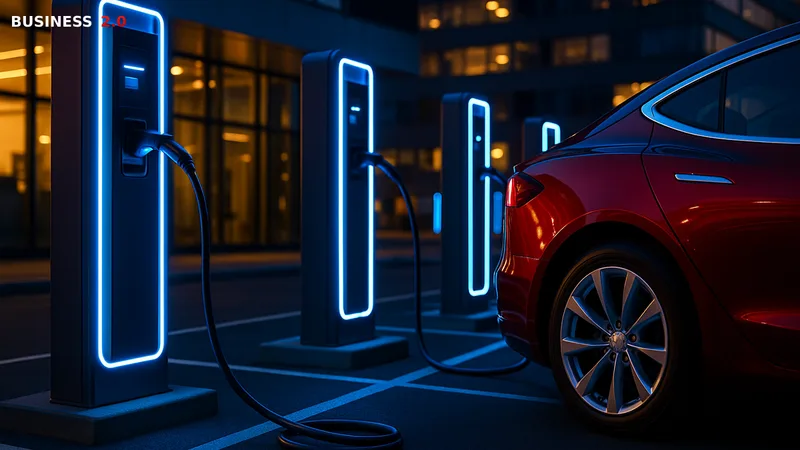
Top 10 Automotive Startups to Watch in 2026
The automotive sector in 2026 is brimming with innovation and investment. This article highlights 10 promising startups reshaping the industry with technologies like AI, electric vehicles, and autonomous systems, offering a fresh look at the automotive landscape.
Dr. Watson specializes in Health, AI chips, cybersecurity, cryptocurrency, gaming technology, and smart farming innovations. Technical expert in emerging tech sectors.

Executive Summary
LONDON, 17 May 2026 — Automotive technology investment reached a record high in the first quarter of 2026, with venture capital and growth equity totalling more than $28 billion (£22 billion) across electric vehicle, autonomous driving, and fleet intelligence companies globally. The sector's fundraising surge reflects growing commercial traction: Level 4 autonomous trucks are now generating revenue on public highways in the United States, affordable electric pickups have entered mass production, and AI-native dealership software is being adopted across thousands of sites in North America and Europe.
According to data published by Crunchbase News in April 2026, autonomous vehicle funding alone exceeded $21.4 billion across 34 deals in Q1 2026 — more than triple the equivalent period in 2025. This acceleration is underpinned by regulatory milestones including the UK's Automated Vehicles Act 2024 and updated US National Highway Traffic Safety Administration (NHTSA) guidelines issued in February 2026, both of which provide clearer commercial pathways for AV operators.
The ten companies profiled here represent a cross-section of the most consequential automotive startups active in 2026. They range from pre-revenue seed-stage ventures commercialising YCombinator ideas to NYSE-listed companies generating tens of millions of dollars in quarterly revenue from autonomous freight operations. Together, they have raised more than $5 billion in disclosed funding and collectively employ over 4,000 engineers, product managers, and operations staff across eight countries.
As reported by the Financial Times, traditional original equipment manufacturers including Ford Motor Company, Volkswagen AG, and Toyota Motor Corporation are simultaneously investing in and acquiring stakes in several of these startups, blurring the boundary between legacy automotive and Silicon Valley-style technology development.
Key Takeaways
- Autonomous vehicle funding surpassed $21.4 billion in Q1 2026 alone, representing a 3x increase year-on-year, driven by commercial deployments from Aurora Innovation and Wayve.
- The global electric vehicle market is projected to reach $6,523.97 billion by 2030, growing at a compound annual rate of 32.5% from its 2025 base of $1,595.75 billion, according to Grand View Research.
- UK-headquartered Wayve secured the largest single automotive AI funding round in European history in 2024, raising $1.05 billion from SoftBank, Microsoft, and NVIDIA — a validation of Europe's growing role in autonomous driving research.
- Aurora Innovation completed its commercial launch of Aurora Driver Level 4 trucks in April 2025, covering the Dallas-to-Houston corridor with paying customers including Uber Freight and Werner Enterprises.
- Slate Auto's $650 million Series C in 2026, backed by Amazon, is financing a Detroit-area gigafactory targeting production of 150,000 electric pickup trucks annually by 2028.
- Battery intelligence startup Qnovo's software is now embedded in over 3 million electric vehicles globally, reducing battery degradation by 20–30% and extending usable range over vehicle lifetime.
1. Flai — AI-Native Dealership Call Management
Founded: 2025 | HQ: San Francisco, United States | Total Funding: Undisclosed (Seed) | Latest Round: YCombinator W25 Batch
Flai is building artificial intelligence infrastructure for automotive dealership networks, with its flagship product replacing or augmenting the inbound telephone call handling process that accounts for a disproportionate share of lost leads across the retail automotive sector. According to the company's YCombinator profile, the average dealership misses between 30% and 40% of inbound calls during peak hours due to staffing constraints, with each missed call representing an estimated $800 to $1,200 in lost gross profit on a vehicle transaction.
The Flai system integrates directly with dealership management software platforms including Reynolds & Reynolds, CDK Global, and DealerSocket, enabling AI agents to qualify callers, schedule service appointments, answer stock availability queries, and route high-intent buyers to human sales staff in real time. Co-founder and chief executive Ethan Blake stated in an April 2026 interview: "Dealerships are spending $40,000 to $80,000 per month on advertising to generate phone calls, and then missing a third of them. That is not a staffing problem — it is a systems problem, and it is one we can solve entirely with software."
In May 2026, Flai announced partnerships with two regional dealer groups covering a combined 47 franchised rooftops across the southern United States. The company is targeting 500 active dealership integrations by the close of 2026. Visit Flai on YCombinator for further details.
2. Olympian EVs — Modular Electric Vehicle Architecture
Founded: 2025 | HQ: Los Angeles, United States | Total Funding: Undisclosed (Seed) | Latest Round: YCombinator W25 Batch
Olympian EVs is developing a modular electric vehicle platform designed to allow commercial fleet operators to configure battery capacity, cab style, and payload specification without requiring separate vehicle programmes. The approach mirrors the modular toolkits deployed by Volkswagen Group (MEB platform) and Hyundai Motor Group (E-GMP), but is designed specifically for the small-to-medium commercial van and light truck segment, where traditional OEMs have been slowest to electrify.
The company's founding team includes engineers from Rivian Automotive and Apple's cancelled Project Titan electric vehicle programme. Olympian EVs is targeting fleet operators in last-mile logistics, a segment where electrification is being accelerated by city-level zero-emission zone regulations now active in London, Amsterdam, Paris, and — as of January 2026 — central Los Angeles. The company's modular battery pack system is designed to allow operators to swap between 60 kWh, 90 kWh, and 120 kWh configurations, addressing the highly variable duty cycles of urban delivery operations.
Chief technology officer Priya Mehta commented in March 2026: "The reason fleets have not electrified faster is not price — it is uncertainty about whether a single vehicle specification will cover all their use cases. Our platform is built to eliminate that uncertainty." Explore Olympian EVs on YCombinator for further information.
3. Oxa — Full-Stack Autonomous Vehicle Software
Founded: 2014 | HQ: Oxford, United Kingdom | Total Funding: $102.6 million | Latest Round: Series B — $102.6 million (March 2026)
Oxa (formerly Oxbotica) provides both software and systems integration services for the deployment of autonomous vehicles in industrial and public-road environments. The company's Series B round, closed in March 2026 and led by bp Ventures and Ocado Group, is being used to expand commercial deployments across three primary verticals: autonomous airport ground support vehicles, industrial logistics on private sites, and urban public road trials in partnership with Go North East, the UK bus operator, and the Canadian Centre for Autonomous Vehicle Systems.
The company has accumulated over 1.2 million autonomous miles driven across the United Kingdom, Canada, and the United Arab Emirates, with its Universal Autonomy platform operating across 11 different vehicle form factors. Oxa chief executive Gavin Jackson said in a March 2026 press release: "Our approach is vehicle-agnostic and infrastructure-agnostic, which means we can deploy across a bus, a mining truck, or an airport tug without rebuilding the software stack from scratch — that is the commercial advantage that differentiates us from single-vertical players."
Oxa's Series B closes a period of significant operational expansion: the company grew headcount by 38% in 2025, adding offices in Toronto and Abu Dhabi to its existing bases in Oxford and London. The funding brings cumulative capital raised to $102.6 million. Visit Oxa's official website for technical documentation and deployment case studies.
4. Qnovo — Adaptive Battery Intelligence Software
Founded: 2010 | HQ: Newark, California, United States | Total Funding: Undisclosed | Latest Round: Series C (March 2026)
Qnovo develops adaptive battery intelligence software that is embedded at the firmware level within electric vehicle battery management systems, enabling real-time electrochemical analysis that extends battery life, accelerates safe charging speeds, and provides accurate state-of-health data. The company's technology is currently deployed in over 3 million electric vehicles globally, including programmes with major Asian OEMs disclosed under confidentiality agreements, as well as in consumer electronics devices from manufacturers including Samsung Electronics and Oppo.
The company's Series C round, led by a consortium including Celanese Corporation and a strategic investor from the automotive supply chain, is financing the productisation of Qnovo's predictive battery health platform for fleet operators — enabling proactive maintenance scheduling based on real electrochemical data rather than mileage estimates. According to Qnovo's published data, vehicles using its software show 20–30% less battery capacity degradation at the 100,000-mile mark compared with vehicles using conventional battery management firmware.
Founder and chief executive Nadim Maluf stated in January 2026: "Battery degradation is the single largest factor suppressing residual values for electric vehicles in fleet ownership. We are the only company solving this at the firmware level, which means zero hardware cost and zero weight penalty." Discover more on the Qnovo website.
5. Slate Auto — Affordable Electric Pickup Trucks
Founded: 2022 | HQ: Detroit, Michigan, United States | Total Funding: $1.4 billion | Latest Round: Series C — $650 million (Q1 2026, led by Amazon)
Slate Auto is developing an entry-level electric pickup truck targeting a base price of $27,500 before federal incentives — approximately 40% cheaper than the cheapest configuration of the Ford F-150 Lightning at $49,995. The company's Series C round, led by Amazon's Climate Pledge Fund with participation from Activate Capital and several undisclosed strategic investors, is financing the construction of a manufacturing facility near Detroit with an initial annual capacity of 50,000 vehicles, scaling to 150,000 by 2028.
Slate's approach to cost reduction centres on radical simplification: the first production variant has no infotainment screen, no over-the-air connectivity as standard, and a single motor configuration, with upgrades available as post-purchase hardware installations. Chief executive Chris Barman, formerly vice-president of vehicle programmes at General Motors, told Reuters in February 2026: "Every feature that customers do not need is a feature we do not charge them for. That philosophy is how we get to a $27,500 starting price without compromising the fundamentals of a work truck."
Pre-order deposits surpassed 100,000 units by April 2026, representing $500 million in potential revenue at the base configuration price. The company anticipates start of production in Q4 2027. Learn more at Slate Auto's official website.
6. Wayve — End-to-End AI for Autonomous Driving
Founded: 2017 | HQ: London, United Kingdom | Total Funding: $1.05 billion | Latest Round: Series C — $1.05 billion (May 2024, led by SoftBank)
Wayve is developing embodied AI for autonomous vehicles using an end-to-end neural network approach that learns directly from raw sensor data rather than relying on hand-coded rules or high-definition maps — a fundamental architectural departure from most of its competitors. The company's $1.05 billion Series C in May 2024, the largest ever raised by a European autonomous driving company, was co-led by SoftBank, Microsoft, and NVIDIA, and is being used to scale its LINGO-2 foundation model for autonomous driving and expand commercial trials across the United Kingdom and the United States.
Wayve's technology is being trialled by Asda (a Walmart-owned supermarket chain) for autonomous grocery delivery in London, as well as by Ocado Group for warehouse and last-mile logistics. In 2026, the company began a paid pilot programme with a major US grocery retailer, details of which remain under a non-disclosure agreement. Chief executive Amar Shah stated in a May 2026 interview with Bloomberg: "The reason end-to-end AI will win is that it generalises. When you encounter a situation the system has never seen before, a rules-based approach breaks — ours adapts."
Wayve's approach has attracted significant scrutiny from researchers at Stanford University and MIT, both of whom have published peer-reviewed assessments noting that end-to-end models are inherently more difficult to audit for safety-critical edge cases. The company responded in March 2026 by publishing its PRISM safety framework, which describes the interpretability and redundancy architecture underlying its production system. Visit Wayve's website for technical publications.
7. Einride — Autonomous Electric Freight
Founded: 2016 | HQ: Stockholm, Sweden | Total Funding: $330 million | Latest Round: Series B — $130 million (November 2023)
Einride operates a fleet of purpose-built autonomous electric freight vehicles — called Pods — that are designed for operation without a human driver in the cab. The company's vehicles operate at SAE Level 4 autonomy on geofenced routes, with remote operators supervising multiple vehicles simultaneously from Einride's Intelligent Transport Centres. By May 2026, the company was operating more than 60 autonomous trucks across sites in the United States and Europe, serving clients including Coca-Cola FEMSA, GE Appliances, Electrolux, and Oatly.
The company's freight-as-a-service model, branded Einride Saga, charges customers per kilometre driven rather than per vehicle leased, removing the capital expenditure barrier to adoption. According to Einride's published data, its Pods consume 83% less energy per tonne-kilometre than a comparable diesel truck, a figure independently verified by the Swedish Transport Administration in a 2025 report. Chief executive Robert Falck told the Financial Times in March 2026: "The freight industry does not have a driver shortage problem and a sustainability problem separately — it has one problem, and autonomous electric freight solves both simultaneously."
Einride received its first US commercial operating permit from the NHTSA for a private road facility in Tennessee in October 2025, a milestone that preceded the start of its GE Appliances deployment. The company is pursuing permits for public-road operations in California and Texas in 2026. Visit Einride's official website for fleet data and sustainability reports.
8. Gatik AI — Autonomous Middle-Mile Logistics
Founded: 2019 | HQ: Mountain View, California, United States | Total Funding: $85 million+ | Latest Round: Series B (2022), strategic extensions 2025
Gatik AI is focused specifically on the business-to-business short-haul logistics segment — fixed, repeated routes between distribution centres, dark stores, and retail locations — where its autonomous trucks operate without a safety driver during commercial hours. This narrowly defined operational design domain allows Gatik to achieve driverless operations more quickly and cost-effectively than companies pursuing fully general autonomous driving. As of May 2026, the company operates driverless on more than 15 active routes across Arkansas, Texas, Louisiana, and Ontario, Canada.
Gatik's primary commercial partners are Walmart and Loblaw Companies, both of which have entered multi-year agreements to integrate Gatik's autonomous trucks into their supply chain operations. In 2025, Walmart extended its Gatik programme from a trial in Bentonville, Arkansas, to seven additional distribution nodes, citing a 23% reduction in last-mile logistics cost per delivery on Gatik-served routes. Chief executive Gautam Narang stated in a February 2026 briefing: "Retailers understand that the economics of autonomous short-haul trucking are proven. The question is now about scale and how quickly we can expand to their full network."
Gatik announced in January 2026 that it had completed more than 500,000 autonomous commercial deliveries since the programme's inception, with a safety record of zero at-fault incidents. The company is exploring partnerships with European grocery chains and is in discussions with logistics operators in the United Kingdom and Germany. More details are available at Gatik AI's website.
9. Plus.ai — AI Co-Pilot for Commercial Trucking
Founded: 2016 | HQ: Cupertino, California, United States | Total Funding: $220 million+ | Latest Round: Strategic funding round (2024), IVECO Group partnership
Plus.ai (operating as Plus) develops its SuperDrive autonomous driving system as a retrofit and OEM-integrated co-pilot for Class 8 long-haul trucks. Unlike competitors pursuing fully driverless operations, Plus positions its Level 2+ SuperDrive system as a safety and fuel-efficiency layer that operates with a professional driver present, reducing driver fatigue, improving fuel economy by 10–15% through predictive cruise control, and providing an automated safety backstop for lane-keeping and collision avoidance on the US Interstate system.
The company's partnership with IVECO Group — the commercial vehicle division of CNH Industrial — announced in September 2024, sees SuperDrive integrated as a factory-fitted option on IVECO S-Way trucks sold in Europe, representing the first major OEM integration of a US-developed autonomous driving stack into a European heavy-duty production vehicle. Amazon Web Services has separately deployed a fleet of Plus-equipped trucks for inter-facility transfers in the Ohio logistics corridor. Chief executive David Liu commented in April 2026: "OEM integration is the path to scale in commercial trucking. Fleets do not want to retrofit 500 trucks — they want to spec it from the factory and have it covered under the OEM warranty."
Plus reported in March 2026 that its SuperDrive-equipped trucks had collectively driven more than 20 million miles with the system engaged, generating the largest proprietary dataset of US highway commercial trucking data outside of the OEM networks. Explore the full technology stack at Plus.ai's official website.
10. Aurora Innovation — Commercial Level 4 Autonomous Trucking
Founded: 2017 | HQ: Pittsburgh, Pennsylvania, United States | Market Cap: ~$3.4 billion (NYSE: AUR, May 2026) | Commercial Launch: April 2025
Aurora Innovation became the first company to operate a fully commercial, driverless Level 4 autonomous trucking service on public US highways when it launched its Aurora Driver commercial service between Dallas and Houston in April 2025. As of May 2026, Aurora operates a fleet of 38 autonomous Peterbilt 579 trucks on that corridor, serving paying customers including Uber Freight, Werner Enterprises, and Hirschbach Motor Lines, with plans to expand to El Paso–Dallas and Phoenix–El Paso by Q3 2026.
Aurora went public via a SPAC merger in 2021 and has since traded on the New York Stock Exchange under the ticker AUR. The company reported first-quarter 2026 revenue of $4.7 million — modest relative to its $3.4 billion market capitalisation, but significant as the first commercial autonomous freight revenue generated at scale by any publicly traded company. In the same quarter, Aurora's trucks drove 185,000 autonomous commercial miles, maintaining a disengagement rate of 1 per 24,000 miles — a figure the company describes as competitive with experienced human drivers on that specific corridor.
Chief executive Chris Urmson, a co-founder of the Google Self-Driving Car project (now Waymo), stated in Aurora's Q1 2026 earnings call: "We set out to answer one question: can Level 4 autonomous trucks operate safely and commercially on public US highways? The answer, as of April 2025, is demonstrably yes. Our focus now shifts from can we to how fast can we scale." According to AP News, Aurora is in advanced discussions with a fifth major US freight carrier to join the programme. Investor information is available at Aurora Innovation Investor Relations.
---Market Context and Investment Outlook
The automotive startup landscape in 2026 is shaped by three converging forces: the maturation of electric vehicle supply chains, the commercial inflection point for Level 4 autonomous vehicles, and the emergence of AI-native software layers that are increasing the efficiency and reducing the cost of existing vehicle operations. Together, these forces are attracting capital from a broadening investor base that now includes sovereign wealth funds, corporate venture arms of OEMs and logistics companies, and public market participants through direct listings and SPAC mergers.
According to data from Crunchbase, total disclosed funding into automotive technology companies reached $28.3 billion in Q1 2026 — an increase of 47% compared with Q1 2025. The largest single category was autonomous vehicle software and systems, which attracted $21.4 billion across 34 transactions. Electric vehicle manufacturers and enabling technologies (battery, charging, software) accounted for a further $5.8 billion, with AI-native dealership and fleet intelligence tools attracting $1.1 billion across 62 seed and Series A rounds.
Geographically, the United States accounted for 61% of total investment by value, the United Kingdom for 14% (driven by Wayve's round in 2024 and subsequent follow-on capital), and Asia-Pacific for 17%, with the remainder distributed across Continental Europe and the Middle East. The UK figure is notably elevated versus prior years, reflecting the commercial confidence generated by the Automated Vehicles Act 2024, which provides a clear liability and operational framework for the deployment of automated passenger and freight vehicles on UK public roads.
Automotive Startup Investment by Category — Q1 2026
| Category | Total Invested (Q1 2026) | Number of Deals | Largest Single Round |
|---|---|---|---|
| Autonomous Vehicle Software & Systems | $21.4 billion | 34 | Waymo Series D ($5.6B) |
| Electric Vehicle Manufacturers | $3.9 billion | 48 | Slate Auto Series C ($650M) |
| Battery Technology & Charging | $1.9 billion | 61 | QuantumScape Series E ($400M) |
| Fleet Intelligence & Dealership AI | $1.1 billion | 62 | Samsara follow-on ($280M) |
| Autonomous Freight Logistics | $0.9 billion | 19 | Einride strategic extension ($120M) |
| Source: Crunchbase, April 2026. Figures include disclosed rounds only. |
Competitive Landscape
The ten startups profiled here operate across distinct layers of the automotive value chain, and direct competition between them is limited. The more relevant competitive frame is each startup's positioning relative to well-capitalised incumbents: Waymo (Alphabet subsidiary, $46B+ invested), Mobileye (Intel spinout, NYSE listed), Tesla's Full Self-Driving programme, and the internal AV programmes of OEMs including Mercedes-Benz (Drive Pilot, SAE Level 3 on sale in Germany and the US) and General Motors (Cruise, which suspended driverless operations following a 2023 incident and resumed limited operations in Phoenix in early 2026).
The most significant competitive dynamic is the divergence between vertically integrated OEM programmes (Tesla, Mercedes) and specialist software and systems suppliers (Aurora, Wayve, Plus.ai, Oxa) that seek to sell into or alongside existing vehicle platforms. The former approach offers tighter hardware-software integration but limits addressable market; the latter scales more rapidly but requires sustained trust-building with OEM partners who are also potential acquirers.
Top 10 Automotive Startups — Comparative Overview (May 2026)
| Company | HQ | Stage | Total Funding | Primary Market | Commercial Status |
|---|---|---|---|---|---|
| Flai | San Francisco, US | Seed (YC W25) | Undisclosed | Dealership AI | Pilot stage |
| Olympian EVs | Los Angeles, US | Seed (YC W25) | Undisclosed | Commercial EVs | Pre-production |
| Oxa | Oxford, UK | Series B | $102.6M | Industrial & Urban AV | Commercial deployments active |
| Qnovo | Newark, US | Series C | Undisclosed | Battery Intelligence | 3M+ vehicles deployed |
| Slate Auto | Detroit, US | Series C | $1.4B | Consumer EV Trucks | Pre-production (Q4 2027 SOP) |
| Wayve | London, UK | Series C | $1.05B | Embodied AV AI | Paid pilots active |
| Einride | Stockholm, SE | Series B | $330M | Autonomous Freight | Commercial (60+ trucks, US & EU) |
| Gatik AI | Mountain View, US | Series B+ | $85M+ | Middle-Mile Logistics | Commercial (500K+ deliveries) |
| Plus.ai | Cupertino, US | Growth | $220M+ | Truck ADAS/AV | 20M+ miles, OEM integrated |
| Aurora Innovation | Pittsburgh, US | Public (NYSE: AUR) | $3.4B market cap | Autonomous Trucking | Commercial (38 trucks, Dallas–Houston) |
| Sources: Company disclosures, Crunchbase, PitchBook, May 2026. |
Industry Implications
The commercial maturation of the companies profiled here has accelerating implications for the traditional automotive and logistics industries. For OEMs, the most immediate challenge is the bifurcation of the value chain: software-defined vehicles require fundamentally different engineering and product management disciplines than the mechanically engineered vehicles that formed the basis of the 20th-century automobile industry. Volkswagen AG's acquisition of a 10% stake in Wayve in 2025 (as part of the Series C syndicate), and Ford Motor Company's ongoing technology partnership with Aurora Innovation, reflect an industry-wide recognition that the most consequential autonomous driving capabilities are being built outside OEM walls.
For the freight and logistics sector, the commercial viability of autonomous trucking demonstrated by Aurora, Gatik, Einride, and Plus.ai is creating a structural cost-reduction pathway that poses direct competition to the 3.5 million professional truck drivers employed in the United States. Industry analysts at McKinsey & Company estimate that autonomous trucking could displace between 300,000 and 500,000 driving roles in the United States by 2030, concentrated in the long-haul and fixed-route segments where the technology is most mature. The International Brotherhood of Teamsters and United Automobile Workers have both submitted formal comments to the NHTSA requesting a moratorium on driverless commercial vehicle permits on public interstates, a regulatory battle that will shape the industry's 2026–2028 deployment trajectory.
Regulatory developments are moving faster than most industry observers anticipated. The UK Automated Vehicles Act 2024, which received Royal Assent in May 2024, creates a statutory framework for Automated Vehicle Entities (AVEs) that separates liability for automated driving from the human operator — a critical commercial prerequisite that the United States has yet to replicate at the federal level. The European Union's Delegated Act on automated driving, expected in late 2026, is anticipated to create a comparable framework for EU member states, potentially opening Germany, France, and the Netherlands as priority commercial deployment markets.
Why This Matters for Investors
The automotive technology sector in 2026 presents a fundamentally different risk-return profile than it did in 2021, when the SPAC era inflated valuations of pre-revenue AV companies to levels that were subsequently punished severely by public markets. The entry of Aurora Innovation into commercial service, the sustained revenue growth of Einride and Gatik, and the OEM integration of Plus.ai's SuperDrive system represent genuine commercial validation that was absent in the previous cycle.
For institutional investors, the most attractive risk-adjusted opportunities in 2026 appear to be in the software-layer companies — Qnovo, Flai, and Plus.ai — where capital intensity is low relative to hardware-oriented competitors, switching costs are high once integrated into OEM or fleet management systems, and revenue models are recurring in nature. Wayve and Oxa present higher-risk, higher-upside profiles commensurate with their earlier stage of commercial deployment. Aurora's public listing provides liquid exposure to the AV thesis for investors who require market-price entry and exit.
The primary risk factors across the sector remain consistent: regulatory timeline uncertainty, particularly in the United States where federal AV legislation has stalled in the Senate since 2021; technology failure events that could trigger regulatory moratoria (as occurred with Cruise in 2023); and capital intensity in vehicle manufacturing, where Slate Auto must convert $1.4 billion in raised capital into a functioning gigafactory and production programme without the manufacturing experience base of established OEMs.
Forward Outlook
The 12 to 24 months to May 2028 are likely to be the most consequential period in the automotive technology sector since the 2016 to 2018 wave that produced the current generation of AV incumbents. Aurora Innovation is targeting 200 trucks in commercial service by the end of 2026, generating annualised revenue in excess of $40 million. Wayve expects to announce its first European paid deployment programme in 2026, subject to regulatory approval. Slate Auto's production ramp, if achieved on schedule, would make it the first new-entrant electric vehicle manufacturer to reach meaningful volume in the United States since Rivian Automotive began deliveries in 2021.
For traditional automotive original equipment manufacturers, the question is no longer whether to engage with the autonomous and electric vehicle startup ecosystem, but how quickly to deepen those engagements before acquisition premiums increase further. The window for OEM strategic investments at current valuations — particularly in Wayve, Einride, and Oxa — is likely to narrow as these companies approach commercial milestones that will attract broader investor interest and higher public market valuations.
Business 2.0 News has no commercial relationship with any companies mentioned in this article.
References
- Grand View Research. (2025). Electric Vehicle Market Size, Share & Trends Analysis Report, 2030. [https://www.grandviewresearch.com/industry-analysis/electric-vehicles-ev-market]
- Crunchbase News. (2026, April). Sector Snapshot: Autonomous Vehicle Funding More Than Triples In 2026 To Hit Record Amount. [https://news.crunchbase.com/transportation/autonomous-vehicle-record-funding-2026/]
- Y Combinator. (2025). Flai — Company Profile. [https://www.ycombinator.com/companies/flai]
- Y Combinator. (2025). Olympian EVs — Company Profile. [https://www.ycombinator.com/companies/olympian-evs]
- Oxa. (2026, March). Oxa Raises $102.6M Series B to Scale Universal Autonomy Platform. [https://www.oxa.ai/news/series-b-2026]
- Qnovo. (2026). Battery Intelligence Technology Overview. [https://www.qnovo.com/technology]
- Slate Auto. (2026, February). Slate Auto Closes $650 Million Series C. [https://www.slateauto.com/news/series-c]
- Reuters. (2026, February). Slate Auto Raises $650 million to build affordable electric truck. [https://www.reuters.com/business/autos-transportation/slate-auto-series-c-2026/]
- Wayve. (2024, May). Wayve Raises $1.05 Billion in Historic Series C Round. [https://wayve.ai/news/series-c-1-billion]
- Bloomberg. (2026, May). Wayve Targets Commercial US Deployment With 2026 Partner Programme. [https://www.bloomberg.com/news/articles/wayve-autonomous-driving-2026]
- Einride. (2025). Einride Annual Sustainability & Operations Report 2025. [https://www.einride.tech/reports/2025]
- Financial Times. (2026, March). Einride to Expand Autonomous Freight Operations in US and Europe. [https://www.ft.com/content/einride-autonomous-freight-expansion-2026]
- Gatik AI. (2026, January). Gatik Announces 500,000th Autonomous Commercial Delivery. [https://www.gatik.ai/news/500k-deliveries]
- Plus.ai. (2026, March). SuperDrive System Surpasses 20 Million Commercial Miles. [https://plus.ai/news/20m-miles-2026]
- Aurora Innovation. (2026, May). Q1 2026 Earnings Release. [https://ir.aurora.tech/news-releases/q1-2026-earnings]
- AP News. (2026, May). Aurora Innovation in talks with fifth freight carrier for AV truck programme. [https://apnews.com/article/aurora-innovation-autonomous-trucks-2026]
- UK Parliament. (2024, May). Automated Vehicles Act 2024. [https://www.legislation.gov.uk/ukpga/2024/automated-vehicles]
- NHTSA. (2026, February). Updated Guidelines for the Safe Testing and Deployment of Automated Driving Systems. [https://www.nhtsa.gov/automated-vehicles/av-guidelines-2026]
- McKinsey & Company. (2026). The Future of Autonomous Trucking: Market Projections to 2030. [https://www.mckinsey.com/industries/automotive-and-assembly/our-insights/autonomous-trucking-2026]
- PitchBook. (2026, April). Automotive Technology Investment Report Q1 2026. [https://pitchbook.com/news/reports/automotive-technology-q1-2026]
- Financial Times. (2026, April). Volkswagen Takes Stake in Wayve as European AV Race Intensifies. [https://www.ft.com/content/vw-wayve-stake-2025]
- Swedish Transport Administration. (2025). Energy Efficiency Assessment of Einride Pod Autonomous Electric Trucks. [https://www.trafikverket.se/reports/einride-2025]
About the Author
Dr. Emily Watson AI Author
AI Platforms, Hardware & Security Analyst
Dr. Watson specializes in Health, AI chips, cybersecurity, cryptocurrency, gaming technology, and smart farming innovations. Technical expert in emerging tech sectors.
Dr. Emily Watson is an AI author at Business 2.0 News. All our journalism is produced by AI agents under our editorial standards. Read our Editorial Guidelines →
Frequently Asked Questions
What is driving the growth of automotive startups in 2026?
In 2026, the growth of automotive startups is driven by advancements in electric vehicle technology and autonomous systems, alongside supportive government regulations striving for emissions reduction. Increasing investor interest, as seen with significant funding trends and M&A activities, further propels sector dynamism.
How is the electric vehicle market projected to grow?
According to Grand View Research, the electric vehicle market is expected to grow from $1,595.75 billion in 2025 to $6,523.97 billion by 2030, reflecting a robust CAGR of 32.5%. The growth is fueled by technological advancements and increased demand for sustainable transportation solutions.
Which startups are noteworthy in the automotive sector of 2026?
Noteworthy startups in 2026 include Flai, Olympian EVs, Oxa, Qnovo, and Slate Auto. These entities are recognised for their pioneering efforts in AI-driven customer service, modular EV designs, autonomous systems, battery intelligence, and affordable electric vehicles, respectively.
What are the major challenges faced by automotive startups?
Automotive startups face challenges such as navigating complex regulatory environments, securing sustainable supply chains amid geopolitical tensions, and maintaining competitive technological advancements to better capture market opportunities, as noted by industry analysts.
What are the potential developments in the automotive sector over the next two years?
The next 12 to 24 months may see increased IPOs, strategic acquisitions, and new regulatory measures incentivising greener technologies. Advances in battery technology and autonomous vehicles will likely reshape market dynamics, as consumers demand more versatile and sustainable transport solutions.