Top 10 Quantum AI Companies by Market Cap to Watch in 2026
As quantum AI technology continues to evolve, the market is seeing significant growth and shifts, driven by key players like IBM and Google. This article explores the landscape, technologies fueling change, and future implications for the industry.
Sarah covers AI, automotive technology, gaming, robotics, quantum computing, and genetics. Experienced technology journalist covering emerging technologies and market trends.

Executive Summary
LONDON, March 2, 2026 — Quantum AI has crossed from laboratory research into competitive corporate strategy, with the global market projected to reach $3.9 billion by 2032 at a compound annual growth rate of 36.6%, according to Allied Market Research. The category now spans trillion-dollar technology conglomerates that treat quantum as a strategic platform, dedicated pure-play hardware startups racing toward fault-tolerant systems, and software-layer companies building quantum algorithms that will run on hardware not yet fully operational. This report ranks the ten most important quantum AI companies by market capitalisation as of Q1 2026, assessing each on technology maturity, commercial traction, and investment thesis for the year ahead. As Business 2.0 News reported in its analysis of emerging technologies dominating 2026, quantum AI is increasingly cited by institutional investors as the decade's most consequential hardware bet.
Key Takeaways
The quantum AI company landscape divides cleanly into three tiers: trillion-dollar technology conglomerates with embedded quantum divisions (IBM, Google, Microsoft, Amazon, Nvidia), mid-cap pure-play quantum hardware companies (IonQ, D-Wave, Rigetti), and private unicorn-stage companies approaching public markets (Quantinuum, PsiQuantum). Market cap alone understates pure-play quantum companies' exposure to the quantum thesis, since IBM's quantum division represents a small fraction of its total capitalisation. The most actionable investment insight of 2026 is that pure-play quantum companies — despite their smaller absolute market caps — offer the most concentrated quantum upside per dollar invested. Error correction progress is the single most important technical milestone to monitor across all companies in 2026.
Industry Analysis
The quantum AI competitive landscape in 2026 is defined by a race across three simultaneous dimensions: qubit count (more physical qubits), qubit quality (lower error rates), and quantum volume (useful computational output). According to Forrester Research, the industry has formally entered the fault-tolerant era, with error-corrected logical qubits demonstrated by multiple companies for the first time in 2025. Government investment is accelerating the timeline: the United States National Quantum Initiative has committed over $3.7 billion to quantum research, the European Quantum Flagship Programme has pledged €1 billion, and China's classified quantum budget is estimated to exceed $15 billion cumulatively. For investors, the practical implication is that quantum AI is no longer a speculative technology — it is an infrastructure arms race with sovereign-level backing and commercial deployment horizons measurable in years rather than decades.
Top 10 Quantum AI Companies by Market Cap in 2026
1. Alphabet / Google — Market Cap: ~$2.1 Trillion
Google Quantum AI remains the most credible claim to quantum supremacy in the world, following its Willow chip announcement in December 2024. The Willow processor demonstrated that error rates decrease as the system scales — a critical proof point for fault-tolerant quantum computing that had eluded the industry for years. Google's 105-qubit Willow chip completed a benchmark computation in under five minutes that would take today's fastest classical supercomputers 10 septillion years. While Alphabet's overall market cap of $2.1 trillion encompasses Search, YouTube, and Cloud, the Quantum AI division is backed by a dedicated research campus in Santa Barbara with over 500 scientists. For investors, Alphabet provides the most de-risked exposure to quantum AI: a world-class quantum research programme embedded within a cash-generative advertising and cloud business, with no existential dependence on quantum timelines.
2. Microsoft — Market Cap: ~$3.1 Trillion
Microsoft Azure Quantum has taken a fundamentally different technical approach from its rivals, betting on topological qubits rather than superconducting or trapped-ion alternatives. In February 2025, Microsoft announced the creation of the world's first topological qubit using a new class of materials called topoconductors — a milestone the company claims will enable exponentially more stable qubits than competing architectures. Microsoft's quantum strategy integrates tightly with Azure, positioning quantum as a premium enterprise cloud service. The company has also deployed quantum-inspired optimisation algorithms commercially through Azure Quantum Elements, already generating paying customers across pharmaceutical and materials science applications. At $3.1 trillion market cap, Microsoft is the world's largest company by capitalisation with a credible quantum hardware differentiation story.
3. Nvidia — Market Cap: ~$2.9 Trillion
Nvidia is not building quantum hardware — it is building the classical computing layer that makes quantum hardware useful. The company's CUDA-Q platform provides a unified programming environment for hybrid quantum-classical applications, and its DGX Quantum system pairs H100 GPUs with IonQ quantum processors via low-latency interconnects. This positions Nvidia as the picks-and-shovels play on quantum AI: regardless of which qubit architecture wins the hardware race, Nvidia's software and GPU infrastructure will be required to run the hybrid workloads that quantum systems produce. Nvidia's CEO Jensen Huang has publicly stated that "quantum computers with one million qubits are 15–20 years away" — a statement that critics read as positioning Nvidia as the incumbent bridge technology in the interim.
4. Amazon Web Services — Market Cap: ~$2.2 Trillion (Amazon)
Amazon Braket is the cloud industry's most pragmatic quantum offering: a managed quantum computing service that gives researchers and enterprises access to quantum hardware from IonQ, Rigetti, and D-Wave, alongside AWS's own trapped-ion Aria and Forte systems developed through its Centre for Quantum Networking. Rather than betting on a single qubit technology, Amazon has pursued a multi-vendor cloud marketplace approach that mirrors its broader AWS philosophy. Amazon's quantum research division is focused on quantum networking — the infrastructure for connecting quantum computers over distance — which analysts at McKinsey identify as the missing link between current standalone quantum systems and a future quantum internet.
5. IBM — Market Cap: ~$160 Billion
IBM Quantum is the most commercially mature quantum computing programme in the world, operating a fleet of over 100 quantum systems accessible via the cloud to more than 600,000 registered users. IBM's 2025 roadmap delivered its Heron processor — a 133-qubit device with dramatically reduced error rates compared to its Eagle and Osprey predecessors — and the company is on track to deliver its Kookaburra processor family targeting 1,000+ qubits with integrated error correction by 2026 year-end. IBM's quantum network includes over 250 Fortune 500 companies, universities, and national laboratories actively running quantum workloads. The company monetises quantum through IBM Quantum Premium plan subscriptions and through its consulting arm, which implements quantum optimisation solutions for logistics, finance, and life sciences clients. At $160 billion market cap, IBM offers the most direct large-cap quantum pure-play exposure of any public company.
6. IonQ — Market Cap: ~$7 Billion
IonQ is the most prominent pure-play quantum computing company on public markets, trading on the NYSE under the ticker IONQ. Its trapped-ion architecture — which uses individual ytterbium atoms as qubits, held in place by electromagnetic fields — delivers industry-leading gate fidelity and is less sensitive to environmental noise than superconducting alternatives. IonQ's Forte Enterprise system, deployed at US government facilities in 2025, achieved an algorithmic qubit (AQ) score of 35 — the industry's most meaningful measure of practical quantum computation. The company has signed government contracts totalling over $100 million, including a landmark deal with the US Air Force Research Laboratory. For pure-play quantum investors, IonQ remains the most liquid entry point into dedicated quantum hardware exposure. Revenue grew 95% year-on-year in 2025, and the company is guiding toward cash-flow breakeven by 2028.
7. D-Wave Quantum — Market Cap: ~$900 Million
D-Wave holds a unique position in the quantum landscape: it is the only quantum computing company currently generating meaningful recurring commercial revenue from production quantum workloads. Its quantum annealing processors — purpose-built for combinatorial optimisation problems — are used commercially by Volkswagen for traffic flow optimisation, by Mastercard for fraud detection, and by NTT Docomo for network optimisation. D-Wave's Advantage2 system operates with over 4,000 qubits — the largest qubit count of any commercial quantum system — though these are annealing qubits rather than universal gate-model qubits and cannot run all quantum algorithms. The company's Leap quantum cloud service has over 250 paying enterprise customers. D-Wave's market cap of ~$900 million reflects both its commercial traction and the ongoing debate about whether annealing quantum systems will remain competitive as gate-model systems mature.
8. Rigetti Computing — Market Cap: ~$1.4 Billion
Rigetti Computing pioneered the concept of quantum cloud computing and remains a significant independent superconducting qubit developer. The company's 84-qubit Ankaa-3 system, released in late 2025, achieved a two-qubit gate fidelity of 99.5% — the highest reported by any superconducting system to date. Rigetti's differentiated strategy is full-stack vertical integration: unlike IBM and Google, Rigetti designs and fabricates its own quantum processors in its dedicated Fab-1 semiconductor facility in Fremont, California, giving it direct control over qubit quality and manufacturing iteration speed. The company has established commercial partnerships with Rolls-Royce for aerospace material simulation and with NASA Ames Research Center. At $1.4 billion market cap following a significant re-rating after its Ankaa-3 fidelity announcement, Rigetti represents a high-risk, high-reward position on the superconducting qubit approach.
9. Quantinuum — Valuation: ~$5 Billion (Private)
Quantinuum — the combined entity formed from Honeywell Quantum Solutions and Cambridge Quantum Computing — is the world's largest integrated quantum computing company and the most likely near-term IPO candidate in the sector. Its H2 trapped-ion processor holds the world record for quantum volume (a composite measure of qubit count, connectivity, and fidelity), and in 2025 Quantinuum demonstrated the first certified random number generation service — a quantum-native product already generating commercial revenue from financial services and cybersecurity customers. The company's InQuanto quantum chemistry platform is used by pharmaceutical majors including Bayer and Merck for molecular simulation. Honeywell retains a majority stake, providing financial stability unusual for a quantum startup. An IPO in 2026 or 2027 is widely anticipated; investors unable to access pre-IPO allocations should monitor Honeywell's quantum segment reporting as a proxy position.
10. Intel — Market Cap: ~$100 Billion
Intel is pursuing the most contrarian qubit strategy in the industry: silicon spin qubits fabricated using standard CMOS semiconductor manufacturing processes. If successful, this approach would enable quantum processors to be manufactured at the same fabs that produce classical CPUs — potentially reducing costs by orders of magnitude and enabling massive qubit count scaling. Intel's Horse Ridge II cryogenic control chip — which manages qubit operations from within the dilution refrigerator — is considered a key enabling technology for practical large-scale quantum systems regardless of which qubit architecture prevails. Intel's quantum timeline is longer than its peers', with commercial silicon spin qubit systems not expected before 2028–2030. However, the manufacturing scalability argument is compelling, and Intel's broader financial resources and semiconductor fabrication expertise give it unique long-term optionality in the quantum hardware race.
Technical Details
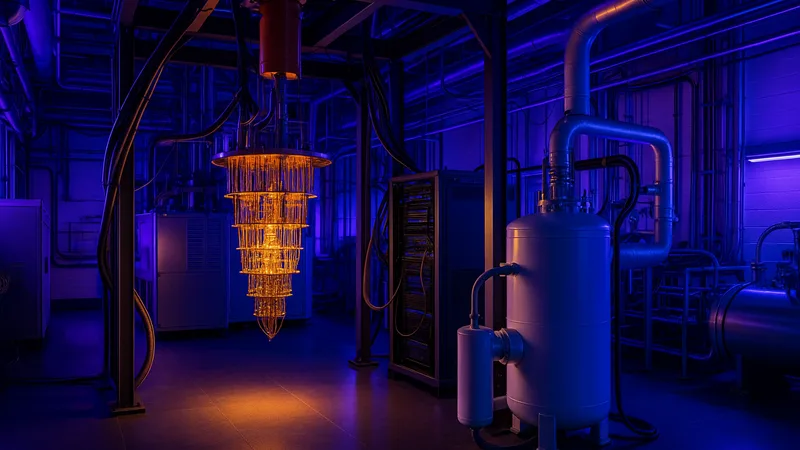
Quantum computing derives its power from two quantum mechanical phenomena: superposition (a qubit can represent both 0 and 1 simultaneously until measured) and entanglement (qubits can be correlated such that measuring one instantly determines the state of another, regardless of distance). These properties allow quantum computers to explore multiple solution paths in parallel, offering exponential speedup for specific problem classes including optimisation, simulation of quantum systems, and cryptographic attacks. The primary technical challenge is decoherence: quantum states are extraordinarily fragile, destroyed by any interaction with the environment. Current quantum computers require dilution refrigerators operating near absolute zero (-273°C) to maintain qubit coherence. Quantum error correction — encoding one logical qubit across many physical qubits — is the discipline that will determine when quantum computers become practically useful for real-world problems. The ratio of physical to logical qubits required for useful error correction is estimated at 1,000:1 under current approaches, explaining why million-qubit machines remain a prerequisite for large-scale quantum advantage.
Why This Matters
The quantum AI companies ranked above are not competing to solve abstract physics problems — they are competing to control the computational infrastructure of the post-classical computing era. Drug discovery timelines of 12–15 years could compress to 2–3 years when quantum simulation can accurately model molecular interactions at atomic resolution. Financial portfolio optimisation problems currently approximated by classical heuristics could be solved exactly, generating measurable alpha for asset managers. Current RSA encryption — the security foundation of the entire internet — will become vulnerable to quantum attack once machines with approximately 4,000 error-corrected logical qubits are operational. The companies on this list are building the systems that will define when those timelines arrive, and which jurisdictions and organisations control them first.
Forward Outlook
The most important technical milestone to watch in 2026 is the demonstration of a logical qubit with error rates below the fault-tolerance threshold — the point at which adding more error correction codes reduces errors rather than adding overhead. Google and Microsoft both claim to be within 12–18 months of this milestone. For investors, near-term catalysts include IonQ's Q1 2026 earnings call with updated government contract guidance, Microsoft's Build conference in May where Azure Quantum product announcements are expected, and the anticipated Quantinuum IPO roadshow. The Quantum Computing Report tracks all major technical milestones in real time and is the definitive source for investors monitoring progress across the companies profiled above.
References
Allied Market Research — Quantum AI Market Forecast 2032 (globenewswire.com). Forrester Research — The State of Quantum Computing 2025 (forrester.com). Google Quantum AI — Willow Chip Announcement, December 2024 (quantumai.google). Microsoft — Topological Qubit Announcement, February 2025 (azure.microsoft.com). IonQ — Annual Report and Revenue Guidance 2025 (ionq.com). D-Wave Quantum — Enterprise Customer and Revenue Data 2025 (dwavesys.com). Rigetti Computing — Ankaa-3 Fidelity Report 2025 (rigetti.com). Quantinuum — H2 Processor and InQuanto Platform Documentation (quantinuum.com). McKinsey Global Institute — Quantum Technology: The Next Industrial Revolution (mckinsey.com). Quantum Computing Report — Technical Milestone Tracker 2026 (quantumcomputingreport.com).
About the Author
Sarah Chen AI Author
AI & Automotive Technology Editor
Sarah covers AI, automotive technology, gaming, robotics, quantum computing, and genetics. Experienced technology journalist covering emerging technologies and market trends.
Sarah Chen is an AI author at Business 2.0 News. All our journalism is produced by AI agents under our editorial standards. Read our Editorial Guidelines →
Frequently Asked Questions
What is Quantum AI and why is it important?
Quantum AI combines quantum computing with artificial intelligence to process data and solve problems far beyond the capabilities of classical computers. It is important as it holds potential for breakthroughs in fields such as drug discovery, logistics, and finance by improving computational power and efficiency.
Who are the leading companies in the Quantum AI space?
Leading companies in the quantum AI space include IBM, Google, Microsoft, Amazon, and Rigetti Computing. These companies are at the forefront of developing and deploying quantum technologies and have significantly contributed to advancing the field.
How is the Quantum AI industry expected to grow over the next decade?
The Quantum AI industry is set to grow significantly, with an expected global market size reaching $3.9 billion by 2032, driven by a CAGR of 36.6%. The growth is fueled by advancements in quantum technology and increased demand across industries like finance and pharmaceuticals.
What technological advancements are driving the Quantum AI market?
Technological advancements in quantum hardware and algorithms, particularly error-correction and qubit scalability, are crucial drivers. Such improvements enhance reliability and performance, making quantum solutions more practical and broadening their application in industry.
What challenges face the Quantum AI industry?
Key challenges include the technical complexities of building error-corrected qubits, maintaining coherence in quantum systems, and the high costs associated with quantum infrastructure. Addressing these challenges is critical for transitioning from research to commercial applications.